
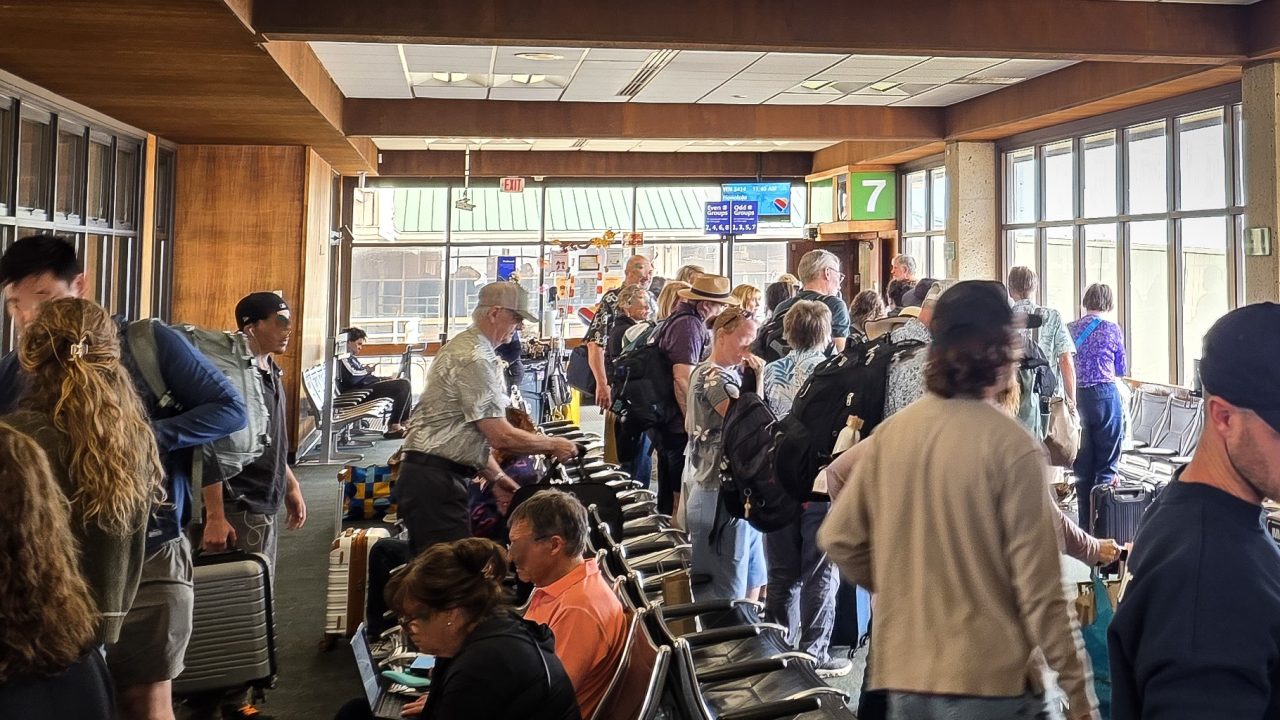
You plan to board the same way you always have. The same boarding groups are called at the same gate, and the same seat number appears on the same ticket. But somewhere between the gate agent’s first announcement and the aircraft door closing, the trip is now taking longer than it used to, and nothing on your itinerary says why.
Overhead bins fill faster than they did a few years ago. Gate agents ask for volunteers to check bags more often, lines start forming before the first group is called, and on some interisland routes, more passengers will soon be boarding through that same gate on every flight.
None of it shows up on your ticket. All of it shows up while you are standing at the gate waiting to get on the plane.
Hawaii flight boarding already feels different.
For many travelers, boarding is no longer the first slowdown of the day. TSA screening lines can already consume more of the airport buffer than expected, especially during busy departure periods. Once passengers finally clear security, they can face another round of waiting at the gate as boarding lines form early and carry-on bags slow the process.
You do not have to fly every week to notice that something has shifted. Roller bags have become nearly universal, while overhead bins that once seemed to have room until late in the process can now fill before the final boarding groups are called.
Announcements asking passengers to gate-check carry-on bags also seem more common than they were a few years ago. We increasingly see passengers standing near the gate well before boarding begins, apparently hoping to improve their chances of finding bin space close to their seats.
This is not unique to Hawaii, and it is not about blaming airlines or passengers. It is simply a different boarding experience than many of us remember, with more people and more bags trying to move through the same narrow window before departure.
Bigger interisland planes will add more passengers.
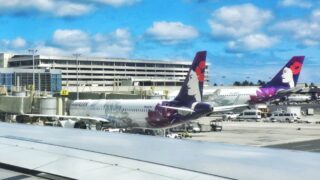
Aircraft size is about to add another wrinkle on Hawaii’s interisland routes. Beginning in 2028, Hawaiian Airlines plans to retire its Boeing 717 fleet and replace those aircraft with Hawaiian-branded Boeing 737-800s.
The current 717 carries 128 passengers. The replacement 737-800 carries 161, adding about 33 people to a full flight. Before that broader transition begins, an Alaska-branded 737-800 is scheduled to operate three daily Honolulu-Kahului round trips beginning in October 2026.
That means roughly three dozen additional passengers finding overhead bin space, moving down the aisle, waiting while other travelers stow bags, and settling into their seats before departure.
The 737-800 has larger overhead bins than the aging 717, which should help. Those bins will also serve significantly more passengers, however, and it remains unclear whether the added capacity will fully keep pace with the additional carry-on bags.
We previously covered what the fleet change means inside the cabin, including the seating layout shift and new amenities, in Hawaii’s Beloved Two-Seat Side Disappears In 2028. Boarding presents a separate change, and one travelers may notice before they ever reach their seats.
Airlines are already allowing more boarding time.
Southwest recently acknowledged what many passengers have already observed. The airline said it will begin boarding many flights five minutes earlier because travelers are bringing more carry-on luggage and need additional time to place those bags in the overhead bins.
That is one airline’s response, but the cause is much broader. More passengers are trying to fit more bags into the same boarding window, while Hawaii’s own shift toward larger interisland aircraft will add another layer to the process.
Travelers may need more airport time than before.
The practical effect is more time spent waiting at the gate and less room for anything to go wrong. That becomes especially noticeable when travelers are making an interisland connection, returning a rental car, checking luggage, or heading directly into plans after landing.
Arriving with the same airport buffer that worked several years ago can now feel tighter than expected. Security may still be the biggest variable, but boarding has become another part of the trip that deserves more time than travelers once allowed.
The same issue can continue after landing. More passengers and more gate-checked bags may mean additional time before travelers reach baggage claim, retrieve their belongings, and leave the airport. The flight time printed on the ticket may remain exactly the same, while the travel day surrounding it continues to grow.
Have you started arriving at the airport earlier than you once did, or have you noticed Hawaii flights taking longer to board than you remember from a few years ago?
Photo Credit: © Beat of Hawaii at LIH.
By Rob and Jeff, Beat of Hawaii.
Some of the most meaningful parts of Hawaii are the ones visitors walk right past without knowing they are there. We’ve spent nearly 20 years finding them firsthand for BOH as full-time Hawaii residents reporting on travel, culture, and island life, and telling you what they mean for your trip. Join us →
Get Breaking Hawaii Travel News




One of the most noticeable and annoying changes is the habit of parents giving their toddlers and small children their own mini rollaboards. It might make them feel special, but it’s a massive time and space waster. As keiki, our belongings were packed into our parents’ suitcases. It cut down on the amount of bags lugged through the airport, cluttering aisles and overhead bins.
Or, flight crew help load bags and get things moving..
I remember when you could arrive at the airport 45 minutes before your flight, also books of tickets you could just tear out. POG in paper cups. Always flew Aloha Airlines since it was more efficient. And then came Mahalo! Air with the “roller coaster” flights…whoppee!
Baggage fees, late boarders and those that don’t follow carry on rules are all contributing to long boarding times.
We both have Atmos and Southwest cards which eliminate paid checked bags. We also board early, so no issue with finding overhead space.
In May we flew Hawaiian/Alaska over to BI boarding was like usual, but when we flew SW back it was a s… show.
The boarding process was a mess very confusing we had early boarding passes flight crew had to block boarders with tickets towards the back of the plane from using overhead bins in the front on the plane.
It was a mess…
Once in the air I’ve never seen so much crap pulled out of overhead bins in my life instead of a 5 hour flight it felt like people were moving in a new apartment.
I find the threat at the gate of putting my carryon to checked baggage very off putting. Especially if it comes to camera and other tech stuff I am trying to protect from being thrown around or lost by baggage handlers.
May have to buy higher priced ticket just to get in the plane earlier. Ugh.
Maybe the US airlines need to take a page from some of the European carriers and truly monitor carry ons. If you have ever traveled Turkish airlines, they have weight limitations on your first carry on suitcase and personal carry on such as backpacks. They truly do weigh and tag them at check in.
A big problem is people arriving late to the airport. Horrible to sit an extra 45 minutes in the hot, exhaust filled plane watching late travelers walk in laughing about how close they came to missing the plane.
The planes should leave when scheduled.
Carry on baggage became a problem when outrageous charges started on checked bags. No more shopping trips to Ohau, “Costs too much to bring um back home!” For everyone’s information this badging of aircraft, Alaska bought Hawaiian there is but one airline that owns both trademarks etc. Alaska now also owns all the old Aloha trademarks too, and could just as easily paint a bird of paradise on the tail and write Aloha on the nose. They own that too.
Yes, the boarding process is taking longer. The obvious reason is , yes, when they began all of the charges for checking a bag people began carrying their possessions onboard as carry-ons. But it doesn’t end there because the airlines then ironically shoot themselves in the foot by requesting people gate check their bags and it will be free. If this sounds counter-intuitive that’s because it is. All this does is add time onto the boarding process by bags piling up in the jetway waiting to be stowed in the belly of the plane. The airlines began the problem by charging for checked bags then added to their own problem by then offering free checked bags at the gate and jetway. Just go back to a free checked bag per person and add it to the cost of the flight. Period.
So many passengers abuse the carry on rules and this makes late boarders stress out. If airlines just enforced their own rules the problem would just go away.
Is it easier for the airlines to ignore this issue to save on the number of bags they need to handle?
The airlines created this problem when they started charging for checked bags. Then they reconfigured the planes to cram more bodies into an already crowded space, and set impossibly short turnaround times for aircraft. So why is everyone so surprised that flying has become such an ordeal? All fingers point to the airlines insatiable quest for bigger profits, and the resulting loss of customer service.
That happened to Hawaiian’s 717 when they swapped out the better and orinsl seats the planes had as new, and put in the thinner plasticky hard seats they have now to squeeze in what? Eight more passengers? This happened in 2015.
Airlines created this problem when they started charging for luggage. Easiest fix would be to go back to free bags.
Airlines should charge for carry-on bags. I’ve seen people with army duffel bags, a backpack and laptop. This is a problem created by the airlines. Let people check 2 bags free, and charge $75 for second carry-on. One carry-on is plenty. And a purse is a carry-on. I’ve seen purses the size of my carry-on! I always fly business/first class and several times the bins were full by the time I got on. Flight attendants then have to track down the coach class passenger to give them their bags. And I do not have a problem asking for the bags to be removed. I am paying 3 times your ticket for those perks. Flying seems to be a free-for-all for space.
Never mind.. I found my answer.
Thanks
I haven’t done anything different as far as arrival time goes since they started TSA checking decades ago. If I’m there at least a minimum of 1.5 hours before a flight, I’ll make it, and I haven’t missed a flight yet.
As for overhead bins filling up, that was a forgone conclusion as soon as the first airline announced they were going to start charging to check bags, and, as the price goes up, more people will decide to use the carry-on option. But, really, if the airlines will check your bag for free at the gate, what’s the point of charging at all? Yeah, I know, they still make a ton of money off that scam anyway.