
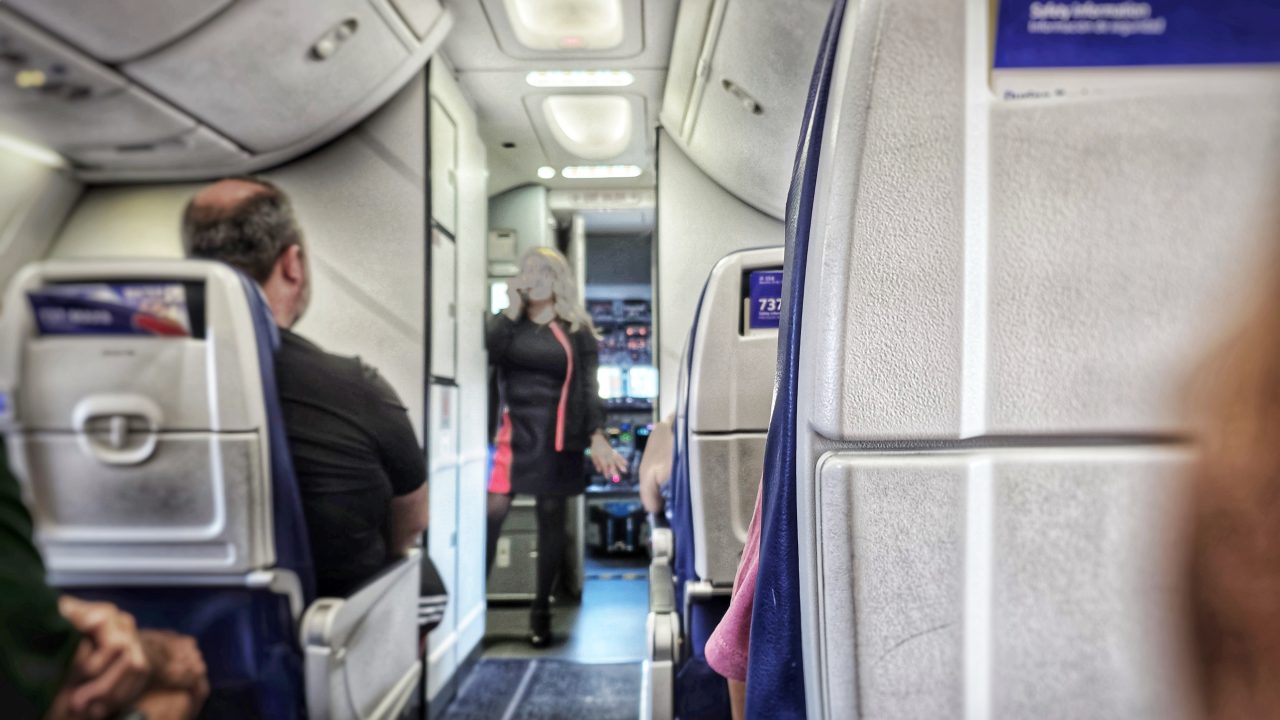
You’re on a flight to Hawaii with your phone out, filming the aisle, snapping service offerings, or even recording something that doesn’t look right. That’s normal behavior for many travelers nowadays, and depending on which airline you’re flying, it could soon cross a line that triggers problems and penalties.
One airline just moved that line closer. And other airlines already did the same. None of the major US carriers flying to Hawaii has adopted it yet, but the industry’s direction is clear.
What British Airways actually led in changing.
British Airways added a new rule to its General Conditions of Carriage that makes it a violation to photograph, film, or livestream cabin crew without consent. The new rule covers more than phones. It includes smart glasses, GoPro-style cameras, and any other body-mounted device capable of recording video or images during the flight. The airline is aiming at the full range of recording tools now showing up on board.
The penalties carry weight. BA can remove a passenger upon landing, cancel the remaining ticket sectors, ban future travel, and refer the matter to local authorities. That last piece depends on where the aircraft lands, but it’s written into the rule as an option.
Passengers can still take photos of meals, seats, cabins, and views out the window. The restriction focuses on recording the crew or other passengers without consent. That is the line British Airways is drawing in the sand.
A traveler on a recent BA flight reported a new onboard announcement before departure. Beat of Hawaii editors can report, however, that they both flew two British Airways flights last week, and neither yet featured the new announcement. The warning isn’t buried in fine print; it’s reportedly said out loud before the aircraft leaves the gate.
Other airlines are already doing this.
British Airways isn’t first. KLM and Virgin Australia already enforce similar restrictions, and their policies have been in place for some time. Travelers report that KLM makes this pre-flight announcement on every flight. Passengers are told directly that filming the crew or other passengers without permission is not allowed.
That sets expectations before anything happens and helps remove the argument that travelers didn’t know there was a rule. VA says crew is not to be recorded without consent, and passengers are expected to respect that boundary. This is no longer a one-off decision by one airline, but a pattern building across carriers.
Why the timing isn’t a coincidence.
Aircraft now also have fast, reliable Wi-Fi, which changes behavior onboard. Even livestreaming from a seat is now simple and immediate. That’s especially true on flights with Starlink high-speed WiFi, which already includes most Hawaiian and some Alaska planes.
The sense is that this has created a different kind of exposure for airlines. A disagreement in the aisle or an interaction with crew can even be broadcast in real time, and once it’s online, the airline can’t control how it gets framed or where it spreads.
Onboard incidents have been climbing for years, with arguments over everything from seats and overhead bin space to passenger and crew behavior common enough now that many travelers reach for their phones without thinking twice. Restricting the recording of crew is one way airlines are pushing back on that.
What this would mean on a Hawaii flight.
Hawaii flights run long, and passengers tend to move about more than on shorter routes. People stand in the aisle, talk to the crew, and spend hours in a shared space where small issues can build over time.
A similar rule on Hawaii flights would change how passengers might react in those moments. Recording a disagreement or any service issue involving the crew would become a violation rather than something travelers still assume is allowed.
It would also change how problems get documented. Travelers currently rely on video or photos if they feel something needs to be shown or reported later, and under a rule like this, that option carries a new risk. It can clearly cut either way.
Onboard behavior has already escalated in ways that get filmed and shared, as covered in Seat Squatters On Hawaii Flights: The Rise Of Entitlement Vs Aloha. A recording restriction changes how those situations may play out going forward and how they reach the rest of us thereafter.
Our own recent encounter stands out.
Both BOH editors were on a Hawaii flight last week, simply trying to photograph the premium cabin snack offering held by a flight attendant, the kind of detail BOH readers ask about all the time. The flight attendant’s reaction felt visually confrontational in a way that didn’t match our intent in the moment, and the discomfort lingered well after landing.
No rule was broken, no policy cited, just a look, and that made clear the photo wasn’t welcome. We are not publishing that photo. However, under something like the new BA rule, that same routine shot could move from awkward to a contractual violation. The line between merely documenting the trip and crossing into prohibited territory may be much thinner than any Hawaii traveler expects.
Where US carriers stand right now.
US airlines haven’t moved in BA’s direction, and one of them went the opposite way, albeit years ago. United loosened its onboard photo policy back in 2018, making it clear that passengers can take photos and videos in most situations, as long as they don’t interfere with crew duties or violate other rules. That leaned toward allowing documentation rather than restricting it.
Hawaiian and Alaska haven’t introduced anything comparable to the BA rule. American and Southwest are stricter than United, but still nowhere near BA, with Southwest asking passengers to get permission before photographing customers or employees, and American prohibiting unauthorized photography of airline personnel. None of them treats the filming crew as a contractual violation that can cancel your ticket and ban you from future travel, which is a line BA just crossed.
That doesn’t mean it stays that way. All airlines watch each other closely, especially when a policy starts showing up across multiple carriers.
The fair accountability question travelers are raising.
Travelers are already picking up on the tension. Recording has been one of the few tools passengers feel they have when something does go wrong onboard.
Crew are dealing with more stress and more frequent confrontations, and being filmed during those moments adds another layer, especially when the video then lands online without any context.
The BA approach decidedly weights crew protection over passenger documentation. Travelers who rely on their phones to capture problems will see that as losing a tool they’ve come to expect and need.
If this reaches US carriers serving Hawaii, the choice gets sharper. Either recording stays broadly allowed, or it becomes restricted with real consequences attached.
If you saw a situation on a Hawaii flight tomorrow that felt off, would you reach for your phone knowing it could violate a rule like this? Or would you leave it alone and hope the airline handles it later, trusting that the story still gets out in some other way?
Lead Photo Credit: © Beat of Hawaii.
Get Breaking Hawaii Travel News



let me fill in the rest of the post that didnt copy in. I understand and agree with no filming crew members or passengers without consent, my question is, how is this go to affect those who record the fights arguments, etc that needs to be used in courts for evidence? there are many upon many videos of crew members harassing passengers as well as passengers harassing crew members. what is the law going to be about that, how is that going to be handled?
Aloha,
This begs the question “what right do you have to photograph or record whatever is in your camera range”? You have no right to, period. Most people in possession of a cell phone seem to demonstrate an IQ approximating room temperature. Unacceptable.
Mahalo
It is perfectly legal to photograph people in public places. Look up the term “street photography.” There are a lot of people, including myself, whose hobby is photographing interesting things in public, and that includes scenes with people. 100% legal. The only exceptions are when on private property or photographs that would be considered lewd (i.e. upskirt photography or peeping tom, into private property windows from outside, that sort of thing.) Aircraft are of course private property so they can restrict photography if they want to.
Quite correct … Mahalo right back at ‘ya.
Flying the “Friendly Skies” on a commercial airliner is a privilege – most definitely NOT a “right”. You have to purchase a ticket to go fly; it’s not a right.
If a Cop tells you what to do/what not do – you really should comply and in this discussion, comply with what the Flight, Cabin crew, or airline says. Assuming you’d like to get on (or stay on) the airplane and “go fly”.
In the pre and early cellular days, “we” never had this problem, so it’s easy to extrapolate to the present and say you really Do Not “Need” to photo Anything on a flight, no matter how much you might like to do it. Unfortunately, many people cannot live or function “normally” these days w/out their cellular in their ear or the camera panning anything and everything. It’s almost like an addiction.
If you see something you perceive as “wrong” — airplane, employee, or passenger, notify a crewmember ASAP. We appreciate it.
Spoken as a retired 30+ year airline pilot.
This post by Dickie sums up how horrible flying is. Dickie believes flying is ” Noy a right”. Why compare flying to dealing with the Cops? Sadistic attitude?
“Notify a crewmember” is no solution when the abuser is the crewmember!
Rules like no photos are one more excuse for rude treatment of passengers.
The airlines, TSA, and, Flight attendants have made flying like a prison sentence, now I get the Cop threat.
Not to worry – I’ll protect you from those “mean” Flight Attendants. Once again – flying the Friendly Skies is not a “right”, just to help re-clarify reality ‘specially for you.
And thank you for the personal insults.
Not too hard to see what your problem w/ flying is, right ? I guess you didn’t get the “Coply” analogy and seem to think the reference some kind of “threat”? Sad indeed …
Self entitlement seems to run rampant these days, yes ?
Come back and see me when you know what you’re talking about and have racked up >30K hours of flight time – USN and international commercial airlines – and have put up w/ many emergencies, bad weather, bad food, no sleep, lousy schedules, missed family events, less than “perfect” airplanes and crewmembers, and yes, some disruptive passengers that I removed.
And I still brought ’em all “home” from Point A to Point B and did it safely.
Hey Dickie,
I apologize you felt insulted, sounds like you worked hard in the good old days. A Google search lists crimes by pilots and flight attendants in 2025-2026 including drug smuggling, filming girls in lavs, Intoxication, and gun related threats- etc… Pilots failed to protect the girls filmed in the lavs by AA flight attendant Estes T. who was sentenced to 18.5 years in prison. Crimes by airline staff happen often and passengers should be respected and protected, not threatened or ridiculed.
“Hey, Robbie”:
No fake apology necessary.
But the only crime I’ve been charged w/ committing while flying the “Friendly Skies” is allowing folks w/ attitudes such as – oh, I don’t know – such as yours (?) to board my (the?) airplane … ??
I’ll have to plead “guilty” — and I’m a repeat offender.
My Wife happened to see your online missives and when the laughing stopped (no damage other than slightly bruised ribs from her guffawing) she suggested:
“Why doesn’t he take the bus or train to Hawai’i next time .. ??” And I completely agree w/ her. She’s always been the smart one in our marriage.
I think we’re all done here – it was “fun” – kinda’ like a toothache. So let’s not do it again anytime soon – o.k.?
You’ll have to figure out the challenges you seem to face flying the crime-infested airways yourself while in the meantime, I’ll enjoy life.
Bye now – and O U T. (Out: that’s radio-speak for “bye now”)
The airlines have to remember that they’ve seen benefits from passengers taking pics and videos. Take the many case of passengers causing disruptions in flight and the videos of other passengers have served to document the incident and prosecute the individual And acquit the airlines of any guilt they’ve been charged with.
Videos and pictures out in Public, are lawful. There is no privacy, out in public, unless you create the privacy yourself. Pictures of the lav or the snack onboard, etc should be allowed. But pictures and video of the crew members- No. You’re not in public. I think most people would not like it, if complete strangers came into their workplace and just started recording and taking pictures of them???
I think there is an assumption here that streaming people you do not know on line is fine. It isn’t. Whilst Taking video of staff or other passengers without express consent can lend you in legal trouble. If you are talking about family memories with a few people in the background, no one is likely to bother you but the minute you stream it on line or otherwise publish or distribute it and receive payment from websites apps or sponsors it is commercial and you need to ask permission. Any airline can say no and not only throw you off the plane you could also be introduced to the local Police Department. Other passengers could have cause to file a law suit against you. When it comes to filming out on the window, an airline can say no, perhaps citing security concerns but if you catch an irregular occurrence then any news company will take steps to make sure they do not get sued, pixelating faces etc.
I think I side with the airlines on this one. I wouldn’t want people constantly recording me at my job.