
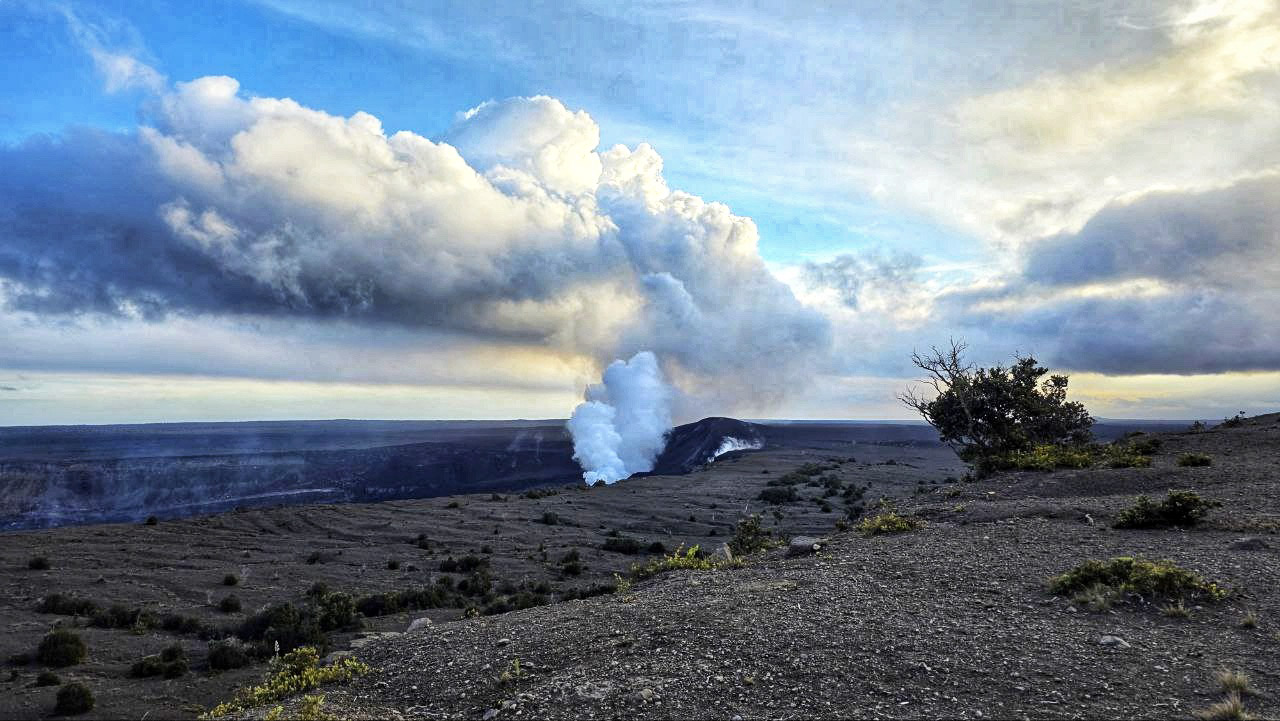
Visitors hoping to see Kilauea’s spectacular lava fountains just lost something that was finally helping them plan a Big Island trip. After months of increasingly useful eruption forecasts, the Hawaiian Volcano Observatory says the patterns that made them possible have disappeared. Scientists can no longer predict when episode 55 might begin, or whether another major fountain episode will happen at all.
As of October 7, Kilauea remains at WATCH/ORANGE status with minor spattering and glow, but the summit is fundamentally changing. The announcement comes just one month after we found that HVO’s forecasts were becoming remarkably useful for visitors willing to adjust their travel dates. Now Kilauea may be entering a very different phase, including a possibility that could eventually make seeing active lava easier, not harder.
The eruption forecasts visitors could use are gone.
On September 5, we published Can You Actually Time A Hawaii Vacation To See Kilauea Erupt? We examined HVO’s forecasts for the previous 10 fountain episodes and found that nine of the 10 broad forecast windows included the eventual eruption start. Some predictions shifted, but the results were good enough that we said we’d consider adjusting our own travel dates.
That was a big change from our December 2025 experience at Volcano House, when we booked months ahead, stayed on the caldera rim for several days, and missed the eruption entirely. We thoroughly enjoyed the park anyway, but after 54 fountain episodes, it seemed visitors finally had a better chance of timing it right.
Now HVO says that advantage is gone, at least for the moment. Its October 7 report states: “It is clear that the patterns of forecastable eruptive behavior at Kilauea summit are no longer being observed in volcano monitoring data.”
Magma is finding new ways to move.
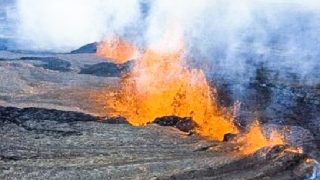
Following the last major fountain episode on August 25, Kilauea began behaving differently. Six new vents appeared in September, and between September 30 and October 1, magma pushed into underground fractures created during the summit’s dramatic 2018 collapse. About 130 earthquakes accompanied that movement.
Previously, scientists could monitor pressure building beneath the summit and estimate when another fountain episode might begin. Now magma has additional underground pathways, making those familiar pressure measurements much less useful for forecasting.
The eruption hasn’t ended. HVO says high fountains could return, new vents could open within the caldera, or magma could continue moving underground without producing another major fountain episode.
Another possibility has a fascinating history. Kilauea could shift from brief, towering fountains to a more continuous eruption that produces lava at a lower rate.
HVO points to the Puu Oo eruption, which began in 1983, and Maunaulu, which began in 1969. Both started with episodic fountains before developing longer-lasting lava activity. Scientists aren’t predicting that outcome now, but they haven’t ruled it out.
Kilauea could become easier to see erupting.
The current fountains have been extraordinary, but their short duration frustrates visitors. Episode 54 lasted approximately nine hours. Someone staying in Kona could spend much of that time driving to the park, only to hit traffic, crowded parking, or an eruption that has already stopped.
A more continuous eruption could offer visitors days or longer to see active lava instead of just a few hours. It might lack the drama of fountains shooting hundreds of feet into the air, but the opportunity to see flowing lava without racing against the clock would be welcome.
Whether that happens remains unknown. Even sustained activity might occur somewhere visitors cannot safely see it, and HVO currently considers further underground magma movement a likely near-term possibility.
What Big Island visitors should know now.
Hawaii Volcanoes National Park remains open, although volcanic hazards, temporary closures, and ongoing construction can affect access. Visitors should continue checking USGS volcano updates, webcams, and the park’s official eruption-viewing information. We wouldn’t rearrange flights or make hotel reservations expecting another fountain episode until scientists can once again provide meaningful forecasts.
There’s still plenty worth experiencing at Hawaii Volcanoes National Park, even when the fountains are quiet. We know that firsthand from our own stay, although we’d certainly love another chance to see the lava.
Would you still plan a Big Island visit hoping to catch Kilauea erupting, even without the forecasts that were available just a month ago?
Photo Credit: © Beat of Hawaii at Kilauea.
By Rob and Jeff, Beat of Hawaii.
Some of the most meaningful parts of Hawaii are the ones visitors walk right past without knowing they are there. We’ve spent nearly 20 years finding them firsthand for BOH as full-time Hawaii residents reporting on travel, culture, and island life, and telling you what they mean for your trip. Join us →
Get Breaking Hawaii Travel News


We have visited the Big Island several times and still haven’t seen actual flowing lava. Somehow we always manage to be there at the wrong time. Maybe our next trip will be different.
I think the USGS did an amazing job predicting something as unpredictable as the volcano. The fact that they were getting so close with their forecasts is remarkable.
The possibility of continuous lava flows sounds way more appealing to me. I’d rather have a few days to enjoy the experience than spend half the night rushing around somewhere and hoping we aren’t too late.
I wouldn’t have planned a whole vacation around a volcano erupting. Too many things could change between booking a flight and getting there. If we happen to see lava, that’s a wonderful bonus. If it returns to regular eruption viewing, that will be a different story.