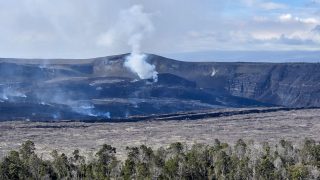

A few months ago, after missing the mark and staying at Hawaii Volcanoes National Park between eruptions, we came back with a pretty firm conclusion. You can reserve flights, hotels, and rental cars, but you cannot reserve an eruption. We wrote Kilauea Keeps Erupting. Just Not When You’re There.
Since then, Kilauea has kept going, and so has the Hawaiian Volcano Observatory’s effort to forecast when each new fountain episode may begin. We, too, have been researching this and have gone back through HVO’s public forecasts for the last 10 completed episodes to see whether we’d actually use one to change our own travel plans. Nine of the 10 broad forecast ranges we found contained the eventual start of the eruption, although several shifted before the fountaining actually began. That’s our reconstruction, not an official USGS forecast-accuracy statistic, and the windows weren’t all the same length. Kilauea’s current summit eruption began December 23, 2024, and has now produced 54 completed fountain episodes to date.
Only one of the last 10 forecasts was missed.
The recent sequence is starting to look remarkably regular. Episodes 51 through 54 began roughly 13 to 15 days apart, but earlier parts of this eruption had very different gaps, with pauses lasting days or weeks. That’s nowhere near enough consistency for us to treat Kilauea as an every-two-weeks volcano that you can plan a trip based on.
Episode 51 is the clearest warning against treating the forecasts as a schedule. An early HVO range of July 6 through 10 eventually moved later, and the fountains did not start until July 15. Anyone who had booked only those first forecast days would have come and gone before the eruption began.
Episode 52 went another way. HVO initially put it somewhere between July 24 and August 3, then adjusted the range as summit inflation changed. By July 27, the expected period had moved to July 29 through August 2. Stronger activity the very next day shifted it back toward July 28 through 30, and, in fact, episode 52 began that evening.
A visitor who planned several Big Island days within HVO’s original July 24-August 3 window might have caught the eruption. However, someone who waited for the supposedly more precise July 29-August 2 forecast would have arrived after the fountains had already started.
HVO is watching pressure building, not counting in days.
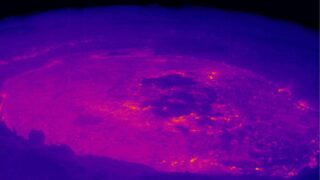
HVO has been publishing forecast ranges since episode 5, using instruments around the summit to monitor the shallow magma system as it empties and then recharges between fountain episodes. When an episode erupts, pressure drops and the summit deflates. During the subsequent pause, magma accumulates again, and the ground begins to inflate. Tiltmeters measure those changes closely enough that HVO can sometimes estimate when the system may return to conditions similar to those that preceded an earlier episode.
Inflation can slow, stop, or briefly reverse, forcing HVO to revise the expected timing. Closer to an eruption, vent glow, tremor, gas activity, spattering, and other changes can add more information, but by then a visitor has much less time to react.
In its September 4 update, HVO placed episode 55 between September 7 and 13, assuming inflation would follow recent patterns. The previous range had been September 7 through 12, but another deflationary step extended it by a day. Someone arranging several flexible Big Island nights around that window now has information that wasn’t available months ago, but still has nothing resembling a reasonable length reservation window.
The fountains often last less than half a day.
Episodes 51 through 54 lasted roughly 8, 7, 10, and 9 hours. The National Park Service recently warned visitors that the last 10 eruptions had lasted between six and 10 hours and could easily pause before someone reached the park.
Hilo is under an hour from Hawaii Volcanoes National Park under normal conditions, while Kailua-Kona is roughly two to two and a half hours away and Waikoloa is about two hours. Those times don’t include the eruption traffic that can develop around the park or stops en route.
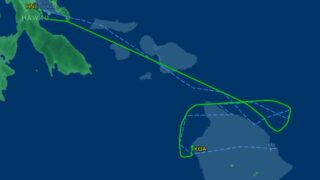
For anyone staying near Volcano, even a short episode leaves a reasonable chance to react quickly. From Kona or Kohala, however, the drive starts to consume a significant part of the time available to react. From the mainland, or even from Kauai, Oahu, or Maui, waiting for fountains means getting to the airport, finding a flight with seats, getting to the Big Island, picking up a rental car, and then driving to the park while the eruption is already underway. That doesn’t work.
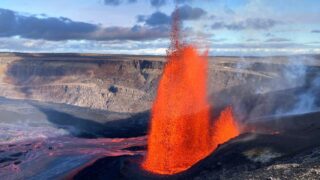
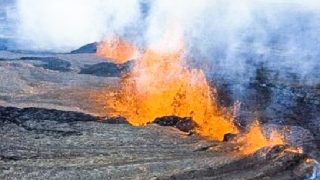
Episode 54 on August 25 produced lava fountains around 500 feet high and a plume reaching roughly 17,000 feet above sea level during nine hours of continuous fountaining. Those are the kinds of numbers sitting behind the spectacular images people see online, even though the opportunity to see them in person may disappear the same day.
Parking, weather, and closures can still get in the way.
The active eruption area will be closed, with visitors watching from legal locations along the caldera rim. NPS points eruption viewers toward places including Uekahuna, Kilauea Overlook, and the Welcome Center area, while warning that conditions can change and visitors should have another viewing location in mind if their first choice is full. Traffic adds a huge snafu to moving around during an eruption.
Those viewing areas do not have unlimited capacity. Uekahuna has about 70 parking spaces, and Kilauea Overlook 36, and NPS says summit lots can fill by around 10 a.m. During eruptions, the park warns visitors to expect increased traffic and reduced parking. Entry to the park may not even be possible.
We’ve already experienced the parking problem without an eruption underway. In Hawaii Volcanoes Already Overwhelmed Before Next Eruption Begins. We described roads backing up and parking disappearing during our own stay, including the night we wound up walking about a mile from Volcano House because closer spaces were gone. An active fountain episode sends many more people toward the same limited places.
Weather adds one more variable that no eruption forecast can solve. NPS says fog or rain can sometimes prevent viewing of eruptions altogether, while volcanic gas, tephra, and changing air quality can affect where visitors can safely watch.
Given what we are learning, if the same choice came up for us now, we’d change our dates while keeping the rest of the Big Island trip as intact as possible. We’d know we could still miss it, but we no longer think leaving the timing entirely to chance is the only reasonable choice.
Would you rearrange part of a Big Island trip around a six-day HVO forecast if seeing Kilauea erupt were high on your list? Or would you still leave the timing entirely to chance?
Lead Photo and video: © Beat of Hawaii.
By Rob and Jeff, Beat of Hawaii.
Some of the most meaningful parts of Hawaii are the ones visitors walk right past without knowing they are there. We’ve spent nearly 20 years finding them firsthand for BOH as full-time Hawaii residents reporting on travel, culture, and island life, and telling you what they mean for your trip. Join us →
Get Breaking Hawaii Travel News