
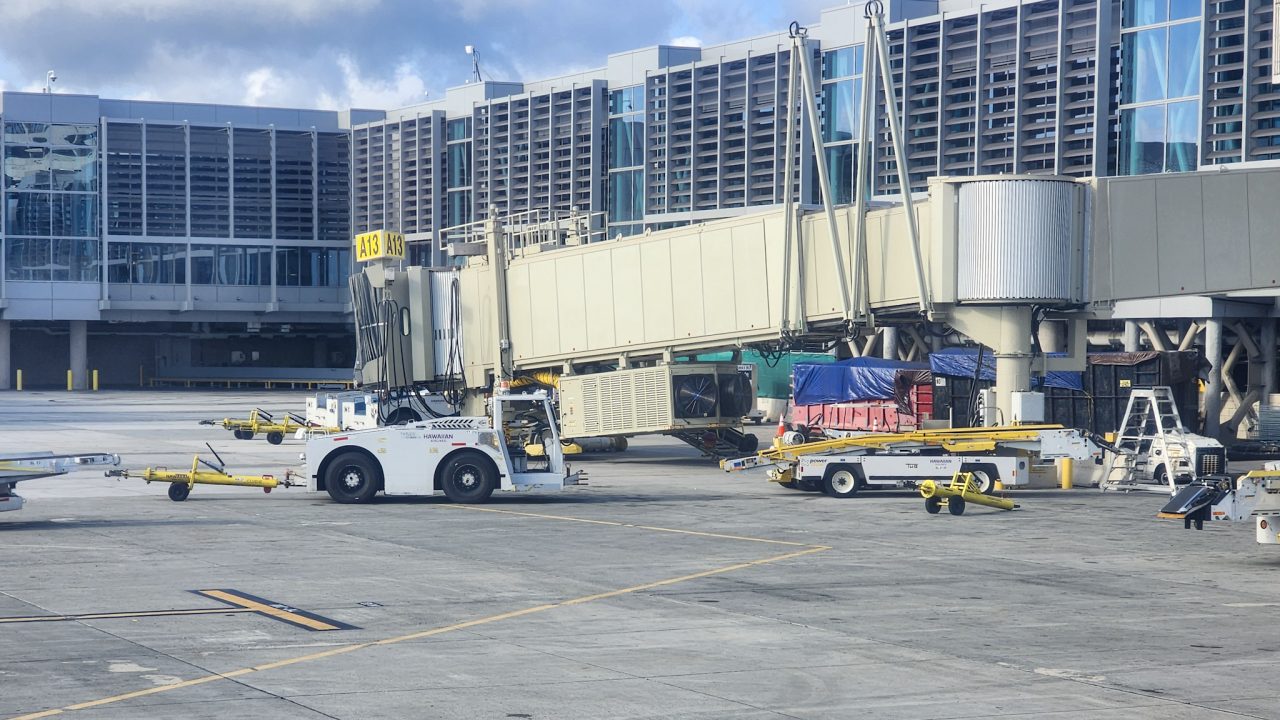
With heavy rain expected to begin Sunday afternoon and affect all of Hawaii through Tuesday, we’re writing this from Kauai as we prepare for Hurricane Lowell. While tomorrow’s storm has nothing to do with a March incident at Honolulu Airport, a newly filed $521,900 lawsuit over rain-soaked artwork made the question feel unusually immediate: what happens to your checked belongings when the Hawaii sky opens up?
What the lawsuit says happened at HNL.
Distinguished Programs Insurance Brokerage filed the case on Thursday in the New York State Supreme Court as a subrogee of Naga Antiques. According to the complaint (attached at the end), Compass Forwarding, acting as Naga’s agent, contracted with Alaska to transport 11 original paintings on paper from Osaka to JFK, with the shipment stopping in Honolulu en route. Alaska Airlines, Hawaiian Airlines, and Compass are all defendants.
The filing says the paintings were packed in cardboard crates and alleges that in Honolulu, “Alaska deplaned the Artworks during a heavy rainstorm” without protecting them from water damage. It says the paintings became soaked and sustained significant damage.
Distinguished alleges damage exceeding $521,900 and says it reimbursed Naga for its loss. Its claims against Alaska and Hawaiian accuse the airlines of gross neglect, reckless disregard, and willful misconduct, while Compass faces a separate claim over its role in transporting and protecting the shipment. All of that remains allegations at this point.
The complaint doesn’t say how long the crates were exposed, where they were sitting, what equipment was being used, or when anyone discovered the water intrusion. It also involved commercial cargo, a freight forwarder, and an insurer rather than someone’s checked suitcase. That legal difference is considerable, while the underlying physical question is familiar to anyone who has watched bags being moved around the airport.
Your suitcase eventually reaches the open ramp.
We’ve written before about Honolulu Airport’s baggage handling system, where luggage disappears onto conveyors, sorting, and security screening. It’s easy to picture the whole trip unfolding somewhere inside the airport until the suitcase reappears at baggage claim at the journey’s end.
Anyone who has spent much time at Hawaii airports has also seen the other part. Bags ride in carts around aircraft and move up belt loaders on the ramp, sometimes only a few yards from passengers looking through the terminal windows. HNL isn’t unusual in having outdoor aircraft loading, but Hawaii weather can go from benign to pouring surprisingly fast. This weekend is likely a prime example, with up to 10 inches of rain possible starting tomorrow.
We looked for evidence that soaked luggage is a regular problem at Honolulu Airport, but didn’t find any. There are isolated traveler accounts, including one from an HNL passenger who described receiving a bag soaked from rain, but not enough credible evidence to turn that into a broader Honolulu pattern.
We’ve certainly seen a different kind of weather problem before. In our earlier article about losing bags four times on Hawaii flights, one BOH reader described a storm-delayed departure from Kauai in which the passengers made the flight, but their bags were left behind. Our own lost-bag experiences have also made us much less casual about what we’d put in checked luggage.
A soaked bag doesn’t come with the protection you might expect.
The part we didn’t know before researching this was how differently the same damaged suitcase can be treated depending on the trip. For a domestic itinerary, DOT says an airline is responsible for damage to a checked bag or its contents while the bag is under its control, subject to a maximum liability of $4,700 per passenger. But airlines may exclude categories such as electronics, cash, fragile items, and other valuables in their contracts of carriage.
So a passenger could open a soaked domestic suitcase, find an expensive camera ruined inside, and discover that the federal liability limit isn’t the most important thing. The airline’s contract may say that particular item wasn’t covered in the first place.
International travel changes that in a surprising way. Under the Montreal Convention, the current baggage liability limit for most international itineraries is lower: 1,519 Special Drawing Rights, which DOT currently puts at about $2,175. Yet DOT says airlines cannot use the same blanket exclusions for valuables they accepted as checked baggage on covered international travel, interestingly including a domestic segment if it’s part of the international itinerary.
The international limit can be lower while protection for what’s actually inside the suitcase is broader. That’s a distinction we’d never thought about before when checking a bag to or from Hawaii.
What we’d change now when hard rain is in the forecast.
Our own baggage problems had already taught us not to put everything we need at the destination into one checked suitcase. As we wrote after losing our bags four times on Hawaii flights, Jeff once arrived without all his clothes and walking shoes after the bag containing them disappeared for several days.
Rain adds another consideration. Medication, electronics, important documents, art, valuable souvenirs, and anything deemed irreplaceable are better kept with us when possible, while vulnerable items that must be checked can go inside another waterproof layer before going into luggage. That’s a small change compared with discovering later that a suitcase that looked perfectly substantial wasn’t designed to sit through tropical rain.
If a bag does come off the carousel wet, DOT says passengers should file a damage claim with the airline as soon as possible. We’d photograph the bag and its contents before drying or discarding anything, and keep the baggage tag and documentation for any items of value.
The artwork lawsuit doesn’t establish that HNL has a wet-baggage problem, and after looking for one, we don’t see evidence of it either. What it did was make us notice a part of a checked bag’s journey we rarely think about, especially this weekend as another round of very serious Hawaii weather approaches.
Have you ever had a checked bag arrive wet after a flight to Hawaii, or watched luggage being handled outside during a downpour? We invite you to comment.
Lead Photo: © Beat of Hawaii at HNL.
By Rob and Jeff, Beat of Hawaii.
Some of the most meaningful parts of Hawaii are the ones visitors walk right past without knowing they are there. We’ve spent nearly 20 years finding them firsthand for BOH as full-time Hawaii residents reporting on travel, culture, and island life, and telling you what they mean for your trip. Join us →
Get Breaking Hawaii Travel News

My luggage arrived in Lihue after it missed the flight I was on. It was during another big tropical storm. Arrived next day all contents soaked. And it was a hard case but was expanded. So exposure around the edges only. How long did it have to sit outside in pouring rain to get that wet through such a small space?
This isn’t specifically about weather exposure for outside loading of luggage, it is about luggage handling such as this.
On a trip that included a transfer in San Juan, Puerto Rico, we were sitting in the terminal directly next to the window. A luggage cart came onto the tarmac with luggage headed toward our airplane. As it made a rather fast u-turn to position itself for the conveyor loader a couple of pieces fell out, including one that looked like ours. The next cart did the same u-turn and ran over the luggage. Sure enough when we got our luggage at our destination there was a distinct tire track across it. Fortunately it only contained clothes.
We travel with expensive photo gear; it is always in carry-on as is all prescription medication, money, critical papers, and computers. Never trust checked baggage for that kind off stuff.
whoever packed the artwork using cardboard containers should be the only one getting sued here. as much as i dislike the airlines they have to get the luggage and other items on and off the plane regardless of whether it is raining or not. people do need to accept responsibility for properly packing valuable items instead of doing a sloppy packing job and them suing anyone they can think of.
We’ve moved from soft sided suitcases to hard sided ones. Only weak point is the zipper. We check a Patagonia bag that contains our water toys so no worry if it get wet.
We carry all meds, tablets, cables and chargers in our backpack or other carry on. We never leaves cameras, jewelry or anything valuable in our suitcases. Too risky.
We always wear long pants on flights along w our hiking footwater. No slippas or shorts on the plane even if it’s only a 23 minute flight.
I’ve had suitcases arrive wet but not enough to ruin a vacation.
As an FYI I’m seeing much quicker delivery of bags at HNL and LAX when we fly on HA metal. It’s averaging about 15 minutes from when the seatbelt sign is no longer illuminated. Pretty good IMO.
I’ve never experienced quick baggage delivery on HA metal in HNL. My experience is it usually takes 30+ minutes from door open to waiting at the baggage carousel. No wonder HA doesn’t adopt the same 20 minute guarantee they’d lose thousands each week! Also the priority tags on the bags are a joke, it’s there just to make you feel important, I’ve had my bag with those tags come out dead last. HA baggage service sucks IMO.
Along with working for the mainland airline, part of my job was to maintain the baggage handling system. There were times when the system started but a bag/suitcase/duffel bag would get jammed in the turns or rollers and we had to clear it. Time was of the essence and we had to unstack bags or cut the loose straps to get everything moving. I even had a bag that popped open and spilled its contents, which we did our best to put it all into a crate and back onto the conveyor. So, this damaged artwork should have been packed into sealed tubes (plastic would have been best) to prevent any type of damage instead of cardboard; especially if it was so valuable and original. I’d blame whoever was the company that packed it.
Having worked for a mainland airline for 12 years, I was always on the standby list for any flight. Because I never knew if I’d get on the flight, I never checked bags and always used a carry on. To this day, my carry on was the main bag with a weeks worth of clothes and shoes, just in case the check luggage got misplaced. And to this day, I don’t like wasting time waiting at bag claim for luggage. However, we permanently moved to Oahu, so we did have to wait for luggage and our dog! But living here is worth it!
Aloha~. Main culprit here is the Forwarder. They’re ultimately responsible for ensuring the package can handle the rigger of whichever mode of transportation they choose. The airline is the common carrier and is responsible to handle the shipment with care, however, if a shipment is not suitably packed and is damaged within the confines of normal tear and wear, that falls back to the shipper. Cheers.
I’m interested in the freight forwarder more than the airlines here. If I were paying someone to arrange shipment of valuable Japanese art across the Pacific, I’d expect them to make sure the packaging could handle normal airport conditions along the route. Something doesn’t add up.
First I’d really like to know how long those items were actually outside. Getting caught during unloading for a minute or two is very different from leaving cardboard cargo sitting on the ramp through a downpour.
Second, I’d never check medication, electronics or anything irreplaceable, but I hadn’t previously thought about putting clothes in waterproof bags inside the suitcase. Maybe even the shrink-wrap kind. With Hawaii rain that seems like a pretty easy precaution.
Our luggage came off the carousel at Lihue absolutely soaked once when it was raining. Nothing valuable was ruined, but things inside were damp and we spent the first night of vacation redoing laundry.
I’ve flown through Honolulu for decades and only rarely received a wet suitcase. Interesting case, but I’m glad you didn’t turn one incident into another reason for people to worry about Hawaii airports. This could happen anywhere.
This feels like two separate dumb things together to me. The airline should protect cargo they’ve accepted from a rainstorm, but whoever arranged transportation of valuable art worksshould also have anticipated that cardboard and tropical weather aren’t a great combination. Lame all the way around.
The international versus domestic liability difference was something I didn’t realize. Also, I would have assumed a $4,700 liability limit meant the contents were covered up to that amount, not that the airline could exclude some things altogether.
Yes this is a weird one. But, I’ve watched bags sitting outside at HNL while it was pouring and always wondered how much water actually gets inside. Since then I put anything I really care about in very large zip bags inside my suitcase.
Sounds like an absurd lawsuit. Cardboard packing for something of value? It seems to me the the ‘crime’ is a lack if common sense.