
Hawaii travelers are increasingly using ChatGPT and other AI tools to build detailed itineraries before asking residents and experienced visitors whether those plans will actually work. The attractions may be real, the routes may appear logical, and the restaurants may be open, yet the finished schedule can still be a poor way to spend a vacation.
That is different world from what we found when we tested ChatGPT for Hawaii travel last year. Then, the problems included outdated information, geographic mistakes, and recommendations that simply failed. The interesting question now is what happens when AI gets the facts right but it’s judgment is wrong.
AI travel planning has become mainstream.
MMGY Travel Intelligence reported this year that 52% of active U.S. leisure travelers have used AI to help plan a trip, up 10 percentage points from the prior year. ChatGPT and Gemini were the two most widely used tools among those travelers.
Hawaii-specific findings we’ve previously reported on went further, with research presented by the Hawaii Tourism Authority showing that nearly two-thirds of likely Hawaii travelers were using AI tools for planning their trips. That makes this a much bigger issue than it was when we first tested AI travel advice a year ago.
AI itineraries can hide real problems.
Recent discussions among Hawaii visitors show travelers bringing AI-generated itineraries to human communities and forums because they are unsure whether the schedules presented are realistic. One traveler said an earlier AI itinerary had been removed after commenters told them it was just terrible, while another said ChatGPT reorganized an Oahu trip but left the family wondering just why they’d packed too much into it.
The problem isn’t necessarily bad information. AI is designed to satisfy the request received, so when a traveler provides a long list of things they want to do, the system may direct focus to fitting everything together rather than questioning whether doing it all that way will actually make for a good trip or not.
Hawaii is especially difficult to reduce to a schedule.
Mileage tells only part of the story here, because unexpected traffic, parking, narrow roads, check-in times, changing clothes, meal timing, and the effort needed to repeatedly move between activities can add far more friction than a map or perceive. A planner can calculate distances accurately without knowing what adding jet lag, humidity, crowding, or several long days in a row will actually feel like.
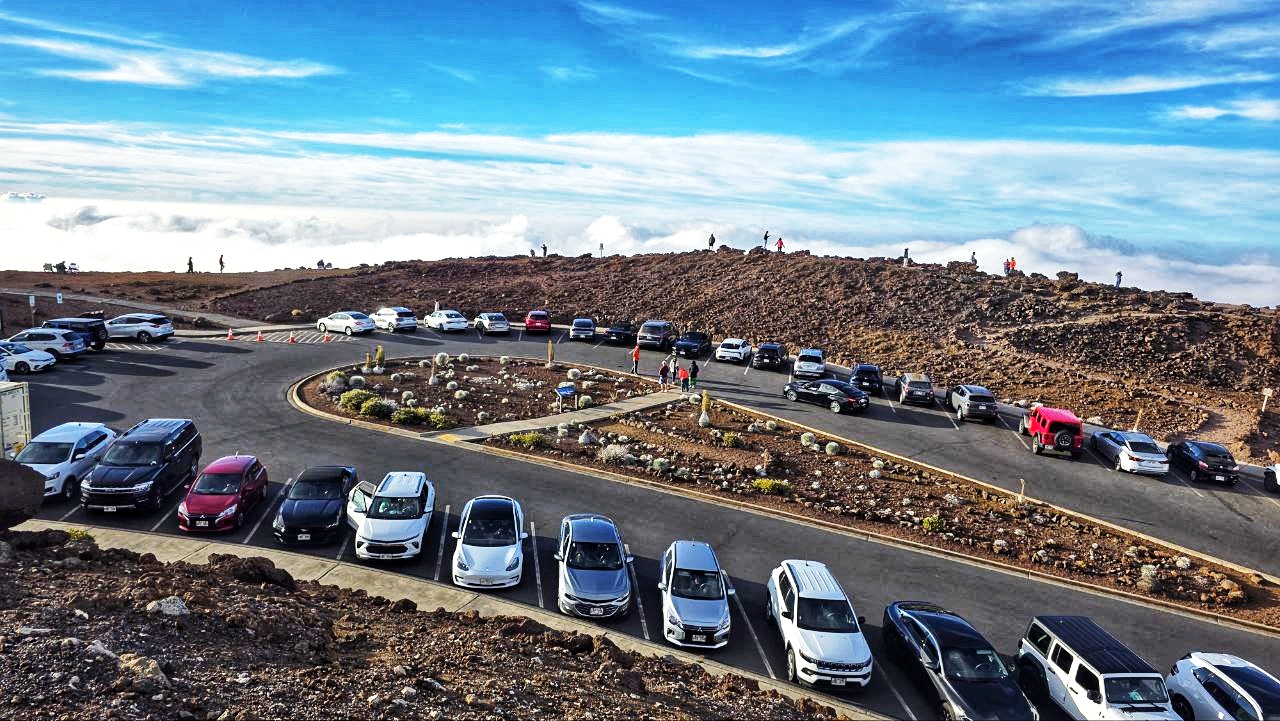
Haleakala (BOH featured image) shows how quickly plans can fall apart. On our own sunset visit, we arrived about two hours early and were still among the last vehicles even allowed through before the parking filled, people abandoned their cars on the road and the park entrance itself was closed. The National Park Service later began advising visitors to arrive at least three hours before sunset while warning that, even then, entry still isn’t guaranteed. But even as of today, AI doesn’t have awareness of the 3 hour advice that the Park Service suggests.
The Road to Hana presents a different set of challenges, where reasonable mileage and stop times don’t convey how tiring the day can become. See Haleakala Sunset Crowds Hit Breaking Point With Safety Concerns.
AI makes over-planning Hawaii appear easier than it is.
Hawaii visitors were already prone to trying to fit too much into limited time. We wrote about travelers attempting too many islands in one week, often underestimating how much time disappears into airport logistics, rental cars, and hotel changes.
AI can take that same instinct and incorrectly make it look highly organized. Once Hana, Haleakala, snorkeling, Upcountry, Paia, West Maui, and several beaches are strewn across seven days with drive times and stops, the itinerary can seem completely manageable even when it leaves almost no blank spaces.
AI is still a powerful Hawaii trip planning tool.
Its strengths are obvious because it can quickly compare options, reorganize plans, adapt to constraints you provide, and surface possibilities travelers might otherwise miss. Used well, it can save a huge amount of research time.
The limitation begins when organization is mistaken for experience. In Hawaii, a plan can be beautifully assembled and completely workable in theory, yet still require visitors to spend too much of their vacation trying to keep up with it.
Lead Photo Credit: © Beat of Hawaii at Haleakala.
Get Breaking Hawaii Travel News





We used AI to plan travel recently. It’s only as good as a reasonable human can analyze and correct it. Sometimes it does have great tips, like the free performances and vendor fairs on Beachwalk grassy area and how far the walk is to Waikiki beach from there. But thats a tip, not a comprehensive itin. We constantly have to double-check AI solutions by going to official websites and reading guidance, open/close times, etc. AI can certainly ruin a trip if trip planning is left to it and not double-checked.
Dear BOH: Speaking of Maui-I have a logistics question: Is it possible to take first KOA to Kahului flight (gets in about 10:00 AM), find transportation to a town that is on the main pick-up list for a quality Haleakala Sunset tour that day,spend the night in that town, and leave Maui the next afternoon-all without a rent car.Thanks in advance for suggestions.
We love using AI to help plan trips, but you have to ask AI the right questions, you need to know what kind of itinerary works best for you (like how much relaxation vs. keeping busy do you want), and you need to check what AI tells you against other sources. And with all that, there will still be mistakes. I think your point is well taken that people need to check out their AI itinerary with some humans who either live in the place to be visited or have visited often.
People need to keep it simple as Jeff S said. AI also can’t foresee problems for example: my daughter and her friend just got back from Austria and Hungary. They made minimal plans other than knowing where they wanted to be and when. Their trip started with a 24 hour flight hold in Denver, they know the Denver airport well now. Lost a day there. On the train from Austria to Hungary, for some reason unknown to any of the passengers, the train stopped in some tiny rural town and disembarked everyone. After 4 hours, another train picked them up and continued the journey. They didn’t know how long they were going to be there so couldn’t leave the station. But they got to know 200 or so new friends from all over. AI planning couldn’t have done anything about that other than make you stressed because you need to be at point a at a given time and point b at another specific time. By the way, they had a blast. Pick one thing a day and relax! Hawaiian time.
I gave up on AI over a year ago when I read somewhere that the Kalalau Trail was a “leisurely walk”.
We have always planned our vacay in Hawaii ourselves and not about to start using Chatgtp or any other artificial intelligence service or travel agency. You don’t have to plan everything, we may plan perhaps a few things, most of the stuff we find is just being out and about on our on. We definitely do not go by anything influencers promotes, the crowds are awful and the Hawaii vibe is missing. Relax and enjoy
Planning a trip to Hawaii is easy.
1. Plan something for the morning.
2. Plan something not that far away for the afternoon.
3. Plan dinner.
4. Plan sleep.
Repeat daily.
Yup! “Island “fever will get ya after the first day. Slow down and enjoy The Islands.
Aloha.