

Hawaiian (owned by Alaska) is offering Cook Islands fares from the mainland for under $700 with limited availability in June, July, and August, the peak of summer. That kind of discounting at this time of year doesn’t signal a normal sale. It signals a route in trouble.
The pricing inversion says everything about where this route stands.
The first thing that jumped out at us was not just the fare. It was where the fare started, because San Francisco to Rarotonga is priced essentially the same as Honolulu to Rarotonga.
We are seeing round-trip fares from San Francisco to Rarotonga around $691 on Alaska-operated Hawaiian itineraries during the summer. It is showing on Google Flights at as little as $643 when purchased through third parties. At the same time, Honolulu to Rarotonga is showing around $675 at the low end, even though Honolulu is the actual nonstop gateway for the flight.
The mainland connection is being priced more aggressively than when the trip originates in Hawaii, meaning the route needs mainland feed to help make the numbers work.
Why peak summer discounting is the warning sign.
The timing makes this more revealing than the fare alone. Sub-$700 mainland fares are scattered across June, July, and August, right when the Cook Islands should be seeing stronger demand from New Zealand and Australia, its two largest visitor markets.

Airlines do not usually give away peak-season long-haul leisure inventory when a route is doing well and there is no competition. When we flew the route, the seat loads did not look remotely strong enough for comfort, and our own flight had too many empty seats to feel close to being profitable.
The nonstop from HNL to RAR has been attractive to travelers; however, even though the only direct route from the U.S., passenger demand never matched what it needed it to be.
We have been saying this for a long time.
This is not a new theory based on a single cheap-fare search. We have been to Rarotonga and Aitutaki, flown the nonstop, driven the ring road, taken the Air Rarotonga puddle-jumper, and seen the route from both the traveler side and the airline side.
We have also investigated the route, its schedule, and the challenge of building U.S. awareness. Most American travelers still know Tahiti, Bora Bora, and Fiji far better than they know the Cook Islands, even though Rarotonga sits in the same time zone as Hawaii and is far easier with the Honolulu nonstop. The only other ways to access the Cook Islands from the U.S. are via Papeete, Tahiti, on a turboprop, or via Australia or New Zealand.
For a long time, based on everything we know publicly and privately, the route has not appeared economically self-sustaining. The current summer fare sale only reinforces what we were seeing then.
What gets lost if the route stops.
The danger here is not simply losing another airline route. Without the Hawaiian/Alaska nonstop, the Cook Islands become dramatically harder for Americans to reach in practical terms. That changes the destination from easy to nearly unreachable for many Americans. Travel times can stretch to 16 to 20 hours or more, fares could well be past $1,500, and the Cook Islands could well return to being one of those places American visitors read about but never quite manage to visit.
Why the Cook Islands?
Rarotonga still has a pace that many repeat Hawaii visitors remember from decades ago. Driving the ring road, stopping casually, seeing beaches without pressure, and moving through this place with little visual clutter all feel like a reminder of an older Hawaii rhythm.
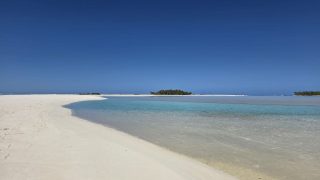
Aitutaki is in another league entirely. Its lagoon is the most breathtaking we have seen anywhere in the Pacific, and that includes places across Hawaii and French Polynesia where the competition is anything but weak. With a resident population of roughly 1,200 and only a limited number of tourists on the island at any time, Aitutaki feels almost unimaginable by modern Hawaii standards.
The value is part of the surprise, too. The New Zealand dollar economy made food, lodging, rental cars, and daily travel costs feel far more reasonable than comparable costs in Hawaii or Tahiti, especially for Americans used to paying Hawaii prices for everything.
The window may be smaller than it looks.
None of this means the route disappears tomorrow. Airlines can keep fragile routes alive longer than expected when network strategy, aircraft utilization, and partnership decisions are all intertwined.
Still, peak-summer discounting, mainland pricing undercutting Honolulu, questionable seat loads, and limited U.S. awareness are not reassuring signs. They point to a route that still has not found the American audience it would need, even with fares low enough to make travelers think twice.
For now, the opportunity is still real. Americans may never again have an easier or cheaper way to reach Rarotonga, and this summer could become the last window before the Cook Islands slip back to being technically possible but practically out of reach. In the meantime, the Cook Islands is hoping for the return of direct west coast to Rarotonga flights.
Would you book a Cook Islands trip this summer before the route disappears, or wait and risk losing the only easy way Americans have to reach Rarotonga?
Lead Photo Credit: © Beat of Hawaii on approach to Aitutaki lagoon.
Get Breaking Hawaii Travel News




Flights through the end of the schedule (April 2027)are bookable again. It was probably a website glitch, not seeing any available flights.
As of now you can’t buy tickets for this upcoming winter. I have a feeling it will be gone by then. When I went in January of 2025 both ny flights were over 80% full…
Global tourism is down this summer worldwide. It’s a factor of political turmoil, skyrocketing costs, and ensuing uncertainty.
That said, airlines need to stem flow of red ink, and Alaska Airlines will not hesitate to cut an underperforming route to retain as much profitability as possible… something Hawaiian was unwilling to do, and we all know where that led. It would be a shame if the route gets cut. Cook Islands is a beautiful destination with a similarly rich Polynesian culture. One can only hope that if it does get cut, the route gets reinstated once things simmer down.
I heard that Alaska/Hawaiian was discontinuing flights to Rarotonga in July. I flew from HNL to RAR in Feb-Mar for around $688 RT. In March I was unable to find any flights after June online or in the app. A few weeks later no flights were available.
We flights booked for late October. No cancelations at this time.
Perhaps the real and immediate problem is the outbreak of Dengue Fever in the Cook Islands. We canceled our trip until it’s under control. We love traveling from Oahu on a direct flight to Rarotonga and Aitutoki, but we’ll wait til fall when the dengue problem is over.
We have our 3rd trip to the Cook Islands booked for late October. The manager at the Pacific Resort Aitutaki where we stay told me on our trip last year that the Cook Islands government actually subsidized the RAR – HNL flights. As long as that is the case, it’s doubtful the route is going away any time soon.
I do not see any flights on Alaska/Hawaiian to the Cook Islands… no flight Jun, July or August 2026. Where did you see it and when?
What are the accommodations like in the Cook Islands?
We stay at the Pacific Resort Aitutaki and the Pacific Resort Rarotonga. They are very nice resorts of the 4 star class. Pacific Resort Aitutaki is very close to being a 5 star resort.
There are many accommodations of all price ranges / star class on Rarotonga. Aitutaki is very limited in accommodation and that is a good thing. They don’t want over tourism.
My wife and I enjoy the beauty, hospitality and laidback feel of Cook Islands and are relatively frequent visitors. We were booked to visit earlier this month HNL – RAR but cancelled after looking deeper into the Dengue epidemic. The Cook Islands have had over 600 verified cases in the past year. While mosquitos generally leave me alone my wife is a mosquito magnet.
Perhaps this outbreak may be a contributing factor to fire sale mainland air pricing.
Maybe the greater efficiency of the MAX 8 could save this route if this is truly the situation rather than just a bargain fare sale to provoke the California market. I wonder what a 737 Max 8 would look like in Hawaiian colors.
Oh boy, sure don’t like the sound of that I traveled to the Cook Islands Rarotonga and Aitutaki the week right after the Maui fires. This wonderful trip was almost magical I remember hotel manager sending condolences to our fellow Hawaiian residents and offering two of therefore volunteer fireman if it would help. It was a kind and poignant gesture. Months ago I tried to book a trip for my family over the Christmas holidays. I thought the dreadful combining problems of Alaska and Hawaii Hawaiian where the problem . No schedule, fares, nothing, showed up. This may be why.
Rarotonga: Southern Hemisphere = Winter while it’s Summer in the Northern Hemisphere. It’s like going to Hawaii in Dec. Not freezing but not balmy and beachy weather like in the Summer. It’s Off season for that travel. It’s still a pretty place to stop and visit. You can have summer in HNL on the way down…they have south sea pearls as does Tahiti. go and enjoy the quiet relaxation. Yes, the bus goes around the island, 2 buses, one way, and the other way!