
Kalaupapa is one of Hawaii’s most important historical sites and a National Historical Park, yet there is now no public way to tour it. The public can still see the peninsula from the Palaau overlook, and residents may still sponsor private guests, but the scheduled tours that took visitors into the settlement have ceased.
Last week we wrote about the death of Aunty Meli Watanuki and what it could mean for Kalaupapa. Since then, the tour company she created has announced that scheduled tours ended on June 12 and will not continue. Guests with reservations are receiving refunds, and a statement from Aunty Meli’s family says she did not intend the tours to continue after her death.
That leaves Hawaii in a place few visitors probably expected. The more we looked into what happens next, the more one question kept coming back: how did a place this significant end up here?
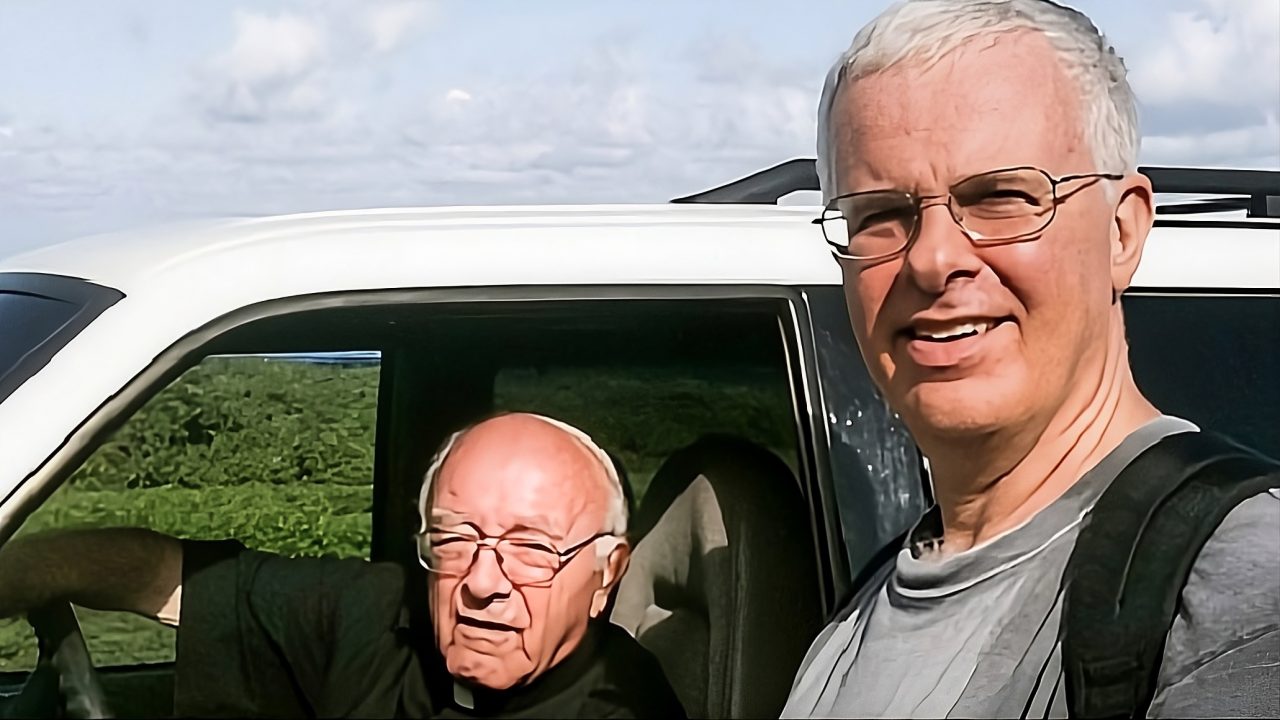
We hiked down the Pali in 2009 carrying gifts of fresh fruit from Kauai, to visit a priest we had not yet met. At the bottom of the trail, there was Father Felix. He’d driven out to meet us, and it was there that we spent time talking (our lead photo). We talked about Kalaupapa and his role there, and about the years he had served on Kauai even before Kalaupapa. What we remember is not a tour or a site, but the hike laden with gifts of love for a man who came out to greet two strangers from a familiar place, at the end of a long descent.
Kalaupapa has always been presented through the lives of the people who carried it, including Father Felix. Father Damien, Mother Marianne Cope, Richard Marks, and Aunty Meli all each kept part of its story alive. Long after patients stopped arriving there, those lives remained the link between Kalaupapa, the rest of Hawaii, and the world.

The tours have stopped.
The end of tours came from the death of Aunty Meli and a decision by her family to honor what they say was her intent. Kalaupapa Saints Tours says its scheduled tours will no longer operate and that paid guests are being refunded.
That decision is one deserving of respect. Aunty Meli created the tour to share the history and honor the people who lived it. The harder question is what happens now that the only public tour has stopped.
Many visitors assume the National Park Service runs tours to Kalaupapa, but it does not. The Hawaii Department of Health issues permits, yet the National Park Service manages the historical park. Public access has always depended on patient-resident participation. It is an arrangement unlike anything else within the National Park Service system.
The number nobody seems to be able to answer.
Depending on the source and how it’s being counted, somewhere between two and seven former Hansen’s disease patients remain connected to Kalaupapa. Some reports count former patients still living at the settlement, while others appear to count people on the state registry or those otherwise connected to the community.
For this place whose very access rules still are dependent on those residents, no agency appears to publicly maintain or disclose a definitive figure. The point is that the system still rests on a population so small that even the count seems to come back differently depending on who’s doing the calculation.
That reality has been coming for years. When we first wrote about Kalaupapa more nearly two decades ago, there were far more surviving patients than there are today. Every subsequent article, reader memory, and official update pointed in this same direction. The generation that lived and experienced Kalaupapa firsthand was getting smaller.
Access to Kalaupapa was always fragile.
Kalaupapa’s public access model has long depended on people already in their last years. A patient-resident had to be part of every tour authorization, the Department of Health had to issue each entry permit, and the National Park Service has never opened the park to visitors on its own, in this unique relationship between them and the Hawaii DOH.
That very structure may have reflected Kalaupapa’s history and the privacy of those who lived there. It also meant that the public’s ability to tour this unique and emotional national park rested on a foundation everyone knew would soon disappear. The fact that tours have now ended shouldn’t come as a surprise to anyone who has followed Kalaupapa closely.
What is surprising is how little has been said publicly about what happens next. The disease that led to Kalaupapa’s isolation to begin with is not an issue; the patient population is nearly gone, and the Department of Health’s role still traces back to that old history. The National Park Service says it is exploring alternatives, but no public plan, timeline, or future access model has been presented yet.
An iconic national park the public cannot tour.
BOH editor Rob kept coming back to the same question as we discussed this article. How can a national park this iconic, spiritual, and important be one the public can no longer tour? That question does not disrespect Aunty Meli, her family, or the remaining residents. Their wishes and privacy come first.
But the question still has to be asked. Kalaupapa is public land and one of the state’s most sacred places. It was preserved so that its story would not disappear, yet the public now has no way to access and appreciate this special place. The Palaau overlook on Molokai remains open, and residents may still sponsor private guests, but that is not the same as public access to the settlement.
This is not about turning Kalaupapa into just another attraction. It should never be treated that way. It is about whether a national historical park can remain meaningful to the public when virtually no one can reach the place where the history happened.
The question that can no longer wait.
Kalaupapa has reached the point people connected to it have talked about for years. We talked about it with Father Felix in 2009. The patient generation is nearly gone, and the public access system built around that generation has stopped functioning.
The silence surrounding what comes next deserves scrutiny. No one has publicly explained who should decide the future of Kalaupapa, how public access might work going forward, or what role the Department of Health should have when the patient era ends imminently. No one has said whether the National Park Service is prepared to take on a different kind of responsibility there in this unique setting.
We do not think there’s an easy answer. Kalaupapa is sacred, painful, beautiful, and unlike any other place in Hawaii. But a national park the public can no longer visit cannot be its final plan. If there is a plan, the public has not seen it and deserves to. If there is no plan, that is the real story now.
Have you been to Kalaupapa, or hoped to, and what do you think should happen to it now? Tell us who you think should decide the future of a national park almost no one can reach.
Photo Credits: © Beat of Hawaii at Kalaupapa. Father Felix drove out to meet us at the bottom of the Pali trail in 2009.
We’re Jeff and Rob, and we’ve spent nearly 20 years covering Hawaii from Kauai. The changes that shape Hawaii often happen quietly, long before most visitors notice them. We follow them closely and tell you what they mean for your trip. Join us.
Get Breaking Hawaii Travel News



Now that Kalaupapa reopened and then closed again just as suddenly, the last paragraphs ring more true than ever. This is an important site: sacred, painful, and beautiful, as you said, and likewise: a national park the public can no longer visit cannot be its final plan.
Out of respect for those living there I think funded tours should be discontinued; however those of us that have relatives that were confined to that settlement should after proper identification be allowed to pay their respects to their Ohana gravesite and limited access to approved (by residents) sites. Means of transport should be regulated by residents and not any outside venue that seek to make profit out of what is a sad and painful history of Hawaii. The comfort of those residents at Kalaupapa should always be first in any decision…z
My wife and I visited Kakaupapa a number of years ago. Richard Marks was our guide. It was a great tour. While I understand how some people would want to be private this part of Hawaii has a unique history. It would be ashamed that future generations would not be able to see that part of the history of that island.
About 12 years ago, my husband and I were able to visit Kalaupapa on a day trip from Oahu. It was a very powerful experience for us both, and I am so glad we were able to go. I’m really torn about what should happen to Kalaupapa now. If it maintains its status as a national park, it should be open to the public in some fashion. But, perhaps it shouldn’t continue as a national park??? I really don’t know.
Kalaupapa should remain closed. To anyone besides family of those who lived and died there. Stop turning this into something the public has a right too. Because they dont.
We got to visit Kalaupapa in 2019 when they still allowed visitors to do mule rides down the Pali. The entire day was one of the best of my whole life, and one I will never forget. Truly an honor to visit and pay our respects to the people who lived and died there. I don’t know the right answer as to continued access but I hope there is a way to honor the history and educate future generations while preserving what is there.
I live in Wailua homesteads and worked at Coco Palms in the late 60’s. I’m wondering whats going on there. Hoping you can shed light on the supposed construction. I have also noticed that the CRB has infected the trees on the Mauka side of the grove. So sad!
One thing that worries me about your articles is that there is no mention of Ka ‘Ohana O Kalaupapa – the organization that was created by residents, their families and friends to create a permanent memorial to the residents who lived there – dedicated to promoting the value and dignity of every individual forcibly relocated to Kalaupapa since 1866. The concept developed in the 1980’s, was signed into law by President Obama in 2009. The memorial has been funded by the US congress and the State of Hawaii and still depends on charitable contributions to fulfill its mission. I fear that contributions from the general public will lose interest if no one is allowed to go there to pay respects and honor and remember what happened there. There have to be rules about visiting, obviously to preserve the dignity of the peninsula. Please learn about this valiant effort to memorialize the heroes who made Kalaupapa what it is and whose families continue to keep the history and remembrance alive.
Probably time to close the national park and let the State take it over or sell the property to the residents that live there now and let it become another area of Molokai where people can own or sell their property. It’s basically no longer a national park open to the public it’s now the property owned by the federal government and should be sold with the residents getting the first right to buy their property properties
IMO, it should no longer be open to tourists but kept as a sacred monument in memory of hopefully what we never forget … our dark history … so we never repeat.
There is still one way to visit. You just can’t get out of the airplane.
Book the 8:35 AM flight from Oahu to Molokai. Mokulele lands at Kalupapa and is on the ground for about 15 minutes before taking off and flying on to Kaunakakai.
My wife, daughter and I took the mule trip down the 30 or so switchback trail down the Napoli a number of years ago before it was washed out in torrential rains a few years later. We got down to the beach walked the mules to a tie up area and then were brought to the village on a little bus for a guided walking tour.
Afterwards, we walked to the church and cemetery where Father Damian was originally buried before most of his body went back to Belgium.
We had a little lunch on a hill overlooking the spot on the inside of a little Island where the newly arriving Patients were forced off the boats in storms when they could not land. Litterally sink or swim.
Looking down the Napoli coast that day was the most magnificent view I had ever seen. It looked like a Hollywood movie set.
I would think that if a trail could have been cut by hand down the cliffs many decades ago, it could be done again.
It was a special life event.
I was blessed to visit Kalaupapa in November 2025. As I stood near St. Philomena Church, I gazed towards a field that is a mass grave of souls. It was painful to think of the living conditions they endured. I have ancestors buried in Kalawao and Papaloa cemeteries. I was thankful to be able to locate their graves at Papaloa, visit and pay my respects. So they would know they’re not forgotten.
That said, given the mentality and behavior of some visitors and social media influencers, I am all for Kalaupapa to be closed. I would be dismayed to see disrespect shown towards Kalaupapa, instead of appreciating the ‘gift’ that Kalaupapa is.
Aloha –
I was fortunate to have been able to take the mule ride down to Kalaupapa a couple of decades ago. We got on a bus that took us to some of the significant places around the site and to say that it was a spiritual event in my life is a gross understatement. The gentleman that led the tour talked story in ways only someone that had been through the worst of it could really explain. Listening him talk about how the citizens there lives changed once it was discovered that sulfa drugs could cure Hansen’s disease that allowed them to finally leave the Island of Molokai and literally tour the world. He spoke about how he actually gave lectures in places that still experience the ravages of the disease also moved me greatly. I truly considerate myself extremely to have had an experience that I will never forget.
Article says the National Park Service is exploring alternatives. I don’t see what alternatives would even be possible. This is an unusual structure to a “National Park”. The State of Hawaii and it’s entities own most of the land. The National Park Service owns none, correct? If that’s the case, and the public cannot enter the property, then why should it have the designation of a National Park. None of this makes sense but it’s not even worth speculating over if the family has the right to say no tours then that’s that. So be it.
It is not a national park. It is a national historic park. That extra word is significant. Ten of the NHP are not owned by the federal government. Some are state owned and some are privately owned.
Kalaupapa could be transformed/repurposed/restored by establishing a rehabilitation center/vocational school.
Students and/or patients could be trained in – and practice – carpentry, building trades, permaculture, and fishing, for starters. They would obviously receive considerable historical education regarding Kalaupapa’s history as well.
U have family who lived and died there?
I remember my husband’s uncle guided a mule train for visitor rides to Kalaupapa for many years. (I assume you knew about this, though it was a couple decades ago?)
When he retired, that stopped.
Hawaii needs to put something in place that isn’t dependent on one person. Because you are right, it’s an important piece of history that should never be forgotten. We honor the people that lived and died there by remembering them.