

Most visitors assume the National Park Service runs tours to Kalaupapa, one of Hawaii’s most sacred and restricted places. It does not. Access has always depended on a long-standing patient-resident holding that authorization, and for the first time there is no living patient doing it.
Meli Watanuki, known across Molokai as Aunty Meli, was that person. She arrived at Kalaupapa as a Hansen’s disease patient, made the peninsula her home for decades, and late in her life fought to reopen it so others could witness what she and her community had lived. The first visitors in five years returned in September 2025.
I wanted to create a tour that not only shares the history, but also honors the people who lived it. This is my home, my story, and my gift to future generations. — Meli Watanuki
Meli died in May. Now there is no living patient managing public tours, and no one can yet say what will happen next. For anyone who has long hoped to see Kalaupapa, that is the whole problem. The ability to visit has always been tied to the people who lived this history, and with Aunty Meli gone, that is now in question.
The woman who brought Kalaupapa back.
Meili Watanuki was diagnosed with Hansen’s disease in American Samoa as a young woman. She moved to Kalaupapa in 1969, the same year Hawaii’s forced isolation policy ended, and spent decades building her life on the peninsula.
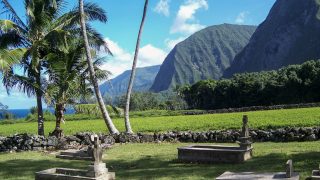
Many Beat of Hawaii readers and we authors know Kalaupapa through its dramatic sea cliffs, the legacy of St. Damien and St. Marianne Cope, and the extraordinary history preserved there. Fewer realize how much the patient-residents themselves have controlled who gets access to visit and on what terms.
That role became critical after the pandemic, when Kalaupapa closed in March 2020, and public tours stopped. Years passed without a clear path toward reopening, that is, until Watanuki stepped forward.
Working through the Kalaupapa Saints Tour in partnership with Seawind Tours and Travel, she became the patient-resident owner required to restart commercial access. The first public tour ran on September 24, 2025.
Demand was immediate. With only a limited number of tours scheduled since the reopening and just eight visitor seats on each aircraft departure, the dates sold out quickly. Yet for many Hawaii travelers, a door that had been completely shut for years had finally reopened, albeit differently.
Why her death affects future access.
Many visitors assume the National Park Service operates the Kalaupapa tours, but it does not. Public access has depended on this unusual arrangement between NPS, the Hawaii DOH, and patient-residents.
The Kalaupapa Saints Tour became the only park-authorized commercial operator after the reopening, and the Department of Health issues each visitor a Kalawao County entry permit through that operator. Visitors must be at least 16 years old and receive that permit before entering the settlement.
What faces Kalaupapa now is without precedent. As longtime Kalaupapa tour operator John McBride told Civil Beat, this is the first time there is no patient alive who is managing tours.
The National Park Service has said it is working with Meli Watanuki’s estate and tour operators on options to keep access open. The Hawaii Department of Health has said the Kalaupapa Saints Tour can keep operating through the end of 2026, so scheduled tours continue for now.
The longer-term question is unresolved. No one has said who, if anyone, could hold the patient-owner role once the current permit ends.
We’ve seen uncertainty at Kalaupapa before.
The concern is not new. Before the pandemic, two patient-owned tour operations made visits possible. But when Covid closed Kalaupapa and public tours stopped, the shutdown stretched far beyond the initial emergency, and visitors spent years waiting for any form of access to return.
The issue was never related to either transportation or demand. It was the structure itself, the rule that a patient-resident hold the commercial authorization, and for years no one did.
Visitors waited, and the peninsula remained closed. The reopening that finally arrived in 2025 happened because Watanuki stepped forward to fill a role no one else did, and her death raises familiar questions once again.
The story has been unfolding for years.
Beat of Hawaii has been writing about and visiting Kalaupapa for nearly two decades. When we visited and reported from the peninsula in 2012, the number of surviving patients was significantly larger than it is today.
By the time we returned years later, that population had declined sharply. Recent reporting puts the remaining former patients at only a few, with possibly just two still living at the settlement itself.
That question has long sat behind discussions about Kalaupapa’s future. Residents have consistently emphasized preserving their history and protecting the dignity of those who lived there, even as the generation that experienced it firsthand kept shrinking.
For years, the question of what happens after the patient generation is gone felt distant. That is no longer the case.
What Molokai visitors should know now.
Kalaupapa remains, without doubt, one of the most unusual visitor experiences anywhere in Hawaii. Current public access is limited to fly-in tours via Kalaupapa Airport, and every visit is tightly controlled.
There are no restaurants, shops, or visitor services like those found elsewhere in the islands. Privacy rules are strict, and photographing patient-residents or their property without written permission is prohibited.
For Molokai travelers unable to secure a permit, Palaau State Park, topside, remains the easiest way to see Kalaupapa from above. The overlook offers one of Hawaii’s most dramatic views of the peninsula without entering down into the settlement itself.
A future that remains unwritten.
Watanuki’s death closes an extraordinary chapter in Kalaupapa’s history. She reopened access after five years of closure, a responsibility few would have ever taken on.
The tours she helped create let visitors experience a place that is sacred, historically significant, and deeply personal to the people who call it home, and let a new generation learn about it firsthand rather than only read about it from afar.
Whether that access continues now rests with the National Park Service, the Department of Health, Watanuki’s estate, and the tour operators. Tours run under the current permit, but the larger question is the same one that has hung over Kalaupapa for years: how access will survive as the generation that lived this history grows smaller.
Have you made it to Kalaupapa, either before the pandemic or on one of the new fly-in tours with Aunty Meli? Tell us in the comments what the place meant to you, so others understand what is at stake here.
Get Breaking Hawaii Travel News



Living on Moloka’i part time, I can walk to the overlook from my hale and have been ‘down below’ on a couple of occasions and been fortunate to play my ukulele at St. Philomena Church with one of the daily guides a friend of mine. Kalaupapa has a very multilayered and complex story when operational, which continues as we look to it’s future. It is one of the most sacred places on Earth and the mana of the residents remains very strong. Whatever the decision is, may it be respectful and show aloha to the many ohana who have loved ones that resided there. Bless them all, and give the decision makers wisdom to be pono in all they do with this land.
I think what your article is actually missing is talking and reflecting on Aunty’s life. Who she was, why she loved Kalaupapa, what she did for that place for decades. While the tours have value to people who want to learn more, it is frustrating to see multiple news sources only talking about that–rather that Aunty herself. Regurgitating the same questions over and over, as if they are original. Aunty Meli was an original–the heartbeat of the settlement, beloved by so many people who are grieving the loss of a real person. I would encourage all news sources in Hawaii to not jump on the “what happens next?” band wagon with each new patient death. Those of us who have lived there and loved the patients will do right by them. And deserve time to reflect when they pass.
Please, check your sources. And some sources should never be associated with Kalaupapa, especially not with the legacy of the beautiful Meli Watanuki.
My magnificent friend–aloha.
I visited Kalaupapa many years ago. Took the flight down and back. Had a tour on an old school bus …. Can’t remember the tour guide’s name but he called himself the Sherif of the community. He was a lovely man and he shared the history of and stories about the community. Kalaupapa is one of the most beautiful places I have ever visited. Its history is heartbreaking and inspirational. I feel blessed to have been there. I felt the true Hawaiian spirit there.
Trust & Pray that the people of Molokai, whom have managed miraculously to ward off big commercial tourist development, will prevail again. What they want or don’t want needs to be fully honored!
Aloha, years ago we flew to Kalaupapa and took the tour via the old school bus. The history must be preserved. It is a sad but beautiful, powerful one. We drove thru the village to Father Damien’s church and the land surrounding. The next visit we took the ferry, no longer running to visit again the island of Molokai. We were not able to go to Kalaupapa but viewed it from the pali. It was moving even without visiting.
Just thinking about and remembering my trips to Kalaupapa in the mid and late 1970s is emotional. We spent time at the Kana’ana Hou-Siloana Congregational Church during those years on work mission trips to help support the aging Congregation with their needs at the time. We got to meet with the late Richard Marks who was an outstanding facilitator of logistical and transportation needs. All of our trips were by Royal Hawaiian Airlines, in and out of the still functioning Kalaupapa Airport. I wish I would have kept a journal of all those trips, as I never thought this day of sorrow and emptiness would ever come. Blessings to all the saints thru the years at the Kalaupapa settlement.
Aloha ke akua
I was blessed to be able to visit Kalaupapa in November 2025 as part of a ‘ohana reunion. We specifically went to locate our kūpuna resting places. I will never forget how I felt there, thinking about those who lived their lives so isolated. It was heartbreaking. I was in awe of their perseverance. I for one don’t wish to see Kalaupapa open up to the public, as social media influencers are so ‘yuck’, they’ll treat their visit as if going to a circus. Let our kūpuna rest in peace, they deserve it.
Hi !
I hiked down the trail access to Kalaupapa in 2013 at age 67. Meeting the tour bus at a set of bleachers at the bottom of the trail, the narrated conducted tour as I recall took several hours to visit the most important historical sites. It was very informative and quite touching. The bus drove through the village community but did not stop. There was no opportunity to encounter any residents at any point. Back to the bleachers and a hike back up to the top of the Pali made for a most interesting and incredibly beautiful day. Kalaupapa could well join such premier National Park Historical Sites such as Manzanar and Andersonville.
My husband and I had been going to Molokai for a few years and decided to train and hike it. We did it when you could hike, ride a mule or fly in. All visitors had to have a tour by a resident guide booked. The hike was spectacular. It was when the aids epidemic was at its height. I will never forget sitting in Fathers Damien’s chapel and our guide telling us to Not shun aids patients and isolate them as the Hansen’s patients had been. It was quite moving. Kalaupapa should remain as it is, but limited visitors should be allowed in small groups as before. People Do need to know the story. No development of any kind, out of respect for the patients. My opinion, of course.
Absolutely stunning scenery. Beautiful beyond imagination.
I went to Kalaupapa in 2019. Rick Shonoly was the guide and it was an excellent tour. There were only three of us on the tour. I would describe it as an historical, but also spiritual experience. I had heard of Fr. Damien, but being there and knowing how much he gave to those very ill people made him seem like the saint he became. Since it was such a small group, Sister Barbara Jean took us into the convent and told us a lot about Mother Marianne Cope who also became a saint. I’ll never forget that one day of peaceful experience. I’d love to go again, but I don’t have much hope for that.
Very sorry to hear about Aunti Meli’s passing. It is an era that comes to a close. We’ve been to Kalapapa when you rode the mules down, I was one who had a mule stumble and almost went over the side. But, the experience and the emotional feeling that being in Kalapapa is one that can’t be matched anywhere else. I was unaware the little souvenir shop had closed, we have a number of things related to Kalapapa and Father Damien that were acquired there. A cherished experience and valued memory. We hope that some tour agreement is made, yet the place remains respected and not a tourist attraction.
Allt the agencies have known for years that the patient population was declining. Are we really supposed to believe nobody saw this situation coming? There has been a strange divide between the NPS and the Hawaii Health Department.
We never made it to Kalaupapa because every Hawaii trip seemed to have something else competing for our time and it has always been complicated one way or the other. Reading this makes me think we should stop assuming it will always be available and we’re going to try to make it happen.
Aunty Meli did something remarkable. Most people her age are slowing down, and she took on the responsibility of helping reopen one of the most complicated visitor experiences in Hawaii. Great legacy she leaves.
I finally just made it to Kalaupapa after putting it off for years and years. What struck me wasn’t the scenery, even though it’s absolutely spectacular. It was realizing that people actually lived through all of this. If access becomes harder again, that would be a real loss.