
You can spend thousands on a Hawaii vacation and still wonder whether residents actually want you here. A new statewide survey shows most residents still support tourism, even as frustration with visitor behavior and industry management continues. But the survey was conducted before Hawaii’s latest tourism slowdown and Hurricane Lowell brought a sharp drop in arrivals, especially to Kauai, raising questions about how residents feel now.
Visitor disrespect now tops the list.
The state’s Spring 2026 Resident Sentiment Survey, conducted from March through June among 1,716 residents statewide, identifies disrespect for Hawaiian culture, traditions, and the land as the most frequently cited tourism problem among residents who believe the industry creates more problems than benefits. Seventy-five percent of that group identified disrespect, ahead of the high cost of living at 71% and overcrowding at 68%.
More than three-quarters of those surveyed were either born in Hawaii or had lived here for at least 20 years, giving the findings substantial grounding in long-term resident experience.
Across all respondents, 93% agreed that visitors need education about protecting Hawaii’s natural environment and cultural resources. Yet only 44% believe tourism helps perpetuate Native Hawaiian culture and language, down from 52% last year. Residents overwhelmingly favor protecting Hawaii’s culture and environment, but fewer believe the industry is doing its part.
The survey doesn’t ask whether residents welcome individual visitors, so it cannot tell us how many personally feel unwelcoming toward tourists. During our earlier travels across four Hawaiian islands, we encountered little evidence of widespread hostility toward visitors.
What we heard from residents.
What the survey describes sounds familiar to us. At the Hawaii Tourism Authority meeting we attended in Lihue a year ago, residents gathered to discuss tourism’s impact on their lives. to discuss tourism’s impact on their lives. We both watched as boards filled with notes about visitors climbing on heiau, disturbing turtles and seals, ignoring dangerous trails, and creating situations requiring rescues. There were plenty of complaints, but residents weren’t suggesting that tourists go home.
Some wanted stronger enforcement, while others preferred education that started with a welcome before covering the rules. Residents also talked about missing restrooms, unsafe sidewalks, crowded parking, and losing access to places their families had enjoyed for generations. They understood tourism’s economic importance but wanted improvements that reflected the enormous amount of visitor spending taking place around them.
The proposed fixes would have reached visitors before they even got to a beach or trail. Residents suggested short videos on incoming flights, cards at baggage claim, and QR codes to help hikers choose routes best suited to their abilities. They also worried that social media posts could lead people to fragile or unsafe locations. Some wanted warnings when users tried to tag restricted sites, while others favored posts promoting safer places. The suggestions put responsibility on airlines, social platforms, and tourism officials as well as on visitors themselves.
One message written on the boards captured another frustration: “We were never included.” Residents weren’t simply complaining about what visitors did. They questioned who made tourism decisions and whether anyone was listening to them.
What residents want changed.
Statewide, 60% still say tourism should be actively encouraged on their island, yet 66% believe their island is run for tourists at the expense of residents. Only 26% feel they have a voice in tourism development decisions, down from 31% last year.
The survey was completed before statewide visitor arrivals fell 5.6% and spending dropped 9.7% in August, compared with last year. Lowell subsequently brought a much sharper decline in direct domestic arrivals to Kauai. It remains unclear whether those developments have changed how residents feel about tourism, since the survey predates both.
Residents also distinguish between spending tax dollars to manage tourism’s impacts, which 64% support, and using those dollars to encourage tourism, which only 44% support. Individual visitors cannot make those decisions, even when they do everything right during their stay.
At the Lihue meeting, residents pointed to Haena’s reservation system as a model for protecting local access. Others suggested limiting commercial tours on the Wailua River during weekends so local families could enjoy it. The Wailua idea was a proposal, not an announced change, but it illustrates the type of visitor activity residents want to have a say in. Someone who follows every rule may still encounter limits, because space and access are all part of the disagreement.
When you visit Hawaii, do you feel welcome, or do you sometimes feel caught in residents’ frustration with tourism?
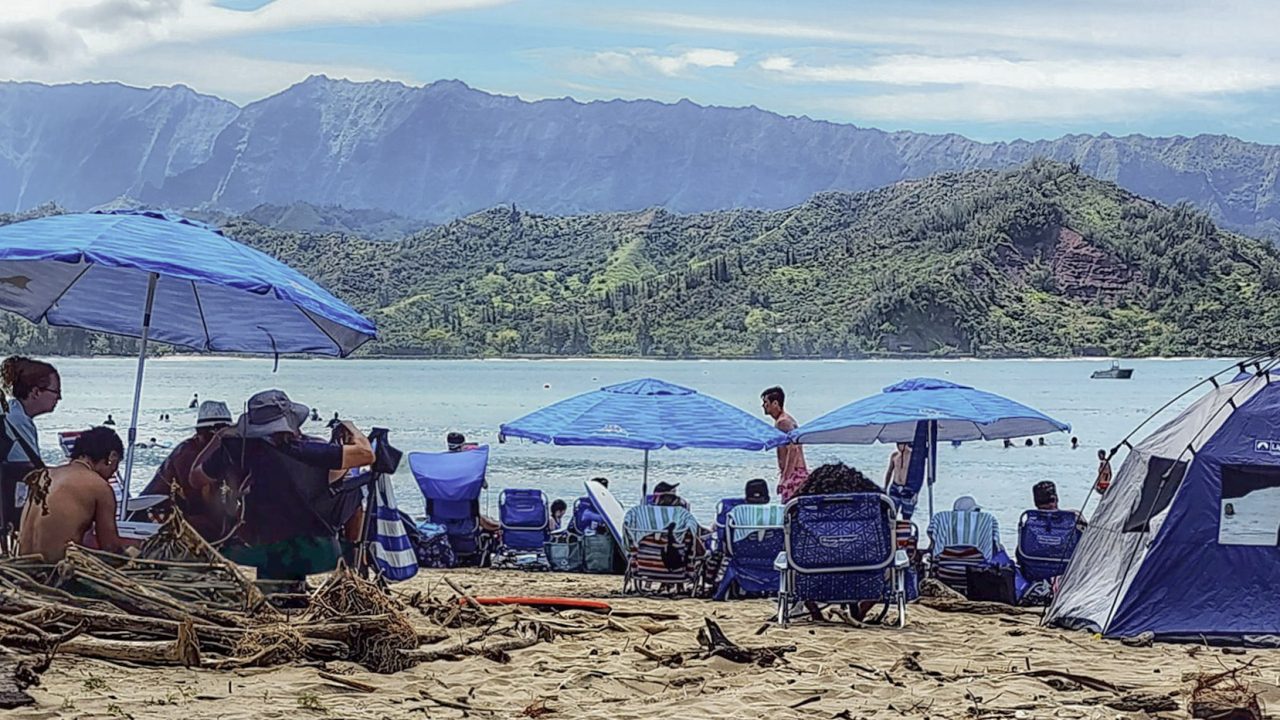
Photo Credit: © Beat of Hawaii at Hanalei Bay, Kauai, during Spring Break.
By Rob and Jeff, Beat of Hawaii.
Some of the most meaningful parts of Hawaii are the ones visitors walk right past without knowing they are there. We’ve spent nearly 20 years finding them firsthand for BOH as full-time Hawaii residents reporting on travel, culture, and island life, and telling you what they mean for your trip. Join us →
Get Breaking Hawaii Travel News



Laughable that the survey said they want visitors to respect the land when So many cars are seen abandoned. I don’t see how you can claim a tourist or disrespectful and they aren’t leaving their rental cars parked as junk.
Such hypocrisy
Nancy, the trash, mattresses, hollowed out cars, and all manner of junk tossed out on Powerhouse Road (North Shore Kauai) is real. But i just learned more on coconut wireless. Residents were told they could do this after Lowell, and county would pick up. County has not done so, and it looks like a third world slum.
County did pick up. Weeks ago. Powerhouse fakas be doing it again when county already done done. Maybe Kilo cinnamon roll stand move to bottom of PH and stop blocking da highway.
Sorry the new generation of young adults are never taught to be respectful IMO. Schools don’t teach morals because the parent’s are responsible for that. IMO I have heard the f bomb is thrown out freely in classrooms as well as instructors. Therefore how do you expect future tourists to even understand culture or respect if they didn’t even grow up with respect or know when to use it. IMO Hawaii expecting future tourists to be respectful might just be a task Hawaii will never be able to handle. IMO young adults today are taught to take what you can get and leave the rest behind.
LOL, I’ve lived on Maui for four years now and have never before heard so many f-bombs used in conversation as I do among the locals.
IMO hard to think culture when everything in Waikiki is focused around shopping and spending. Don’t expect tourists to respect the culture if the environment don’t view it. What part of culture is construction, jackhammers, sirens, shops and the old mighty dollar. You have to go to North Shore to see the natural beauty or visit another island. How do you teach or expect visitors to respect culture if their hotel is surrounded by a concrete jungle. I’ve spoke to locals on the north shore and they don’t even go into Waikiki because it is a tourist area run by outsiders just to make money. I wish the people of Hawaii would offer more experiences to gather with locals and gain respect for one another instead of the us and them attitude.
I think the old saying, “When in Rome,” holds true no matter where you travel.
If you try to fit into your environment instead of imposing yourself in a new place, most locals will embrace you.
Those who don’t, likely have other issues that you’ll never be able to overcome, so just keep away from them.
Is it really the tourists? I talked to a local and he stated construction. Buildings going up where there was native land. This is a permanent change not just something that comes for a week and now gone. Costco’s, Walmart’s, Home
Depot’s, Safeway’s, and then there are KFC’s, McDonald’s, Taco Bells, Stone cold ice cream etc. All this to accomodate the tourist. Hawaiian building code department issued the permit. Not the tourist. This was his biggest issue. Hawaii allowed for this corporate take over and now points a finger to this development problem is tourism. Tourist’s didn’t approve the building permit or issue the business license nor did the tourist sell the land in which the property was developed. Isn’t selling your land to rich and corporate sectors disrespecting your own culture also? Please practice what you preach instead of laying the blame to the only source of income that supports you. The tourist.
Problem is, what locals find disrespectful are things like parking in the same neighborhood as locals do, to walk to a beach. Trying to catch a glimpse or take a photo of Lahaina after the fire, just to get a feel for what happened there.
Locals park and fill up beach parking, invited cameras into Lahaina to view the destruction, kill Hawaiian Monk Seals, leave trash, cars, appliances in the road sides, and they don’t shop locally . It’s Costco, Safeway and Walmart for residents.
I’d say the only ones actually trying to respect the A’ina in overwhelming numbers are tourists coming to relax and embrace the Hawaii culture.
Lived there for 15 yrs. I think I saw 1 young lady who was visibly obnoxious and that was at a bar and she was drunk just having a good time. Plenty more locals were aggressive or tried to be mean to the evil tourists.
How would a random resident survey end up with 75% people who were born or have lived here 20 years? It’s not possible given the demographics of the state, unless the survey is selecting for certain people.
Totally agree that tourists need more education on how to respect and care for the islands. This may be controversial, but before COVID, Kauai had more locally made, culturally rooted markets and shops. Now, you see more chains like Lululemon that could be anywhere and do little to reflect the island’s culture. If we want visitors to understand and embrace Hawaiian culture, we need to support local businesses and make space for authentic, locally owned shops and experiences. So many locals have been priced out and forced to leave, while others work at big-box stores just to make ends meet. The islands have unintentionally pushed out the very people who keep the culture alive while commercializing their home. It’s hard to foster genuine cultural understanding when local businesses and experiences disappear and luaus become one of the few cultural experiences marketed to tourists. Supporting local people and businesses should be part of preserving the culture, not an afterthought.
Unfortunately this is a 2 way problem. The locals want us to respect them and we want the same. The locals want us to respect their land yet so many of them do not. Old cars , obvious local trash bags and a lot of locals mattresses are everywhere. We have been to all islands but mostly Maui and we buy almost exclusively local. Sadly there has been a big change of attitude from everyday locals. This is not at small local restaurants but at lines in groceries driving in off beat areas and also a few staff members at small grocery stores. We love Maui and hope to go for a few more years which at 82 is awesome.
Thanks for reporting this. As someone who gets contact from visitors who have run into trouble or are related to those who suffered fatalities here, visitor safety is paramount for these folks and they wonder why there aren’t warnings on airplanes, on in-room hotel televisions, etc. The tourism industry is not real keen on telling people about the dangers that exist within the beauty, thrills and fun of our beach to mountains environment.
Social media encourages dangerous, often illegal hikes that cross private property and enter kapu watershed. Unconscionable influencers grab photos from others to encourage treks they never took, so visitors go wearing slippers, no protective clothing and carrying a 20 oz bottle of water. ‘Aue! In the processes they are degrading trails, causing erosion and over-taxing our emergency services.
Then visitors go on the rocks to view winter waves or snorkel when they are weak or even non-swimmers. As I said before, ‘Aue!
I’ve been flying on and off to Hawaii from New York for more than 50 years, both living there & visiting. It would be so much cheaper & easier for me to go to the Caribbean or Florida,. but what keeps me coming back to Hawaii is the people & culture.
The wife and I were at the Nui bar yesterday (only place to re-open in Hanalei). A couple sitting next to us were visiting from Ohio, and asked for recommendations on “what to do” on Kauai (they usually go to Maui). We recommended the Hanakapiai Falls hike, since that trail had just re-opened and it is the high point for touristing Kauai. They asked about kayaking on Wailua. We told them Secret Falls still closed. Since Koke`e is still closed at top, I was stumped. What I should have done is lecture them about needing to learn and use Hawaiian language. Maybe start slow by using the Olelo option at the BoH ATM. And I should have lectured them to not leave piles of trash, old mattresses, and hollowed out cars along powerhouse road, because that’s a big no pono for the aina. I’ll try to do better next time.
What you should done is lecture them? Wow. Real hospitality.
And what planet are you living on? People visiting from the mainland are not leaving mattresses and hollowed out cars along the road. Those are locals.
Sue,
Sometimes I think sarcasm is so obvious, it need not be pointed out. But, apparently not this time.
OTOH, I do like to use the Olelo option at the BoH ATMs
just to try something different
Most of the bad behavior I read about comes from residents!
This is a complex issue. Locals protested against visitors during Covid, with some justification. The ‘Hawaii for Hawaiians’ and ‘stay home Haole’ signs and bumper stickers remain in some areas. And yes, some visitors lack common sense and manners. Although this isn’t solely a US-centric problem. We’ve encountered rude Japanese visitors to Hawaii on past trips. So what are the solutions? Behavior police? Banning visitors under 30 years of age? Closing bars and nightclubs early?
I’ve been coming to Hawaii since 1979, and have owned in Poipu since 1989. Hawaii visitors also have their list of dislikes. These include visitor disrespect from locals, jammed traffic due to locals on roads , high prices with mediocre restaurant meals …. Unfortunately . tourism supports most of those who are not receiving a government check (who loved the shutdown during Covid)
There aren’t many jobs not related to tourism or medical or social service industries – so fewer tourists, fewer jobs, worse economy. Thanks to taxpayers, including sky high property taxes and an 18% accommodation tax, Hawaii has the highest net tax free welfare payment of the US at $60,000/yr. Why work?
So before you complain, be more accommodating and dont kill the Golden goose.
That $60K you cited is not possible for TANF (aka welfare). It is possible that a household could reach that much in benefits through a combination of the value of TANF, SNAP, housing assistance, Medicaid, etc., but that would likely be for a larger family with multiple needs, disabilities, and so on.
I have a master’s degree that relates to my job and a long work history, yet as a single person earn a little over $60K a year and I live paycheck-to-paycheck. Luckily, I don’t need to have a car because of our good public transportation.
Visitors also play a part in killing the “Golden Goose.” They do this by overusing trails and causing erosion, disregarding private property and signs that indicate the trail is closed, dangerous, etc. Many appreciate and love our place, but there are others that have a vacay attitude all day and night which can put them and those around them in danger and degrade the places they go.
I am hesitant to weigh in on this a problem as complex as human nature. Nobody in my ohana is on “welfare.” Most of them work in public service (eg, law enforcement, public school teachers, etc) or in the private sector (eg, construction, medical services). The pharmacist will be paying off her student loans for years to come. Most of my nieces and nephews and grand nieces and nephews work more than one job – the new pharmacist cobbled together 3 part time jobs but she managed to do that so she could come home to Maui to work and live. So many of our kids, who are professionally educated on the Mainland do not come home, where generations of family were raised before them because they cannot afford to live here. It is heartbreaking to witness. We do not leave old cars or mattresses by the roadside cuz as another writer said, that is just plain not pono (right or just). Why desecrate the sacred a’aina? Just talk story with us, and we both might learn something new.
It is nice to see you all work hard and still have trouble buying a place. I understand grand children not being able to come home because of cost of property as mine has the same issue. I live in BC Canada and our property is high because of bad money. We cannot get rid of them either. I am also sorry that the tourists come and get mattresses from the hotel and rent cars and and dump them all around.
In over 50 trips to Hawaii, I can count on one hand the number of times we have felt unwelcomed. Maybe it is our generation that was taught respect for others and for the land. I enjoy Hawaii and meet new people every time we are there. With the exception of the Arizona Memorial, we don’t visit “tourist” sites. We visit with friends, golf, and drive around the island, stopping when we see something interesting. We go to local hotel bars when a favorite musician is playing. It is a very relaxing time, even doing nothing. Yes, it is different than years ago but, it is still a great vacation.
Hawaii seems to be doing everything it can to detour tourism. I have been supporting Hawaii for over 40 years and it is losing it’s Aloha! Flights have been reduced, airfare is ridiculous. Airlines would rather fly half full flights instead of cutting costs. Resorts have implemented additional resort fees and vacation rentals have also been mandated to collect additional fees. Car rentals are at a premium.This has effected the total cost of a Hawaiian vacation in a very negative way. Let’s face it, Hawaii financially needs tourism!
We have lived on Maui for the last 20 years. I spent 2 of the best years of my childhood at Mokapu Elementary, Kane’ohe, O’ahu. Mahalo, Miss Yamashiro, who taught us all to play ukulele.
Our ohana just got the gift of the 5th generation born on Maui. Her first Maui born ancestors met in the plantation camps in the 30’s. He was Portuguese, she Filipino. Over time, the family came to include ha’ole, Japanese, Chinese, Native Hawai’ian, and Samoan. We have the best holiday food.
I think we all appreciate the role visitors play in our economy. We have all been happy to assist confused visitors find baggage claim, etc in airports. We will tell you how to get to Costco or where a reasonably priced happy hour is. I myself like meeting visitors, especially Canadians, who were kind to me when I was their visitor.An interest in our culture goes a long way.. just ask.
Me and my girlfriend are an interracial couple in our 50s, not that that matters, I’m just adding it for context. We’ve been to the islands 7 times since 2021 (Maui, Kaui, Big Island and Oahu) and have never had an interaction that was anything but pleasant, which is why we love going.
There was one time when I took one second too long to pull off from a traffic light in Kona, and the driver behind us blew his horn. That’s the extent of any sideways interaction we’ve experienced in Hawaii which speaks to the reasons we keep going back.
We’re returning to Maui in a few weeks for the first time since the fires and are excited and a little nervous but overall we are looking forward to spending our first Thanksgiving in Hawaii.
I understand the local residents frustrations. The unfortunate thing is I don’t think most of their solutions will impact the situation. The disrespectful visitors are almost all “influencers” doing whatever they can for that one viral pic or reel.
We’ve been in places watching influencers doing the disrespectful things where us and others are trying to stop them, but to no avail.
I think a high % of Hawaiian guests honor and respect the culture, but the few who don’t ruin for everyone.