

The Seattle visitor accused of throwing a coconut-sized rock at a Hawaiian monk seal on Maui now wants to know whether Delta Air Lines actually warned him about protected wildlife before he arrived in Hawaii. A federal judge has approved a subpoena for flight records, and Delta was formally served on October 12.
Beat of Hawaii obtained the federal court filings, which show the defense is pursuing more than an airline video. Attorneys for Igor Lytvynchuk are also investigating how Hawaii handled previous monk seal violations, including incidents that ended without prosecution. The trial, originally scheduled for November 16, has now been postponed until January 19, 2027.
What the judge ordered Delta Airlines to provide.
Lytvynchuk flew Delta Flight 344 from Seattle to Maui on April 28, one week before the May 5 incident near Lahaina. His attorneys want records establishing whether passengers received warnings about endangered wildlife, including Hawaiian monk seals.
The October 7 order, signed by Magistrate Judge Rom Trader, authorizes a subpoena for passenger announcements, videos, scripts, entertainment-system records, and playback logs from that flight. The request also covers whether warnings were automatically shown, optional, or available only if passengers selected them. If Delta has no records showing such warnings were presented, the defense wants to know whether the warnings never existed, weren’t played, or simply weren’t documented.
Judge Trader found the request sufficiently specific, relevant, and made in good faith. He authorized the subpoena but did not determine whether Delta provided warnings or whether their absence would help the defense at trial.
Prosecutors say Delta’s warnings are irrelevant.
Federal prosecutors have been investigating whether Lytvynchuk received wildlife warnings similar to those presented in Hawaiian Airlines’ Travel Pono video, which tells passengers that monk seals are federally protected and should not be approached or touched.
In their October 6 filing, prosecutors acknowledged they had no evidence that Delta showed a comparable video. They also said they would not claim at trial that Delta had shown one.
The defense disagrees with the government’s argument that the records are irrelevant. In its October 7 reply, the defense argued that the absence of such a warning could be relevant to Lytvynchuk’s knowledge, intentions, explanation of his conduct, and potentially his sentence.
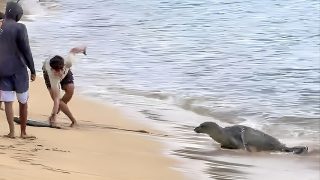
His attorneys also dispute the prosecution’s characterization of the video evidence. They contend the footage could be interpreted as an attempt to protect a sea turtle from the monk seal. That is the defense’s interpretation, not any established finding. The original federal affidavit described witnesses watching the seal play with a log before the rock was thrown toward its head. Lytvynchuk has pleaded not guilty to federal charges under the Endangered Species Act and Marine Mammal Protection Act.
His lawyers are also examining Hawaii’s older monk seal cases.
Another October filing reveals that Lytvynchuk’s attorneys requested extensive records from Hawaii’s Department of Land and Natural Resources. They are seeking information about prior monk seal harassment, injuries, killings, arrests, citations, and incidents where authorities decided against prosecution.
The defense is examining whether comparable alleged violations received different treatment. Prosecutors oppose delaying the trial for that investigation and say the government is unaware of a comparable video-recorded case during the preceding ten years.
In May, BOH reported that 16 Hawaiian monk seals had been intentionally killed since 2009, with only one conviction. The defense’s records request now brings Hawaii’s prior enforcement decisions into the current criminal proceedings, although it has not established a selective-prosecution claim.
At an October 13 hearing, the judge granted part of the defense’s request for additional preparation time. The trial is now scheduled for January 19, 2027. Lytvynchuk remains out of custody under his existing release conditions.
BOH readers were debating airline warnings back in May.
Readers raised this exact question in the comments on our original coverage of the Maui monk seal incident, months before Delta became part of the court case.
Cathy, a frequent Kauai visitor, argued that airlines should show wildlife-protection videos and that arriving passengers should acknowledge the rules. Patty S. also favored mandatory onboard videos covering ocean safety and animal protections.
Chris R. disagreed, arguing that people who ignore posted warning signs are unlikely to pay attention to an airline video. Jay S. put the underlying question more directly, asking where throwing rocks at animals would ever be acceptable.
A federal judge has now authorized the defendant to investigate exactly what the airline he flew to Hawaii told passengers. Whether those records influence the trial remains to be seen, but Delta has been drawn into a case that began with a visitor throwing a rock toward a protected animal on a Maui beach.
Would an airline warning video have changed anything in this case, or should visitors already know better than to throw rocks at wildlife?
By Rob and Jeff, Beat of Hawaii.
Some of Hawaii’s most meaningful parts are the ones visitors walk right past without knowing they are there. We’ve spent nearly 20 years finding them firsthand for BOH as full-time Hawaii residents reporting on travel, culture, and island life, and telling you what they mean for your trip. Join us →
Get Breaking Hawaii Travel News


Great idea about the video. Then I want one to tell me that stealing is not allowed. Or drunk driving. Or any other crime. If people are that stupid, a video is not going to sway them. Are we that far gone in society that we must warn people to behave?
Have you met people? Then you know the answer is yes.
I was fortunate enough to watch a monk seal come ashore on Kauai several years ago. Everyone nearby moved back, and one parent explained to the children why the seal needed space. It was a wonderful experience without anyone getting close enough to disturb the animal. I wish every visitor could see wildlife treated respectfully.