
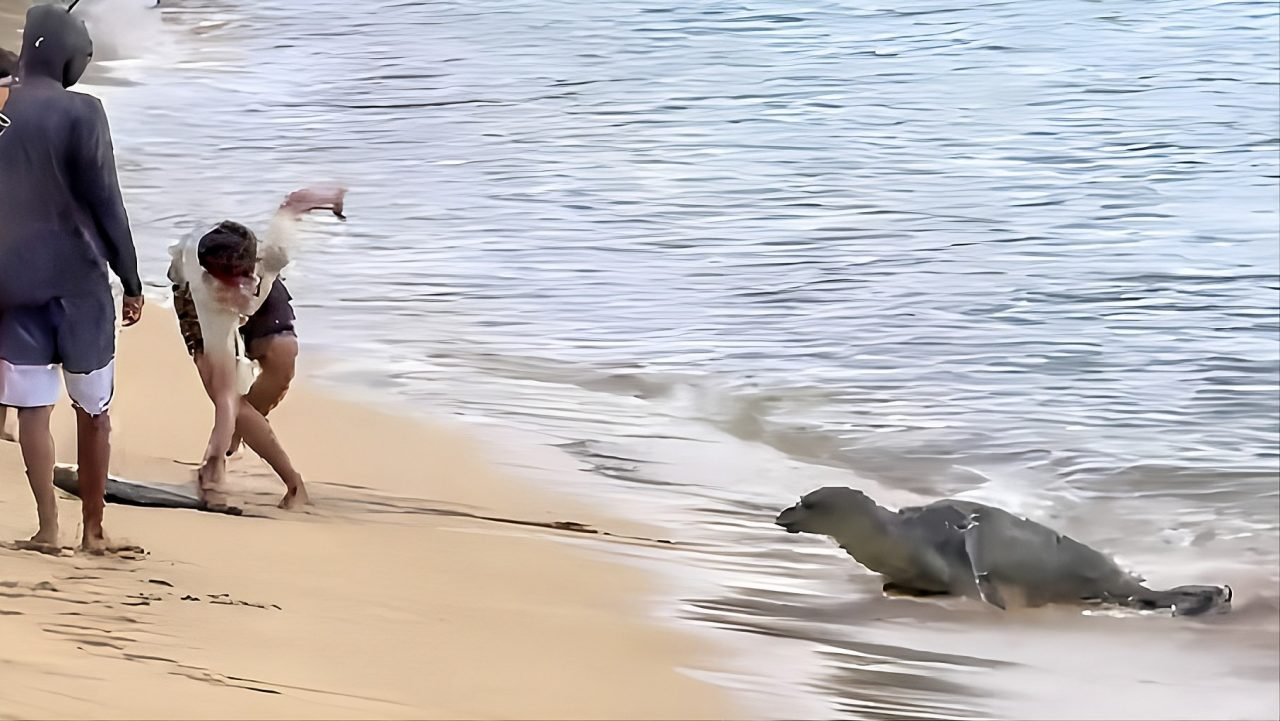
A clip now circulating on TikTok by @killadirks shows someone pulling a fish away from what appears to be a young Hawaiian monk seal at the edge of a Hawaii beach. The seal follows as the fish is carried away, while people nearby on the busy beach react to what is unfolding.
Every person who watches this short Hawaii video, which we display below, appears to ask themselves the same question almost immediately. What would you have done?
@killadirks OMG!!!! 🦭 vs 🐠 vs human
♬ original sound – killadirks
Some viewers were furious that anyone would take food from a wild seal, while others believed the person may have prevented it from swallowing a fishing hook. Many commenters thought they could see that the fish was still attached to a line, although the brief video does not fully establish that.
Others insisted the hook should have been removed and the fish handed over afterward. A third group said the seal should never have been allowed to take the catch at all, since feeding wildlife can teach it to seek food from people. Everyone seemed certain about what should have happened. The video itself leaves important parts unanswered.
What we don’t know about this Monk Seal video.
The circulating clip does not show what happened after the fish was pulled away. We don’t know whether the fish was still hooked, whether a hook was removed, whether the fish was eventually returned to the seal, or what happened after the video stops.
We also can’t independently confirm when or exactly where the video was recorded, or spoken with anyone who appears in it. Those missing moments are a major reason viewers reached such different conclusions.
Some see a hungry young seal losing a fish it had already claimed. Others see someone trying to keep a federally protected animal from swallowing dangerous fishing gear.
If the fish was still hooked, everything changes.
We cannot confirm from the circulating video whether a hook was actually present. If one was, however, the encounter was no longer simply a dispute over who should get the fish.
Hooking and entanglement from fishing gear are among the most significant threats Hawaiian monk seals face in Hawaii waters. NOAA says a swallowed large circle hook can become life-threatening, while barbed hooks can be more damaging and difficult to remove than barbless ones.
That does not mean anyone should approach, touch, restrain, or attempt to treat a monk seal. The official guidance focuses instead on controlling the fishing line and catch, preventing the interaction when possible, and calling trained responders when a seal has been hooked or injured.
What NOAA says Hawaii fishermen should do.
NOAA’s guidance is direct when it comes to feeding Hawaiian monk seals, whether intentionally or indirectly. A seal that receives food, play, or attention from people may continue seeking out humans for the same reward.
That behavior can become dangerous as a young seal grows larger and stronger. Seals that learn that behavior can also fail to develop essential natural foraging skills and can become dependent on people for food.
When a seal approaches an active fishing line, NOAA advises pulling the catch in rather than allowing the interaction to continue. Fishermen should stop fishing if the seal remains nearby and either move or wait until it has left the area before resuming.
NOAA also recommends barbless circle hooks in areas frequented by monk seals. They are easier to remove and more likely to work free if a protected animal is accidentally hooked.
Should a monk seal become hooked, people shouldn’t approach it or attempt to remove the gear themselves. Hawaiian monk seals remain powerful wild animals, even when they appear young, calm, or in need of help.
A hooked, sick, injured, stranded, or entangled monk seal should be reported to the NOAA Marine Wildlife Hotline at 888-256-9840. Trained responders can assess what happened and determine whether intervention is required.
One monk seal showed what can go wrong.
In October 2018, NOAA removed a large barbed circle hook from the tongue of a two-year-old seal named Ka’ale, known to researchers as RH32. X-rays revealed three additional small hooks in his stomach, which NOAA left in place rather than risk surgery, since he was otherwise healthy at the time.
Had the tongue hook traveled farther down his digestive tract, NOAA said it could have caused a life-threatening infection or required far more invasive removal. Ka’ale frequented the jetty area near an Oahu power plant regularly, where NOAA said he likely picked up his most recent collection of hooks.
That case shows how quickly repeated contact between seals and fishermen can become dangerous. A seal that learns to follow fishing activity is more likely to encounter lines, hooks, bait, and fish that have not yet been cleared of such hazards.
Keeping your distance from monk seals is still paramount.
Nothing in the fishing guidance should be interpreted as permission to approach or handle a monk seal. Even when a fish or fishing line may be involved, the guidance concerns managing the catch and line rather than touching the seal.
Visitors should remain at least 50 feet from a Hawaiian monk seal on land or in the water. The recommended distance increases to at least 150 feet from a mother and pup, and everyone should remain behind any posted signs, cones, ropes, or barriers.
If maintaining that distance becomes impossible because a seal approaches you, move away cautiously instead. You should never attempt to untangle, capture, or rescue a marine mammal.
The appropriate response to a seal that appears hooked or injured is to call the hotline. Wildlife responders can help beachgoers or fishermen decide what direct intervention is necessary.
What the Monk Seal video doesn’t show.
The argument surrounding this clip is unlikely to end, since the decisive moments are missing. Perhaps the person pulling the fish away was protecting the seal from a hook, perhaps it was removed afterward, or perhaps the fish was never hooked at all. The video doesn’t reveal any of that.
Ka’ale never got the chance to answer that kind of question for good. NOAA confirmed in May 2026 that he died at age ten after being found off Nanakuli, and that the cause was toxoplasmosis, unrelated to the hooks that once nearly killed him in 2018. He survived the fishing gear, only to die years later from something else entirely.
What would you have done in that split second, and have you ever witnessed an encounter between a Hawaiian monk seal and someone fishing in Hawaii? Tell us about it in the comments.
Lead Photo is a screenshot from @killadirks video on TikTok.
By Rob and Jeff, Beat of Hawaii.
For more Hawaii travel news, visitor information, and stories from across the islands, sign up for our free Beat of Hawaii email updates. Mahalo!
Get Breaking Hawaii Travel News


As a 20 year seal volunteer, I can say that this young seal, maybe 2-3 years old was probably saved by having the fish pulled away. Young seals get hooks lodged in their mouths and guts because they are not savvy yet and will steal fish off of fishing lines. If they swallow a hook that cannot be seen, they will often die from it so better to have the fish pulled away and leave him a little hungry. He has good body weight so not in any danger of starving.
Look at the tip of the pole. Fish is still on the line and hook. Best to keep the line and hook out of the seal.
I say beat the fish thieves up and then the State should prosecute them.
Or do we only do that to the whites?
I would have asked them what they are doing so that they could explain if they were trying to steal the fish from the monk seal or removing a hook. Then get help.
The fish is clearly dragged away on a line. Question is, did the people remove the fish from the hook and give it up to the seal? I would have.
If you click on the red hyperlink for Killadirks other videos you’ll see another titled Monk Seal. Watch that other video that says it was at Waimea Bay. I believe it was the same location and time as the video in question because you can see the same people in white longsleeved shirts with fishing rods. In fact, there’s a few fishermen in this second video. I see some of the same people. Putting those two together I can believe the explanation that they were attempting to stop the monk seal from swallowing the fish on the line so the monk seal wouldn’t get injured from the hook. In the first video, after the fish is removed from the seal’s mouth, they walk away. Personally, I can see how this was being done for the seal’s sake.
None of this explains the idiots in the second video who were snorkeling in the water with the seal and only 10 feet from it.
How can you not see the fishing line? It doesn’t show that the line broke or was able for the hook to be removed.
Yep, the line is clearly visible. Once released, the fish is being drug across the sand. So unless this is a magic slithering fish, it was hooked.
The toxoplasmosis killing the seals is from cat poop in runoff. If you love other animals as much as you love your cat, please keep it inside. 🙏
I do not see line but when fish finally breaks away from seals mouth the fish rapidly slides across sand such that being pulled by a line.