
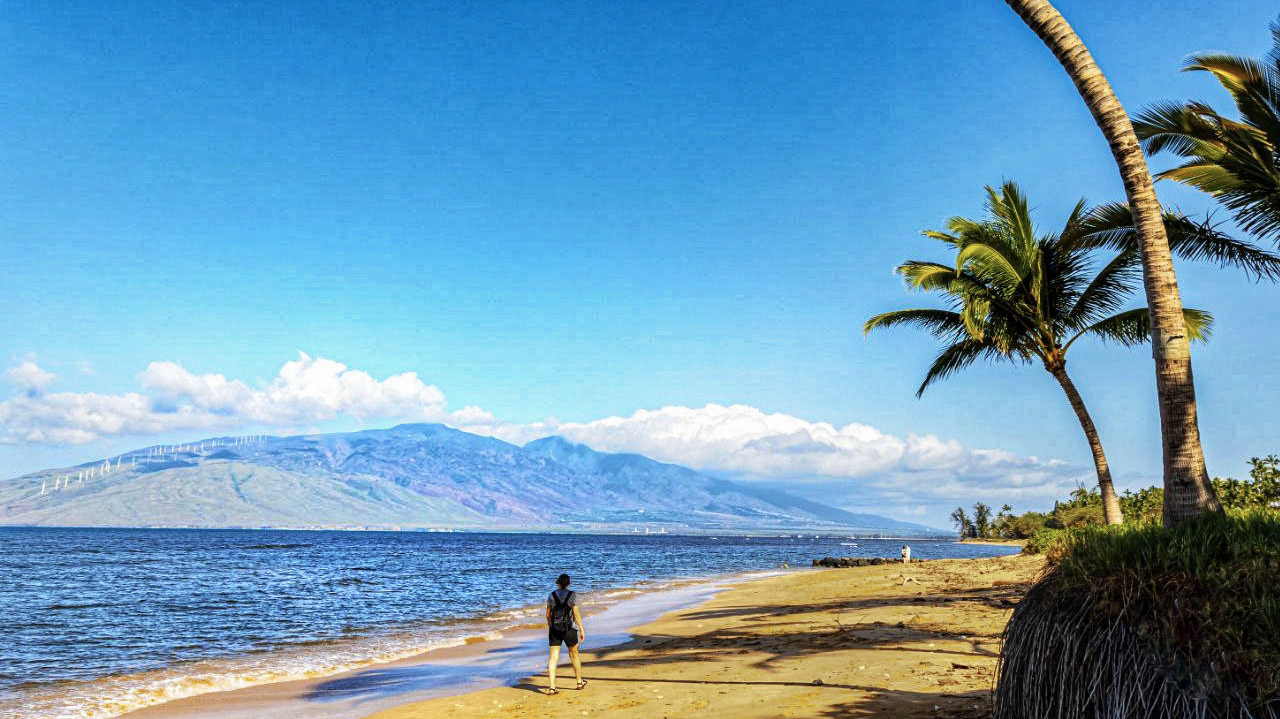
A visitor walks down a Hawaii beach path with a phone held five inches from their face. The ocean is breaking nearby. Wind is moving through the trees overhead. Birds are singing in the distance. The scent of flowers is drifting across the path. But the visitor never looks up.
They crossed an ocean, five or more hours to get here. They spent thousands of dollars to be here. Yet for the next hundred yards, they pay more attention to something on a screen than to the surroundings they came to experience. Once you notice it, you start seeing it everywhere.
What a resident notices on the same walk every day.
That scene came to us from Beat of Hawaii reader Michael Z., whose comment generated an unusually strong response in our recent discussion about what Hawaii residents wish visitors knew.
Michael spends five or six months a year in Hawaii and walks about five miles every morning without carrying a phone. Over time, he has become familiar with the regular walkers, runners, and residents he passes. The visitors stand out, not because they are tourists, but because, to him, so many seem disconnected from what is happening around them.
According to Michael, many visitors are not looking at the ocean, the trees, the flowers, or the people they are walking beside. Their attention is somewhere else entirely. That observation stayed with us enough to write about it because it is difficult not to see once it has been pointed out, as Michael did.
Do you think he was exaggerating?
Do you think he was exaggerating? He was not. Michael’s point was not that every visitor is continually buried in a phone, it was that enough are to change what a Hawaii morning feels like. He said at least a third of the people he passes are moving through the day with their eyes fixed on a screen.
Not glancing down to check directions and then moving on. Not taking a photo and putting the phone away. Walking through Hawaii while focused on something happening somewhere else.
If that sounds exaggerated, that was clearly part of his point. He expected readers to doubt it, and then he answered it. This was not a one-time complaint from someone annoyed on a single walk. It was what he noticed after walking the same miles day after day.
The number itself is almost less important than the recognition. Most of us have seen some version of it and maybe even done it ourselves. A couple walking together while looking at separate screens. Someone standing beside the ocean while scrolling. Visitors move through extraordinary places while barely engaging with them.
We experienced it at a restaurant recently. There were two parents and two teenagers, each on their phone, and no one talked at all throughout the experience.
What visitors miss when they don’t look up.
The surprising thing is that the biggest loss is not necessarily even the famous scenery. Most visitors will notice Waikiki Beach, Haleakala at sunrise, the Road to Hana, Hawaii Volcanoes National Park, or the cliffs of the Na Pali Coast. Hawaii’s headline attractions still do their job admirably, and most people will come home with plenty of photos to prove they were there. What gets missed is almost everything in between.
It might be a flowering hedge along the road, the kind someone might arguably admire. It might be a monkeypod tree reaching over a street, or the smell of plumeria before you see where it is coming from.
Sometimes it is the sound that comes before the visual. Waves reach your ears before the ocean reaches your eyes. Birds, wind, sprinklers, wet pavement after a passing shower, and the rustle of leaves are all part of how Hawaii actually feels when you are inside it.
None of that shows up as a must-see. It is not on itineraries, and it doesn’t need a ticket, a tour, or another reservation. It is just there, to be noticed by those who are willing, which may be why it is so easy to walk past.
Why this affects more than the visitor.
Michael was clear that, intellectually, he knew it was the visitor’s loss. If someone comes to Hawaii and chooses to spend part of the experience looking at a phone, that decision is theirs. And yet watching it happen still affects his own mornings.
When a large share of the people around you are disconnected from this beautiful place they came to experience, it changes the atmosphere. The beach path, shore, trees, and flowers are the same. Something about the shared experience, though, feels different.
Everything is still there.
The encouraging part of Michael’s observation is that nothing he described has disappeared. They are waiting a few inches beyond the screen. For visitors who have crossed an ocean to get here, that may be the simplest Hawaii travel advice of all. Look up. The sights, sounds, and smells that brought you here are still right in front of you.
By Rob and Jeff, Beat of Hawaii.
Some of the most meaningful parts of Hawaii are the ones visitors walk right past without knowing they are there. We’ve spent nearly 20 years finding them firsthand for BOH as full-time Hawaii residents reporting on travel, culture, and island life, and telling you what they mean for your trip. Join us →
Get Breaking Hawaii Travel News





Get rid of Starlink and cell phone usage while flying too.
This could be said for everywhere!
100% True! I l live in West Maui and pretty much daily I’m at North Ka’anapali Beach. These Addicted tech humans is Tragic, Horrifying and Sad. I see Sooo many, @60%+ IMO of all ages of visitors who are 100% glued to their devices as they sit in their rental chairs. Whale Season is a few less @50%+ as some will actually watch the water to see a whale breech. What are they missing is they scroll away? …God’s incredible nature and one of the most gorgeous beaches in the world framing the islands of Lanai and Molokai…Locals tend to “be more present” in my observation; enjoying the water, sea life and scenery- especially the sunsets…An Excellent Docu-Drama movie “The Social Dilemma” explains the planned takeover of the human mind-Ugh!….ps it baffles me who people pay sooo much to come to Maui to look at their phones 🙁
This isn’t just tourists. It’s pervasive in society – everywhere and anyone. I see locals doing it too. The problem is bigger than just missing out on scenery. Ive witnessed two people on separate occasions get hot by cars because theyre staring at a phone
The rude phone creatures are not exclusive to Hawaii. They are everywhere. It seems as though the purpose of travel for way too many people today is to record it on their phone, posted on their Facebook page, and then move onto some other place. They have ruined so many beautiful, culturally enriching places with their lack of appreciation for what surrounds them
Totally agree! And as a boomer, have seen our Human meaningful quality of life go down hill over the decades that makes me not want to be here anymore. Cell phones have turned Humans into zombies. While I have always been an outsider loner type having grown up and still living here in the islands … I do like connecting with folks from time to time. But nobody’s Home anymore. They are being groomed to become cyborgs.
I agree with Michael. We see the same thing. Even worse is when they are having a loud conversation on speaker for all to hear, ruining everyone’s experience. These are the same people who “don’t see any whales” as they are breeching right in front of them as they stare at their phones.
Like many experiences in Hawaii, this is a microcosm of the whole of society in it’s present state. I am kaamaina. I recently traveled to Pennsylvania with my wife. It’s beautiful there. In different ways than Hawaii, but nonetheless beautiful and worthy of “stopping to smell the roses.” Yet, tourists and locals alike are buried in there phones. It’s not a Hawaii problem, its a human problem.
Re: cell phones. I totally agree and I continue to be baffled by phone use. This year I was in my favorite spot at the beach, watching the surfers, listening to the waves, etc. A lady sat down a few feet from me and FaceTimed her kids and grandkids one at a time, yelling over the sound of the waves. I left. Afternoon ruined.
Thank you for amplifying my post from the other day.
You may also be interested in a humorous essay by my wife about the clueless antics of Hawaii visitors published by BULL:
mrbullbull.com/newbull/flash-nonfiction/how-to-mind/
Michael, you are spot on
Mahalo Rob and Jeff… and Michael. This article was dead on. It’s not just about looking at screens. I’ve had dinner at an oceanfront restaurant with a beautiful view and was in awe. But the couple at the table next to me were each reading a book through the entire dinner. There is so much beauty to see and experience on Kauai that it never gets old. The beauty is all around us every day and I wouldn’t want to miss a minute of it.
Reading a book through dinner? I’ve got an even more amazing example:
About a decade ago, the family next to us at an ocean-front table at the Feast at Lele (probably the best and most expensive luau on Maui before the Lahaina fire) had a portable DVD player for their 12-year son; who watched a movie throughout the entire luau. Yes, including the fire knife dancer.
That family paid about $400 (in 2015 dollars) for their teenage son to watch a DVD and have some Polynesian food.
Live entertainment?! What live entertainment?!
Some people have far more money than wisdom…
This is everywhere. Between those glued to the screens and the IG models getting selfies everywhere and showing their followers how awesome their lives are, people no longer can just absorb their location. In Thailand we were mobbed at our hotel pool by a group of younger ladies all taking pictures of each other and using phone flashlights for lighting, totally disregarding other guest. When spoken to by staff they ordered a few drinks, but promptly left after a few more pics.
This is true not just in Hawaii, but all over the world. It’s a pandemic