A visitor planning an anniversary trip to Maui said they couldn’t wait to shop in Lahaina again. Another person responding to the same Marketplace opening, however, wished housing was moving as quickly as shops for tourists, while others looked at the modular storefronts and wondered whether this was really what more than three years of rebuilding had produced. Reactions following the November 10 opening of Ulu o Lele Marketplace reflected enthusiasm, disappointment, and some surprisingly strong feelings.
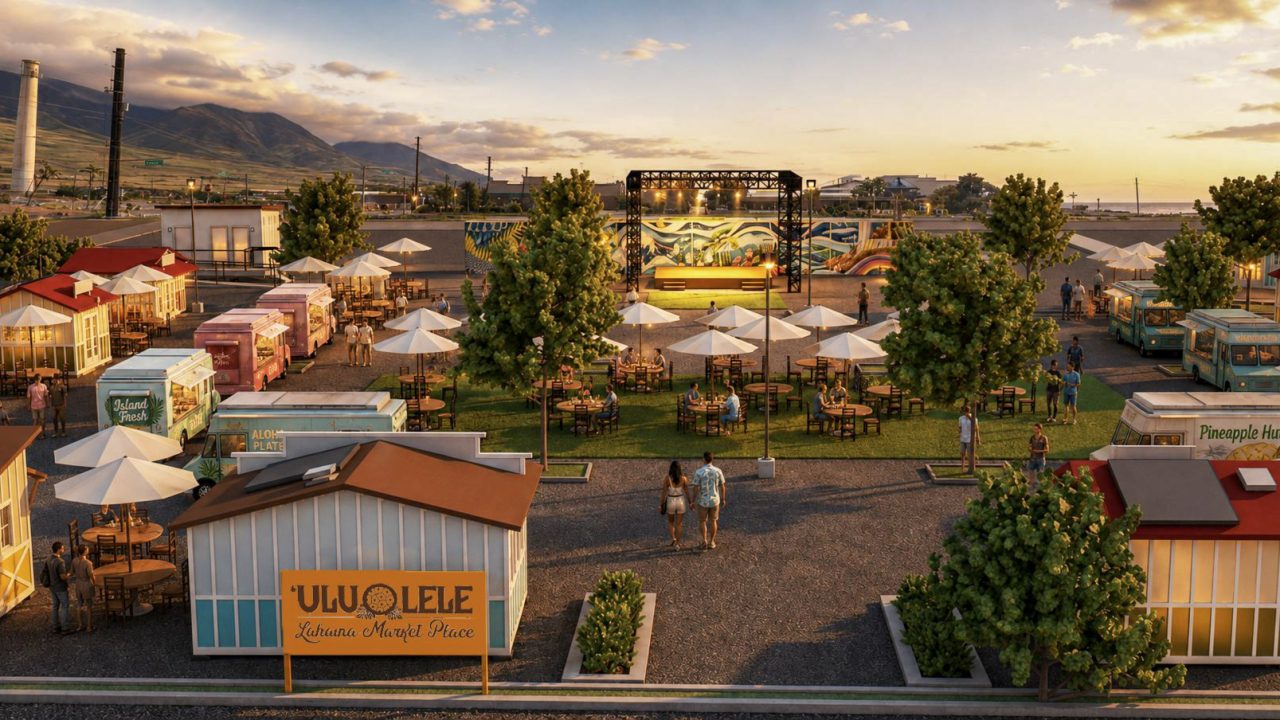
The marketplace has now brought the first temporary commercial storefronts back to Lahaina’s Front Street area since the devastating August 2023 fire. Built on approximately three acres at the former Outlets of Maui site, it features 17 small modular structures made in Hilo and transported to Maui, food trucks, and spaces for community gatherings. Some businesses opened immediately, while others are expected to follow as they’re ready.
We know personally just how emotional returning to Lahaina can be. During our August visit and the Atlantis submarine tour, walking past the vacant lots where homes and businesses once stood was heart-wrenching. The banyan tree was still behind barriers, and the familiar Lahaina waterfront looked profoundly different and eerie. That was before the marketplace opened, but it helps explain why even a welcome addition to the town can still bring very conflicting emotions.
For returning Lahaina businesses, this opening is deeply personal.
For some of the new tenants, having a storefront in Lahaina again represents years of effort following losses that went far beyond their businesses. Among them is Courtney Lazo, whose Henohea Hawaii clothing brand now occupies one of the new shops on Wainee Street, not far from the childhood home her family lost in the fire.
Lazo told Hawaii News Now that her family still isn’t living in that home, but opening a store on the same street feels like coming full circle. She also sees an opportunity for Lahaina to reconsider what its commercial district should become, with more space for businesses owned by people who grew up there.
Another returning business, Front St Fresh, belongs to Sergio Perez and his wife, Brazlee, who was born and raised in Lahaina. They lost their home in the fire, spent two years living in Las Vegas, and eventually returned to Maui to establish their food truck. They now have an opportunity to operate in the heart of the town where they built their family.
Baya Bowls is another local story. Owner Ceone Nojima-Jacinto lost both of her food trucks in the fire, while approximately 80% of her employees also lost their housing. Her business continued operating elsewhere in West Maui, but the chance to return to Lahaina has renewed enthusiasm both among her family and workers.
The marketplace also includes familiar Lahaina names such as The Jewelry Stand Maui and Penne Pasta Cafe, together with a barber shop, local artisans, clothing stores, food vendors, and other small businesses. They’re getting a chance to establish themselves in a commercial area that was previously home to national retail brands.
The temporary storefronts have divided opinion.
Some people are already saying that they love the cheerful, informal appearance of the marketplace. Others have described it as resembling a trailer park, questioned whether the little structures belong in historic Lahaina at all, or have said they are disappointed that the town’s first new storefronts look so unlike anything that once defined Front Street. It all reflects just how much expectation has become attached to the appearance of the town’s first returning shops.
The buildings themselves are modest, measuring either 144 or 240 square feet, and were designed to provide usable commercial space without waiting for permanent reconstruction to happen. Hawaiian Council arranged for their construction by HPM Building Supply on the Big Island and shipment to Maui. They were never intended to recreate Lahaina’s historic commercial architecture and they don’t.
Ulu o Lele is scheduled to operate as a marketplace for approximately 18 to 24 months under a two-year property lease. That limited timeframe raises a practical question for businesses that establish a customer base there: where will they go when the lease ends, particularly if permanent commercial space is still unavailable or becomes far more expensive?
The rebuilding of historic Front Street is advancing, although much more slowly. Since our July report on what’s actually coming back to Lahaina’s Front Street, construction has begun at 612 Front Street, with the replacement commercial building expected to open in summer 2027. Pacific Whale Foundation is slated to become an anchor tenant there.
In October, Maui County reported that of 36 affected properties on the mauka side of Front Street, two building permits had been issued, four applications were under review, and 16 properties were on a pathway toward rebuilding. The historic district’s permitting requirements, rising construction costs, insurance challenges, and coastal restrictions continue to complicate and slow permanent redevelopment. The marketplace may have opened but most of that much larger undertaking is just underway.
What the $8 million is actually paying for.
Questions about the cost have also surfaced. The estimated $8 million price tag sounds substantial for a development consisting largely of small temporary buildings, particularly in a community with so many remaining needs.
According to Maui County’s original project announcement, however, the estimate includes both construction and operations throughout the two-year initiative. It isn’t simply the cost of purchasing 17 modular storefronts. Funding includes a $4 million grant from Hawaii Community Foundation’s Maui Strong Fund and support from Hawaiian Council’s Kakoo Maui Fund.
What hasn’t been made public in the information we reviewed is a complete accounting of the remaining financing, the division between construction and ongoing operating expenses, or the amount being paid to lease the property. A 2020 Maui County agreement identified the Harry and Jeanette Weinberg Foundation as the underlying landowner and Maui Outlets Associates as the lessee, although that’s a historical record and doesn’t confirm current ownership or terms of the marketplace lease.
Subsidized rents were originally announced at approximately $800 to $1,500 monthly, depending on the size of the spaces. Organizers have said that the initiative could sustain about 90 jobs.
There was also a formal selection process. Hawaiian Council says a volunteer, community-led advisory committee reviewed 126 applications and selected 24 businesses, giving priority to those affected by the fire or connected to Lahaina. Published criteria included business readiness, cultural authenticity, community impact, and stewardship.
With far more applicants than available storefronts, some businesses inevitably had to be disappointed. The organizers say additional opportunities are planned for pop-up vendors, artists, and other participants, but how those opportunities develop is also not yet fully clear.
Shops are reopening while many families still need permanent homes.
Perhaps the most difficult reaction to the marketplace concerns housing. Some remain troubled by the sight of new retail structures when so many fire survivors are still trying to return to their neighborhoods, rebuild their homes, or find affordable places to live.
The continuing housing problems are well documented. An August 2026 UHERO recovery survey found that about two-thirds of fire-affected households were living in permanent housing, an improvement from just over half in early 2025. That progress is significant, but temporary and unstable housing remained an issue, and some displaced families have still not returned to West Maui.
It’s understandable that seeing shops reopen might feel premature to someone still struggling with housing. Yet there is no evidence that the marketplace’s grant money was taken from a housing program, and the returning businesses themselves include people who lost their homes. Many are dealing with the same unresolved recovery problems as the people questioning the development.
There is another big concern within the debate about West Maui tourism. Lahaina’s commercial future will depend partly on returning visitors, but at the same time, what kind of town will those visitors eventually find? Hawaiian Council says the marketplace is intended primarily to serve the community, with visitors welcome to support locally owned businesses. The tenant mix and community programming may provide an early opportunity to see how that intention works in practice.
What Maui visitors can expect at Ulu o Lele now.
The marketplace is located at the corner of Wainee and Papalaua streets, on the former Outlets of Maui property. The official Ulu o Lele website lists 16 storefront businesses and seven food trucks, although the initial selection announcement listed six trucks, and not every participating vendor was expected to begin operating this week.
Visitors should therefore expect an evolving marketplace rather than a fully established shopping district. Regular daily operating hours and other arrangements for individual storefronts weren’t clearly available in the published information we’ve seen. The official site advises that everyday parking is available in stalls beside the parking structure and along nearby streets. Visitors are also asked to remain within designated public areas and stay away from adjacent restricted properties, where construction hazards remain.
For people who have been waiting to return to Lahaina and spend money with local businesses, there is now somewhere new to begin doing just that. We’d especially like to hear from readers who have visited or plan to visit Ulu o Lele, including which businesses were operating, how easy it was to get around, and what it felt like to be back in this part of town.
Rendering courtesy of Hawaiian Council.
Get Breaking Hawaii Travel News