
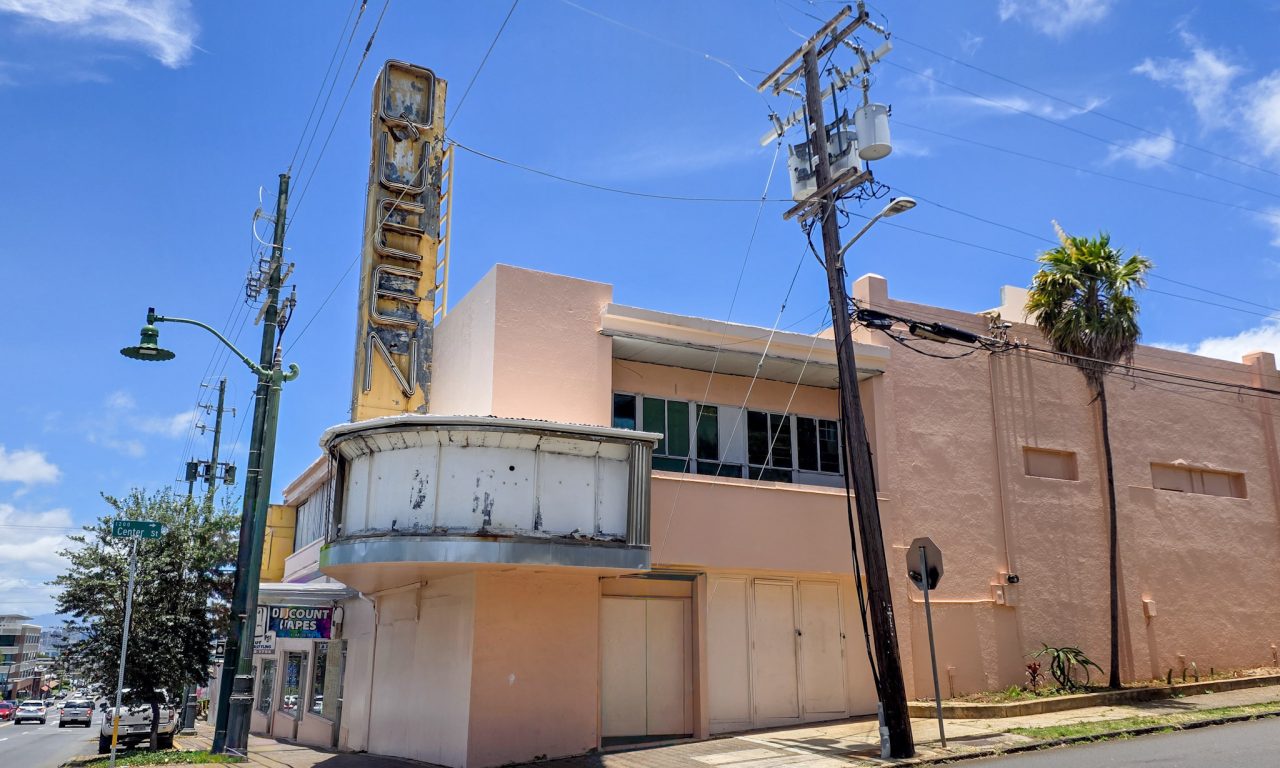
We stood in front of the Queen Theater this week, at the top of Waialae Avenue in Honolulu, and what struck us first was not that it was closed. It was how neglected it has become. The entry is completely boarded over, the facade weathered by 40 years with no one tending it, while the theater is now up for sale for the first time in half a century.
Near that dark storefront, Kaimuki has filled in with the kind of neighborhood people cross the island for: the crack seed store that has held that corner for 70 years, the line down the sidewalk at Breadshop, tables full at The Curb, and the whole stretch moving in a way the theater no longer is. What stayed with us was how few people passing even glanced at it. A building this size, and dark so long, that people have learned to walk right by. The Queen has not changed in 40 years. Everything around it has, and now the neighborhood is arguing over what happens here next.
The Queen Theater grew up with Kaimuki.
The Queen Theater opened in 1936, when neighborhood movie houses were still central to life in Honolulu. By local accounts, it was named as the companion to the King Theater downtown, with the Queen name also nodding to Queen Liliuokalani (or, by some accounts, Queen Emma) and Hawaii’s royal history.
Built in the Art Moderne style, the theater was later remodeled in the 1940s, when its now-familiar neon marquee was added. Even boarded up, that marquee continues to identify the building long after its doors stopped admitting audiences.
The Queen was more than a room with a movie screen. It was built as a performance venue with a stage, fly tower, and dressing rooms, allowing it to host live entertainment as well as films. Friends of Queen Theater describes it as a 560-seat theater, while Historic Hawaii Foundation places its original capacity at 850. Either of those made it a substantial neighborhood venue rather than a small theater tucked into a commercial block.
Its changing entertainment reflected the different versions of Kaimuki that evolved around it. There were 25-cent matinees, vaudeville acts, second-run movies, and Saturday clubs where neighborhood children could spend part of the day. Surf films later drew a whole other generation, followed by midnight showings of “The Rocky Horror Picture Show” and underground punk performances.
The same building that once offered family matinees became a gathering place for audiences far outside Honolulu’s mainstream. The Queen kept changing with the neighborhood, even when some of those changes left people uncomfortable.
Historic Hawaii Foundation listed the Queen as an endangered historic building in 2006. Friends of Queen Theater calls it the last historic theater of its kind in Hawaii. Those claims are about more than the facade. The stage, backstage spaces and auditorium represent a type of neighborhood entertainment building that has almost vanished from the islands.
How the Queen Theater went dark.
The Queen’s final chapter as an operating theater began when Narciso Yu Jr. bought it in the mid-to-late 1970s. Yu already controlled several theaters around Honolulu that were showing adult films, and he brought the same programming to Queen in Kaimuki.
Residents objected, and the dispute soon reached Honolulu Hale. Then-Mayor Frank Fasi and the City Council tried to stop the theater from showing adult films, but federal judge Samuel P. King ruled the law unconstitutional.
Police raids continued to target theater employees for showing material considered obscene. A large raid in 1985 seized 575 films and led to the theater’s eventual shutdown, and the Queen never returned to regular operation.
The adult-film years often dominate retellings of the Queen Theater’s history, but they were only the last stretch of a much bigger life. The building had already spent decades moving between mainstream movies, children’s entertainment, surf culture, and late-night counterculture before one final turn brought open conflict with the neighborhood.
During the long vacancy that followed, the auditorium was even leased for storage by a plumbing business. Until recently, it was still filled with pipes and plumbing supplies, and most of its seats had been removed.
Why the Queen Theater is back in the news.
Kaimuki residents and city leaders have been trying for years to force a decision about the theater. In 2021, the Kaimuki Neighborhood Board backed a resolution asking Honolulu to look at acquiring it. In late 2024, the City Council formally asked the administration to purchase the property and use eminent domain if necessary.
Then this spring, Honolulu’s administration said no. Managing Director Mike Formby cited asbestos, lead-based paint, mold, difficult site conditions, and the lack of parking. The lot behind the theater is now a bank’s. He said the city would rather direct its property spending toward needs such as affordable housing.
Department of Housing and Land Management Director Kevin Auger said the proposed $4 million acquisition cost would equal roughly half his department’s entire operating budget. Council Chair Tommy Waters then reduced his request to $2 million and suggested the state might contribute, with a nonprofit eventually operating the theater.
State Rep. Jackson Sayama has supported condemnation, describing the neglected building as a blight on Kaimuki. One group sees an expensive property with environmental and construction problems, while others see a window closing on a chance to recover a landmark before age and deterioration settle the issue.
The future of the Queen Theater changed in June.
On June 3, the City Council adopted Resolution 26-127, amending the city’s Public Infrastructure Map so the property could be considered for government use. The action does not require Honolulu to buy the theater, but it removes one obstacle to acquiring it and allows money to be appropriated.
On June 9, CBRE announced that it had been selected to market the Queen Theater on behalf of the seller. The 12,497-square-foot building and 10,396-square-foot parcel at 3588 Waialae Avenue are being offered fee simple and as-is, with no public asking price. CBRE says this is the first time the property has been offered on the open market in more than 50 years.
The city’s latest assessment values the land at just over $2.8 million and the building itself at only $459,300, though market estimates run much higher. The theater is now caught between a council that has moved closer to acquiring it, a Honolulu administration that does not want it, and a private market that may produce a buyer with entirely different ideas.
What could happen to the Queen Theater now?
One future begins with the city. The Council could continue toward acquisition and use eminent domain if a voluntary sale cannot be reached. Honolulu could then hold the building while private donors and a nonprofit raise the money needed to restore and operate it.
Waters has pointed to the Palace Theater in Hilo, where a nonprofit operates a historic theater as a community venue. That example shows that an old Hawaii theater can be returned to use, though the Queen’s condition, location and ownership history create a different set of issues.
The other path comes through Friends of Queen Theater, the nonprofit formed in 2008. Its website says the group hopes to take over the lease with help from the owner and restore the building as a community arts venue.
The group envisions after-school arts classes aimed especially at low-income students, along with recitals, classic movies, live productions and other community events. It has also begun raising money for renovation, equipment and the work needed to assume the lease.
City officials have said owner Adoree Yu, who controls the property through Queen Management, has not cooperated with acquisition attempts, while the Friends website describes a gracious owner helping the group toward a lease. Those accounts already clash, and the record adds a third.
At the May 21 Zoning and Planning Committee meeting, the Department of Planning and Permitting testified in writing that the owner had been unwilling to proceed with a voluntary condemnation, and Waters called that false, saying Yu is completely open to it. Now that the property is openly for sale, a private buyer could obtain the theater before either the city or Friends of Queen Theater does.
What Kaimuki decides about the Queen Theater.
For most of its 90 years, the Queen Theater reflected whatever Kaimuki was becoming. It opened when neighborhood theaters helped organize social life outside downtown Honolulu, it survived the TV era by finding new audiences, and it moved from family films to surf movies, midnight shows, punk performances and adult entertainment. After the doors closed, it reflected another side of Kaimuki, a neighborhood changing around a landmark no one could restore, remove or ignore.
The Queen’s future will say something about what Kaimuki sees for the next iteration of Waialae Avenue, a neighborhood that has become one of the places Honolulu’s best food turns up in plain storefronts and strip malls off the tourist path. It could remain a theater, become some other kind of commercial property, sit through yet more arguments, or deteriorate until the options are gone.
People who want to help restore the building can find more information through Friends of Queen Theater. For everyone else, the question is more personal: What do you remember about the Queen Theater, or the neighborhood theaters elsewhere in Hawaii that disappeared before anyone could save them? Do you even notice Queen Theater when driving by?
Lead Photo Credit: © Beat of Hawaii at Queen Theater.
By Rob and Jeff, Beat of Hawaii.
Some of the most meaningful parts of Hawaii are the ones visitors walk right past without knowing they are there. We’ve spent nearly 20 years finding them firsthand for BOH as full-time Hawaii residents reporting on travel, culture, and island life, and telling you what they mean for your trip. Join us →
Get Breaking Hawaii Travel News


Hawaii’s specialty. Make a decision by not making a decision.Just rename it Natatorium two. Everyone will express concern,some will try to save it ( Friends of_______ )fill in the blank. The Natatorium folks have been working on that for decades and nothing has changed there,either. No one wants to make the final decision. I will be amazed if anything actually happens. I certainly hope so. I’ve lived in Palolo almost 40 years.
Same as the Falls of Clyde. The powers that be don’t care about the “old” and when “Friends of….” offer to step up and save something, they stop it by doing nothing. We’ve lost so much and are losing what’s left. Auē.
I had the same thought regarding the Natatorium. When structures like it and this theater (and Coco Palms) are no longer in demand, tear them down and repurpose the land. There is little point in continually dumping money into businesses that no longer thrive.
Thanks for the article on Queen Theatre in Kaimuki – wonder if you could check into the history and what is currently going on with Waikiki 1, 2 and 3 theaters? I grew up near Waikiki and saw nearly every movie released in the 70s and 80s at one of these three theaters. Any chance they could ever become for sale? It would be a dream to go see a movie in Waikiki again!