
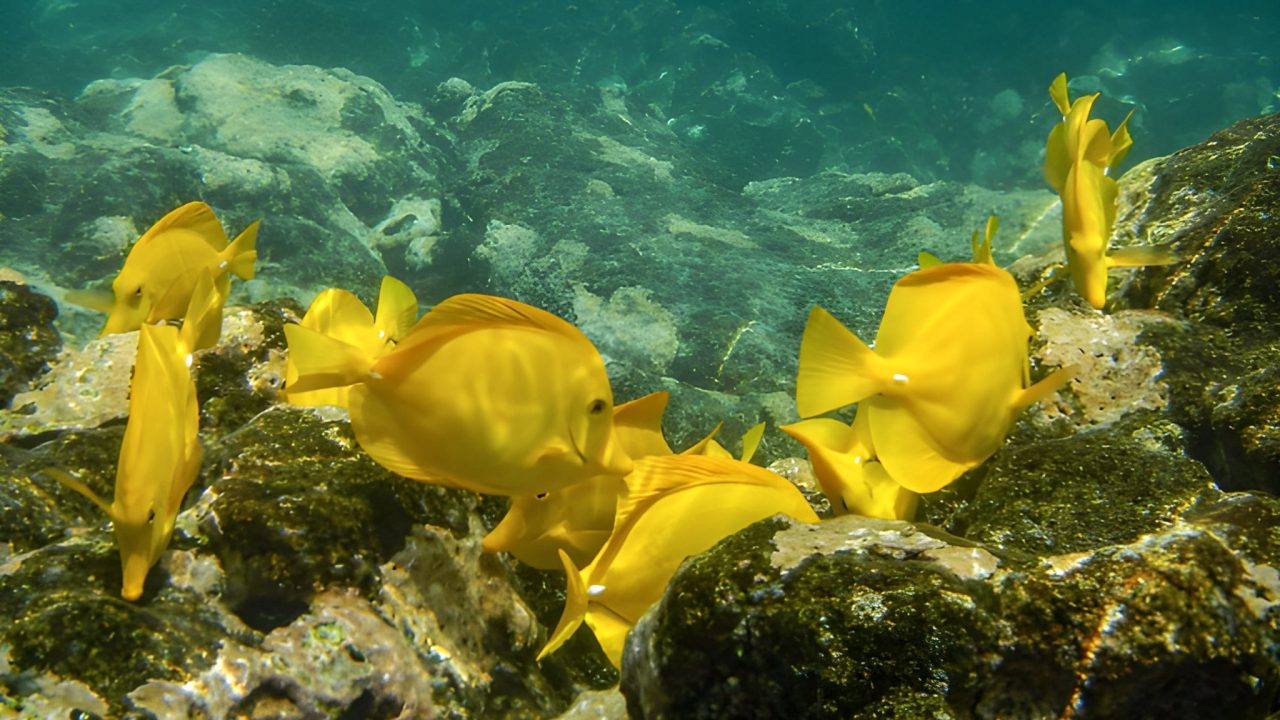
If you’ve snorkeled or dived along the Kona and Kohala coasts, you’ve almost certainly seen them. They’re the yellow reef fish that are difficult to miss against dark lava and coral, known as yellow tang or lauʻīpala in Hawaiian. For almost a decade, commercial collectors haven’t legally been able to take them from West Hawaii for sale to the aquarium trade. Hawaii is now surprisingly close to changing that.
New state rules considered by the Board of Land and Natural Resources on August 28 would have paved the way for commercial aquarium collection to resume, including the removal of up to 100,000 yellow tangs from West Hawaii each year.
The board didn’t approve the rules. Instead, it sent the proposal back to the Division of Aquatic Resources for more work after hours of testimony and questions over public-trust obligations, cultural concerns, and technical and legal issues. For the time being, commercial aquarium collection remains illegal statewide. Both commercial and recreational aquarium collection also remain prohibited throughout the West Hawaii Regional Fishery Management Area.
What Hawaii was preparing to allow.
The 100,000 yellow tang number sounds huge, especially when these are the fish visitors see swimming on West Hawaii reefs. But the proposal before the Land Board would actually create a smaller aquarium fishery than the one Hawaii shut down years ago.
West Hawaii once allowed commercial collectors to take 40 aquarium species. The new rules would permit only five, with yellow tang accounting for nearly all of them: 100,000 yellow tang, compared with 1,086 Potter’s angelfish, 800 brown surgeonfish, 344 bird wrasse and 182 Thompson’s surgeonfish each year. Kole and Achilles tang, both included in earlier proposals, are no longer on the list.
Even 100,000 yellow tang would be well below what collectors once removed. The Division of Aquatic Resources says West Hawaii’s historical annual average was 265,975, with a one-time peak of 375,656. The proposed ceiling is therefore about 62% below the old average and 73% below that peak.
Collectors won’t just return to the old way of doing business either. The new system would require permits, geographic authorization, registered vessels and catch reporting, with fish moving through registered aquarium dealers. Commercial collection could return to West Hawaii after an absence dating to 2018, but at a scale and under controls very different from what existed before.
Supporters say a much smaller, tightly controlled fishery can operate without depleting yellow tang or damaging the reef. Opponents are asking a different question: even if some collection is sustainable, should fish that people come to Hawaii to see alive on the reef be taken for commercial sale at all?
What happened after aquarium collection stopped?
Commercial collection in West Hawaii came to a halt in January 2018 after the Hawaii Supreme Court ruling required environmental review. So what happened to the fish once collectors stopped taking them?
There are signs that yellow tang increased in places where collection had stopped, while state monitoring has also found fewer young yellow tang in areas where aquarium fishing previously occurred. But the bigger picture isn’t as clear. Yellow tang populations increased in protected areas as well, while bleaching, habitat conditions, and natural fluctuations in the number of young fish reaching the reef may all affect what divers and snorkelers see.
DLNR’s Division of Aquatic Resources concluded in 2024 that the fish populations studied were generally stable and that the much smaller fishery now being proposed presented a low risk of major population or reef damage. That of course supports the argument that limited collection is sustainable, but it doesn’t prove that taking fish has no effect or that nine years without commercial collection made no difference.
The Office of Hawaiian Affairs (OHA) speaks out against it.
OHA has consistently supported efforts to end the commercial collection of reef fish for ornamental purposes, according to their press release.
“Reef fish — our iʻa — are not simply commodities. They are an integral part of Native Hawaiian traditional and customary practices, our relationship with ʻāina and kai, and the health and abundance of the ecosystems that have sustained our people for generations,” said OHA Board of Trustees Chairperson Kaialiʻi Kahele. “BLNR’s decision recognizes that protecting these resources must take precedence over removing Hawaiʻi’s reef wildlife for ornamental display. It supports the work being done by communities across our pae ʻāina to perpetuate traditional practices, strengthen food security and ensure healthy, resilient nearshore ecosystems for generations to come.”
Why no decision has been made.
Even with lower catch limits and decades of monitoring behind the proposal, and outspoken opposition, the Land Board wasn’t ready to approve it. The debate now reaches beyond fish population numbers. One question is whether the fishery can operate without significantly reducing the population. Another is whether removing these fish makes sense, given that they are part of Hawaii’s reef ecosystem and are one of the things people come to Hawaii to experience.
The board sent the proposal back for more work, and no new decision date has been announced. Commercial aquarium collection remains closed while the process is underway.
These are fish visitors come to Hawaii to see.
We’ve been watching related questions emerge as Hawaii rethinks how heavily some of its marine places should be used. At Maui’s Honolua Bay, reservations and shuttles are now being considered as officials confront heavy visitation and declining coral.
Would knowing that some of the reef fish you see while snorkeling in Hawaii could also be commercially collected for sale to aquariums change how you view this? Or does a tightly limited fishery make sense if long-term monitoring shows the populations can support it?
We welcome your input.
By Rob and Jeff, Beat of Hawaii.
Some of the most meaningful parts of Hawaii are the ones visitors walk right past without knowing they are there. We’ve spent nearly 20 years finding them firsthand for BOH as full-time Hawaii residents reporting on travel, culture, and island life, and telling you what they mean for your trip. Join us →
Get Breaking Hawaii Travel News




I’m happy that harvesting of these and other marine life are regulated and limited. Hobbyist enjoy having a little sunshine reflected in these fishes in their homes.
So, my question is what will those fish be sold for in the retail market?
I am against it. Stop destroying the environment.
I really hope the Division of Aquatic resources upholds the “no aquarium reef fish take” set by the DLNR. There is already so much illegal taking of reef fish, including at night, that isn’t controlled. The short-sighted and often illegal harvesting of these important managers of the reef ecosystem needs to be stopped.
Who will be better off if commercial collectors are allowed to capture 100,000 Yellow Tang? Obviously, the collectors, but what about the people enjoying the reefs? This smells like a payoff has happened. Leave the fish alone for all to enjoy.
This infuriates me! I have been protesting this for years. As it is, our reef fish have never recovered and everyone wants to continue to rape and pillage the reefs because there is huge money for not just aquaium collectors but this greedy blue very green-progressive state … that pretends to care about it’s enviroment!
The only place visitors can see all of the reef fish the way is used to be is in the, very few, reef fish sanctuaries. So clearly Hawai’i sees all of the reefs outside the sanctuaries as theirs to make millions off of.
Same old same $$$.
During the lockdown (so no more tourists) … what reef fish are left, were seen moving back closer to shore, due to a huge reduction in huge numbers of tourists trampling all over reef fish habitats.
And just only taking Tang is disgusting … as if they are only taking one species is okay. Really?!?