
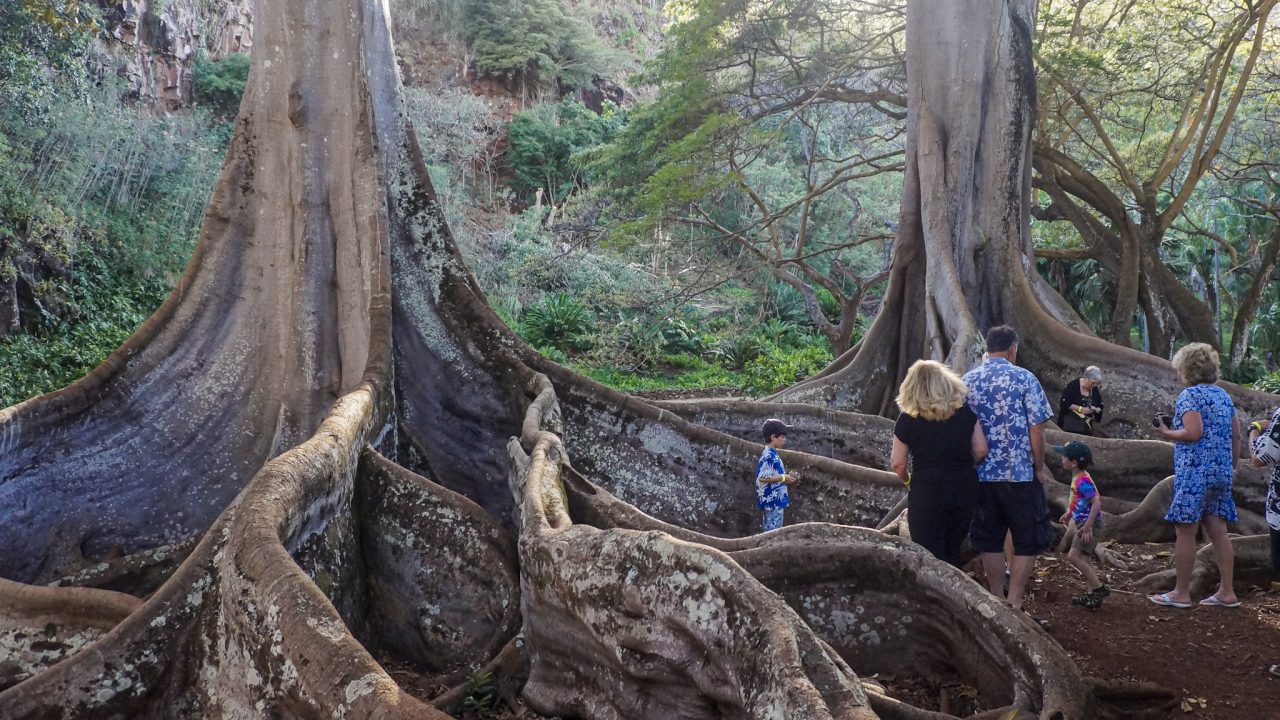
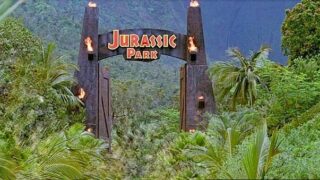
For generations of visitors, Jurassic Park helped create the Hawaii they dreamed of seeing before they ever stepped on a plane. Long before they knew names like Manawaiopuna Falls, Kualoa Ranch, or the Na Pali Coast, they recognized the landscapes where dinosaurs first appeared to roam.
Those scenes did more than give the movie a spectacular backdrop. They turned Oahu and Kauai into places that millions of people felt they already knew before their first Hawaii vacation.
Some visitors (and even residents like us) eventually flew over the waterfall where the helicopter descended into Jurassic Park. Others stood beneath the steep green mountains at Kualoa Ranch or searched for the remains of the famous but elusive gate deep in the Kauai interior.
The landscapes became inseparable from the legendary films, and the films became just one more reason to visit Hawaii. That connection is still strong and visible more than 30 years after the original movie arrived in theaters.
The newest chapter told a different story because Jurassic World Rebirth reached theaters last year without filming a single scene in Hawaii. The franchise returned to its tropical island world, but the islands that helped make it famous were no longer part of the production.
Jurassic World Rebirth left Hawaii out.
Jurassic World Rebirth filmed primarily in Thailand, including locations in Krabi, Phang Nga and Trang. Production also used Malta Film Studios for water work and Sky Studios Elstree in the United Kingdom.
Principal photography for the film took place the prior year. Unlike several earlier films in the franchise, the production did not come to Kauai or Oahu. That may be easy to miss while watching the movie because Thailand once again supplies dense tropical mountains, rivers, beaches, and jungle. The scenery can feel familiar to anyone who has always associated Jurassic with Hawaii.
For viewers who connect the franchise with these islands, something is clearly missing. The newest movie uses the kind of tropical imagery Jurassic helped make famous without returning to the Kauai and Oahu locations that gave the series so much of its identity.
There is still pride in knowing that Hawaii created a movie landscape other places are still asked to reproduce. Yet there’s also a sense of loss in watching the franchise return without the locations that visitors continue to associate with it.
Kauai gave Jurassic Park its original world.
The Hawaii connection began with the original Jurassic Park, which filmed extensively on Kauai decades ago in 1992. Manawaiopuna Falls appeared during the helicopter arrival, while the island’s mountains, valleys and coastline helped establish the scale of the fictional Isla Nublar.
The Na Pali Coast and Kauai interior provided a setting that did not feel manufactured. Even after computer-generated dinosaurs appeared, the landscape surrounding them was real enough to make the entire idea still seem possible.
We know these places from living on Kauai, not only from watching them on a screen. We have flown into the valley and landed beneath Manawaiopuna Falls, an experience that made the movie connection feel almost secondary to the setting itself.
The helicopter drops quickly into the valley before the waterfall comes into view. Landing there with only a few other people delivered the kind of chicken-skin experience that puts you directly into the franchise and stays with you long after the flight ends.
Kauai’s role in the movie also became part of island history for another reason. Hurricane Iniki struck on September 11, 1992, just as the production was completing its work here.
The storm hit on what was scheduled to be the final day of Kauai filming and caused widespread destruction across the island. Director Steven Spielberg and the production moved the remaining scenes to Oahu, where Kualoa Ranch became another important and lasting part of the Jurassic world.
We explored that history and our own experiences at the locations in “Relive Jurassic Park Hawaii On Its 30th Anniversary.” That June 2023 article includes our landing at Jurassic Falls, the Kauai gate trail, Allerton Garden and Kualoa Ranch.
Oahu carried the Jurassic Hawaii story forward.
Kualoa Ranch eventually appeared in several Jurassic films, including Jurassic Park, Jurassic World and Jurassic World: Fallen Kingdom. Its broad valleys and sharply rising mountains became some of the franchise’s most recognizable Hawaii scenery.
Editor Rob knows Kualoa from a different perspective because he has also performed weddings there. Some have taken place at the Jurassic World gyrosphere depot, where a movie set became a very real backdrop for Hawaii couples and their guests.
That combination is part of what makes the Jurassic connection here different from an ordinary filming location. The landscapes continue to be used, visited and remembered long after the production crews left.
Visitors do not only stop for a photograph beside a sign marking where a movie scene happened. They move through valleys, gardens and coastlines that would be remarkable even if a dinosaur had never appeared there.
Why the newest Jurassic filmed elsewhere and not in Hawaii.
The decision to film Jurassic World Rebirth outside Hawaii appears to have started with the needs of its new story. The movie takes place on another fictional equatorial island, and the production wanted specific jungle rivers, coastal settings, and controlled water facilities available in Thailand and Malta.
Money also enters decisions of this scale because Hawaii’s film tax credit includes limits that can reduce its effective value for the largest productions like this, while competing destinations offer their own significant financial advantages. That does not mean Hawaii has stopped attracting film and television projects, and location requirements can be just as important as incentives when a production chooses where to shoot.
The Jurassic Hawaii experience is still here.
The newest movie may have skipped Hawaii, but the visitor experience connected to the earlier films remains very much alive. You can still fly over or land at Manawaiopuna Falls, explore the valleys at Kualoa Ranch and visit the spectacular gardens, beaches and coastlines seen throughout the franchise.
Some locations are easy to reach, while others require a helicopter, boat, guided tour or difficult hike. Several are compelling Hawaii stops even for visitors who have never watched a Jurassic movie.
Our “Visiting 13 Jurassic Park Iconic Filming Locations on Kauai, Oahu, and Maui” guide from July 2024 is the place to start planning. It includes Manawaiopuna Falls, the Na Pali Coast, Limahuli Garden, Kipu Kai, Hoopii Falls, Kualoa Ranch, Halona Beach, and other places visitors can still experience.
Those locations are not just consolation prizes for what the newest movie left out. They are the original Hawaii landscapes that helped make the franchise believable and still draw visitors decades later.
The movies have moved from one fictional island to another, but the Hawaii locations haven’t lost their power. Visitors continue arriving with scenes in mind and discovering that the real places are often more impressive than they appeared on screen.
Did Jurassic Park influence the way you first pictured Hawaii, or have you visited any of its filming locations? Please tell us about your own Jurassic Hawaii memories and whether it bothers you that the newest film went elsewhere.
Lead Photo Credit: © Beat of Hawaii at Allerton Gardens, Kauai, and its “Jurassic Park Trees.”
By Rob and Jeff, Beat of Hawaii.
Some of the most meaningful parts of Hawaii are the ones visitors walk right past without knowing they are there. We’ve spent nearly 20 years finding them firsthand for BOH as full-time Hawaii residents reporting on travel, culture, and island life, and telling you what they mean for your trip. Join us →
Get Breaking Hawaii Travel News


Well I was real disappointed when they cancelled NCIS-Hawaii. It was a way each week to connect with the Islands. They said it was too expensive to film there even though it had the highest viewer ratings of any NCIS feature.
Tropical is tropical. I suspect that Hawaii cut its own throat somewhere with the production companies (remember how many TV shows were being filmed there just a few years ago?).
80% of Chief of War, the Jason Mamoa Apple TV excellent show about King Kamehameha and the Hawaiian Kingdom, was shot in New Zealand. That is almost a crime that these production companies don’t use Hawaii but apparently the tax credits are not there to entice film companies. That needs to change. Nothing brings tourists to the islands like a popular TV show or movie. It’s worked for Hawaii in the past and no reason why it wouldn’t work now.