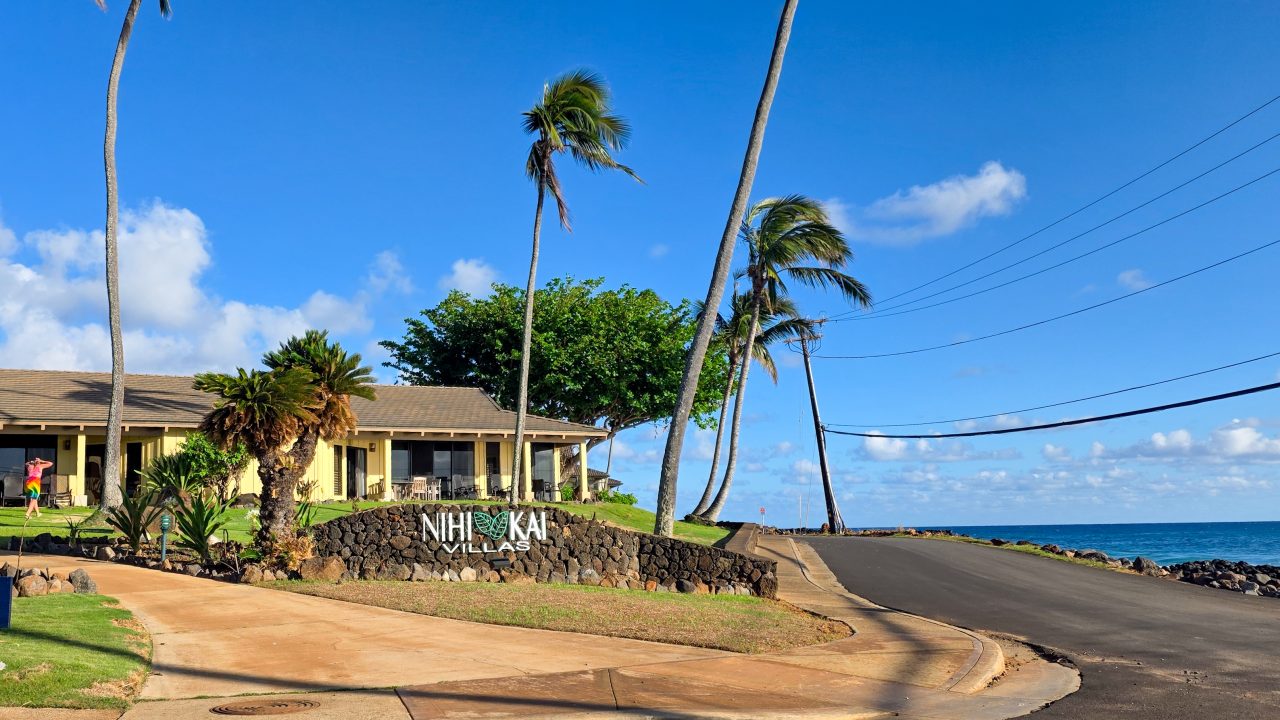
When we heard that Nihi Kai Villas in Poipu was at the center of a Legionnaires’ disease investigation, it hit close to home. Jeff (your Beat of Hawaii editor) once owned and lived at this Kauai condominium resort, and we were there again last month. Now two visitors who stayed there recently have been diagnosed with a serious form of pneumonia, and testing has detected Legionella bacteria in the property’s water systems.
The Hawaii Department of Health announced the investigation on November 4, warning of a potential ongoing exposure risk to guests and residents. The precise source of the infections remains under investigation. The department has not publicly identified which parts of Nihi Kai Villas are affected or what corrective work has taken place.
We knew Nihi Kai Villas long before this investigation.
Jeff owned a condo at Nihi Kai Villas after Hurricane Iniki struck Kauai in the 1990s. The property was part of his life for years. We recalled that history in our 30th anniversary remembrance of Hurricane Iniki, including Rob’s memories of arriving on Kauai about a month after the hurricane and seeing the extraordinary destruction.
Living at the Kauai resort there also meant dealing with things vacationers rarely had to think about. Around 2000, Jeff recalls a substantial special assessment for a required new septic system. Condo owners suddenly had to cough up a lot of money for major infrastructure work beyond their regular maintenance fees. It’s one of the experiences that has stayed with him from those years of ownership.
We also found documentation of later improvements. In 2021, Shioi Construction completed a $4.8 million exterior renovation involving roofing, stairs, railings, and other building work. The following year, the Kauai Planning Commission approved permits to replace and upgrade the property’s wastewater treatment facility, with the Association of Apartment Owners of Nihi Kai Villas identified as the applicant.
These projects involved exteriors and wastewater infrastructure, issues separate from the building water systems implicated in the current Legionella investigation. They document substantial investments in the property over the years but don’t establish the condition of its water distribution systems today.
Our most recent visit was in October, when we went through Nihi Kai Villas while preparing our report on the striking differences in hurricane recovery around Poipu. We were looking at properties damaged by Hurricane Lowell, some severely, while others appeared largely untouched. Nihi Kai Villas looked normal from the outside, without the extensive visible damage we saw elsewhere on Kauai’s south shore.
That observation concerned exterior storm damage, not plumbing. No established connection exists between Hurricane Lowell and the Legionella findings.
What the investigation has found so far.
DOH confirmed two cases of Legionnaires’ disease involving visitors from outside Hawaii who stayed at Nihi Kai Villas. On October 13, the department received water-testing results from the property showing Legionella bacteria in its water systems.
Legionnaires’ disease is a potentially serious form of pneumonia which can be contracted through inhaling contaminated water droplets. Showerheads, faucets, hot tubs, and larger plumbing systems are among the places where the bacteria can grow. The findings indicate a potential exposure hazard at Nihi Kai Villas, although investigators haven’t established exactly where either visitor became infected.
According to Hawaii’s official condominium registration, Nihi Kai Villas consists of eight two-story buildings containing 70 individually owned units. The complex dates to the late 1970s and occupies nearly six acres near Brennecke Beach.
Because the property spans multiple buildings, the locations of the positive water samples could be especially relevant. DOH hasn’t identified which buildings, units, or water fixtures tested positive, and we don’t know yet whether the bacteria were found in isolated locations or in shared portions of the water systems.
The department says it is working with Nihi Kai Villas to address the potential health risk. Its announcement doesn’t specify what remediation has already been completed, whether follow-up water testing has occurred, or whether any units or facilities may be restricted.
The three weeks between testing and the public warning.
DOH received the positive water-testing results on October 13, while the public announcement came November 4, 22 days later. The announcement doesn’t explain when property management or the AOAO first learned of the findings, what work began afterward, or when it notified guests and owners.
We don’t know whether notifications or corrective actions were already underway during those three weeks. The date DOH received the results also doesn’t establish when the samples were collected or when the property first learned of the positive findings.
Nihi Kai Villas is a typical condominium development, not a conventional hotel under single ownership. Individual owners have their own units, while the AOAO association provides the structure for managing shared property and common responsibilities. That arrangement does not reveal how the response is being coordinated and how information about the investigation is reaching residents, owners, and visitors.
The review period is also much longer. DOH wants to hear from people who developed pneumonia within two weeks after staying at Nihi Kai Villas at any time since January 2025, and has notified public health agencies nationwide to request reports of any additional cases involving Hawaii travelers.
Because visitors may develop symptoms after returning home, it can take time to identify potential connections between illnesses and a particular accommodation. The January 2025 date doesn’t establish that Legionella has been present continuously since then or that additional illnesses occurred throughout that period.
Could the property face restrictions or closure?
Kauai has faced a similar investigation before. In June 2016, two confirmed Legionnaires’ disease cases were associated with stays at WorldMark Kapaa Shore Resort, where bacteria were detected in two units. Wyndham temporarily closed that property and relocated guests while remediation was done. We subsequently discussed that investigation in our coverage of Legionnaires’ cases at the Grand Islander in Waikiki.
There is no indication of what Nihi Kai Villas will face in terms of remediation. Depending on the circumstances, responses to Legionella contamination can include restrictions on particular water fixtures, individual units, or buildings while remediation and testing are performed.
If we had a reservation at Nihi Kai Villas, we’d want specific information before deciding what to do. Has Legionella been detected in the building where we’ll be staying? What corrective work has been completed, are follow-up test results available, and has DOH specifically recommended any precautions or restrictions? Those are reasonable questions, especially since public information leaves the property’s current conditions uncertain.
What former Nihi Kai Villas guests need to know.
DOH is advising anyone who stayed at Nihi Kai Villas within the previous two weeks and develops symptoms consistent with Legionnaires’ disease to seek medical attention and contact its Disease Outbreak Control Division. Anyone who developed pneumonia within two weeks of staying there since January 2025 should also contact the department.
Symptoms commonly appear two to 14 days after exposure and can include fever, coughing, shortness of breath, headaches, and muscle aches. People aged 50 and older, current or former smokers, and those with weakened immune systems or certain chronic illnesses face greater risks. Legionnaires’ disease doesn’t generally spread from person to person, and DOH says the risk to the general public is low.
The disease is treatable with antibiotics. Anyone seeking care after a recent stay should tell their doctor about the potential exposure. You can reach the Hawaii Department of Health Disease Outbreak Control Division at 808-586-4586.
By Rob and Jeff, Beat of Hawaii.
Some of Hawaii’s most meaningful parts are the ones visitors walk right past without knowing they are there. We’ve spent nearly 20 years finding them firsthand for BOH as full-time Hawaii residents reporting on travel, culture, and island life, and telling you what they mean for your trip. Join us →
Get Breaking Hawaii Travel News