

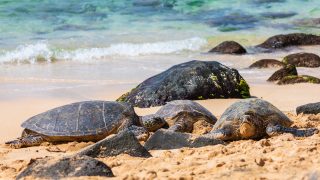
On Kauai’s south shore, one of Hawaii’s most extraordinary wildlife spectacles happens nightly. As the sun sets, endangered Hawaiian green sea turtles, or honu, emerge from the surf to rest on the sand at Poipu Beach. It should be a moment of reverence.
Too often, though, it turns into people crowding the shoreline and pushing past cones and volunteers to get as close as possible. We were there again this past weekend and saw it firsthand. While some visitors stayed respectfully behind the barriers, others ignored repeated warnings.
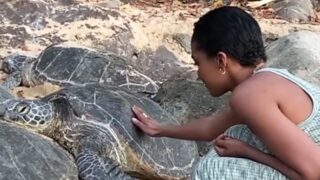
This is not unusual. According to prior reports, people have aimed cell phone lights into the turtles’ eyes as they came ashore, or crowded so tightly at the waterline that the turtles had to maneuver around them.
The scene has left residents, visitors, and conservation volunteers increasingly frustrated and has sparked debate over whether Hawaii must take stronger steps to protect these animals.
The most troubling behavior plays out offshore.
That’s beyond the reach of cones and ropes. We watched people line up waist-deep in the water, creating a human barrier that blocked turtles from reaching the beach.
A few even swam directly at the honu, desperate for a close-up photo. It was both uncomfortable and embarrassing to witness, leaving no doubt that the turtles were being stressed at the very moment they came ashore to rest.
Volunteers work each evening at Poipu to protect honu.
They set up cones and rope lines, post signs, and patiently explain the rules to visitors. Yet their efforts are too often drowned out by the crowd.
We watched as volunteers asked people to step back, only to be ignored. A few people tried to play enforcer themselves, warning others of fines or claiming DLNR had already been called.
Sometimes that startled people into retreating, but it highlighted the larger problem. Hawaii is leaning on goodwill and volunteers when what is really needed is consistent, visible enforcement.

The law is clear, fines are possible, but.
Both federal and state law prohibit harassing or interfering with honu. Penalties can reach $10,000 for a single violation. In practice, however, those fines are rarely imposed on visitors.
That absence of enforcement has bred cynicism. One local said to us at the beach, “If they were really serious about stopping this, the government would not only issue fines but post the photos of violators in the airport arrivals area.”
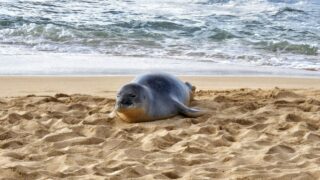
The comparison to California is telling. There, beaches are closed to protect seals and sea lions, and violators face fines immediately. In Hawaii, by contrast, some visitors see cones and volunteers instead of officers, and many test how far they can go.
Honu in Hawaiian culture.
For Hawaiians, honu are far more than wildlife. They are revered as symbols of wisdom, endurance, and good fortune, appearing in petroglyphs, chants, and stories that reach back centuries.
In tradition, they are seen as guardians of the sea, protectors that link land and ocean. Watching one emerge from the surf should call for quiet respect, not a scramble for selfies.
That is why what happens at Poipu stings so deeply. The disturbance is not only harmful to the turtles themselves but also dismissive of the cultural values that continue to shape Hawaii.
Should Poipu Beach be closed at times?
More residents are asking whether cones and volunteers are enough. Some believe the solution is a temporary evening closure of both sand and nearshore water during the hours when turtles come ashore to rest.
Others say the answer lies in lifeguards or DLNR officers being stationed there in person, ready to issue tickets on the spot.
If behavior does not improve, closures may become inevitable. Similar measures have already been taken in California, where beaches were restricted to protect seals once harassment became chronic.
Hawaii’s Department of Land and Natural Resources has not announced any plans for Poipu. However, unless behavior changes, the pressure to impose restrictions will only increase.
What everyone can do.
The rules are not complicated. Stay at least ten feet from turtles, whether they are on land or in the water. Do not block their path, shine lights in their eyes, or surround them. It really is that simple.
If you want to help beyond that, there are support groups like Mālama i nā honu. Their volunteers are the ones out there every night with cones, signs, and patience, trying to protect the honu from the worst of us. Donations and encouragement keep that effort alive.
Most of all, visitors can lead by example. Step back, give the turtles room, and let others see what respect looks like. And if you do run into people who will not listen, the better course of action is to alert a lifeguard or DLNR rather than taking it on yourself.
Should Poipu Beach be closed at times?
We have watched this ritual at Poipu often enough to recognize the pattern. Many people stand back and show respect, but some do not, and the scene usually turns ugly. The honu deserve better. Hawaii has laws meant to protect them, yet until enforcement catches up with reality, volunteers and signs will continue to be outmatched.
These turtles have returned to Poipu for generations. Whether they continue to feel safe here will depend on whether Hawaii is willing to draw a line, even if that means issuing fines, closing access in the evenings, or taking other harsh measures.
What do you think? Should Poipu Beach be temporarily closed in the evening to protect the honu?
Photo Credit: Beat of Hawaii.
Get Breaking Hawaii Travel News



Yes, close Poipu. Especially at night. The caution tape should be widened because people are still approaching too closely. I was angered at the people going under the caution tape.