
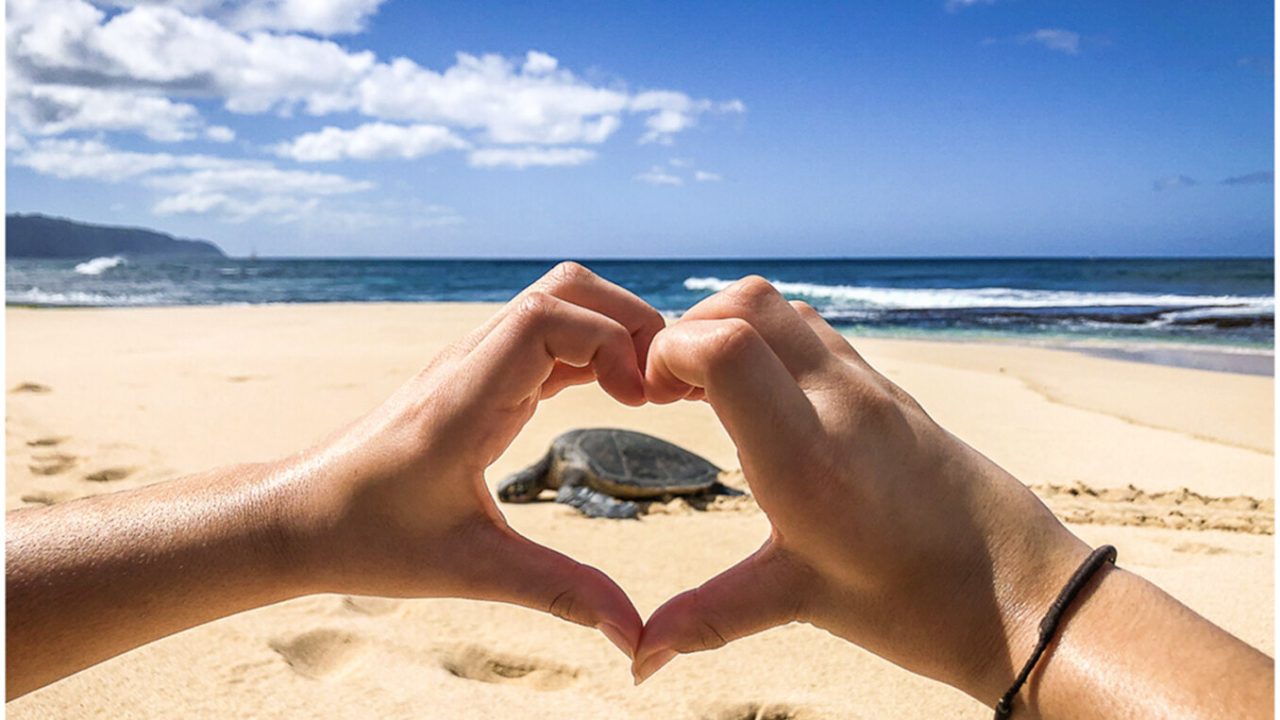
We had just written about Baby Beach and Poipu Beach when a reader pointed us to a research paper she published in Social Media Quarterly back in 2023. It complicated the whole story. The paper looked at a problem almost every Hawaii visitor recognizes, even if they have never thought of it quite this way: a turtle is resting on the beach, people want a photo, signs tell them to stay back, and somebody still ends up getting closer than they should.
The paper, “Encouraging Respectful Wildlife Viewing Among Tourists: Roles for Social Marketing, Regulatory Information, Symbolic Barriers, and Enforcement,” was funded by NOAA and led by Colorado State associate professor Katie Abrams and Amanda Molder. The surprise was which warning sign helped most. The approach that changed visitor behavior had nothing to do with fear, penalties, or a longer list of rules. It suggested to visitors a better photo to take, one that only worked if they stayed farther away.
The beach looked too familiar.
The study took place at Alii Beach on Oahu, about two miles south of Laniakea. That detail is the point, because Alii was not picked as a famous, tightly managed turtle-viewing site. It was chosen because turtles and people were already coexisting there, but the beach lacked the kind of nonprofit management found at some of Hawaii’s better-known turtle resting locations.
The situation sounds a lot like the beaches we walk on at Kauai’s south shore. At Baby Beach, a turtle can blend into the shoreline and rocks so completely that visitors may not realize what they are seeing until they are already far too close. Ten minutes away at Poipu Beach, ropes, signs, and volunteers often change the encounter before anyone has to guess.
The study tested the same gap between rule and reality. What happens when visitors encounter a turtle on the sand, and the only thing standing between the animal and the photo is a message? What happens when the message is moved to where people can see it and gives them something useful they can do?
The first fix was visibility.
One part of the study compared a regulatory sign posted at beach entrances with that same kind of sign moved down near the turtles. That shift may seem small, but it produced a major change in compliance because a rule people do not see when they need it is barely a rule at all.
The placement finding does real work on its own. The study did not show that rules are useless. It showed that rules work much better when visitors encounter them in the place where decisions are actually being made in real time, not back at an entrance where most people are carrying beach bags, looking for family members, or heading toward the water, not even giving thought to Hawaii wildlife.
The same lesson applies to many beaches in Hawaii. A visitor may walk past a sign near a parking area and never later connect it to the dark shape resting along the shoreline. By then, the turtle is not some abstract protected species. It is the thing everyone wants to photograph.
Then the photo changed the rule.
The bigger shift came when the standard warning was replaced by the Amazing From Afar message. Instead of simply telling people to stay back, the sign showed them how to take a forced-perspective photo that still reads as a great shot from at least ten feet back.
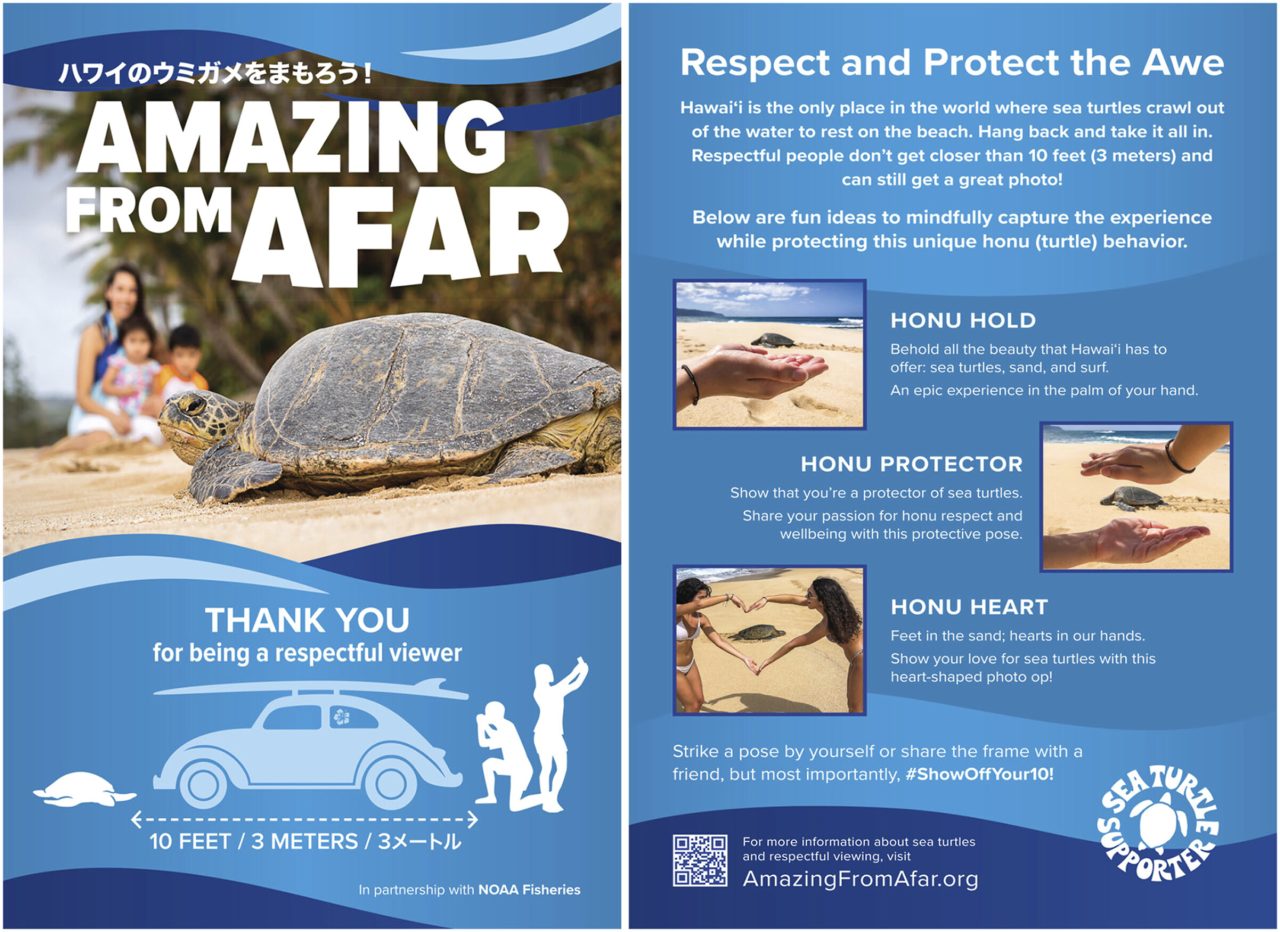
Think of a classic tourist photo where someone appears to hold up the Tower of Pisa. The person is nowhere near the building, but the camera angle creates that illusion. In the turtle version, the visitor still gets a memorable photo while the turtle keeps the space it needs.
Swapping the standard sign for the Amazing From Afar message lifted compliance by about sixteen points head-to-head, on top of the larger jump that came simply from moving any sign down near the turtles. The clear lesson is not that rules failed. It is that rules worked better when paired with a visitor action that made sense in a critical moment.
The sign did not fight the impulse. It redirected it. Visitors still wanted a photo, a memory, proof that they saw something special, and a way to share it later. The safer behavior became part of the photo rather than a barrier to it.
The wall did not solve it.
The study also tested a rock wall, which is the part most people get wrong. A physical barrier sounds like the obvious answer. Put something between people and turtles, and the problem should shrink, right?.
When turtles rested close to the wall, the wall could draw visitors into the wrong place. In that condition, about a quarter of people came within three to six feet of the turtles, and the researchers’ field notes mostly attributed this to the turtles resting near the wall.
Barriers are not necessarily bad. The study showed that compliance improved dramatically when better messaging was added, and cones with active lifeguard enforcement helped to push compliance even higher. The lesson is both more specific and useful: a barrier alone can create a false sense of protection if the animal does not cooperate with the plan.
Turtles do not come ashore where a sign designer or county planner would like. They rest where they rest, and the human system has to work around that reality. A rock wall may look like protection from a distance, but the beach does not always work the way the plan expects.
Rules alone can miss the visitor.
Hawaii has spent years trying to teach visitors what not to do around protected wildlife. Do not touch turtles. Do not feed them. Do not chase them. Do not crowd them for a photo. Those instructions are necessary, and nobody serious about wildlife protection would argue otherwise.
Rules alone can miss the human element on the beach. A visitor sees a turtle, pulls out a phone, and starts thinking about the picture before thinking about the distance. The better intervention occurs at the moment before the person proceeds.
The photo idea gets practical here for one simple reason. It assumes most visitors want the photo, not a confrontation, and works directly in that space. The study reads as practical rather than another warning campaign for the same purpose. A better photo idea may in fact reach the people who were about to step closer without thinking.
What Kauai beaches still lack.
At Poipu Beach, visitors often get a script before they make the mistake. Ropes show where to stand, signs explain why that’s the case, and volunteers may be there to answer questions before they ever become a confrontation. The turtle encounter is not perfect, but it does have structure.
At Baby Beach, the human-wildlife encounter can happen totally unscripted. A turtle may look like a rock, a visitor may move closer, and the only person noticing may be another beachgoer wondering whether to speak up. That was the question in our earlier turtle story, and this study does not change that.
The study offers a more hopeful answer than mere enforcement. If visitors can be shown a better way to get what they came for, some will take that opportunity. It suggests a different kind of protection rather than a warning sign, and it may be more practical for beaches that will never have daily volunteers or formal viewing.
The practical question for Hawaii is simple. Could beaches with regular turtle encounters use visible signs to show visitors how to take the best photo at the right distance? Could the message be placed where the encounter happens, not only where the parking lot begins? It’s an interesting idea.
The turtle still comes first.
None of this changes the basics. NOAA Fisheries recommends staying at least 10 feet from sea turtles, and touching, feeding, chasing, surrounding, or harassing them is prohibited. The photo idea is not a loophole around this. It is a way to help more people follow it.
Hawaii does not need gimmicks that turn turtles into props. It needs tools that work in the real places where turtles and visitors already meet. A good message should protect the animal first and help visitors understand how to enjoy the encounter without changing it.
For Hawaii beaches, this may be a missing piece between doing nothing and trying to police every shoreline. Most turtle encounters never have a volunteer standing nearby or a rope cordoning people off. A sign that gives visitors the right photo from the right distance won’t solve everything, but it might just stop some of the most common mistakes before they happen.
The next time a visitor sees a honu resting on the sand, the safest outcome is not a stern lecture after they get too close. It could just be a better choice before they do.
Photo Credits: Katie Abrams and Amanda Molder, Social Media Quarterly, Volume 29, Issue 1.
Get Breaking Hawaii Travel News




Did this person who did this aware of the place your thumb straight up until it covers the view of the turtle and that reflects 50 feet. If you use this tactic this individual is way closer than 50 feet. IMO looks more like 30 feet to me. Nice thought but isn’t one to give turtles a minimum of 50 feet separation?
While most people rely on their phones carrying a real camera with a long zoom can overcome distance enforcement rules.
I live on BI and think this sign should be posted at All Hawaii beaches & even airports. Do you have any idea who to contact to possibly get this sign posted?? My state reps? Mahalo!
Question………… the signage suggested says 10 feet or approx 3 meters. I might be wrong but I believe the signs at Poipu at least, have always stated a much bigger distance than that, right?
Clever ideas for how to take photos but I’m not sure that will mean anything to people about distance when it’s a beach with no ropes or volunteers.
We were in Poipu in March and can attest that the signage close to the turtle (and a seal) was more effective than had it been at the parking lot. The volunteer who placed the signs also made a driftwood “fence” which also helped. She said that these two come to that spot almost daily which might make it easier for a volunteer to help protect the animals. I don’t remember anything on the sign that said stay 10 feet from the animals. That may be common sense to some, but to others, it is probably a great reminder.
Thanks for your newsletter!
Common Sense just isn’t as Common as most would wish it were. Leaving wild animals alone … seems like Common Sense. But, there are those that have never experienced the beauty and wild of nature and have no clue. Such as getting up and close to a wild Bison. SMH
A positive reinforcement like the “Amazing from Afar” sign is awesome. Whatever it takes.
It is amazing that the human mind just can’t handle “No” and “Don’t” as well.
When I first came to Kauai I was oblivious. The turtles and seals were something to get close to, to touch and enjoy the experience.
It dawned on me that “would I want people on Kauai coming close and touching me for the experience of touching a visitor”. I, at least, have a voice and can ask for space.