
A turtle at Kauai’s Baby Beach can look like nothing more than a rock until you’re already too close. Five minutes away at Poipu Beach, ropes, signs, and volunteers turn a massive version of the same kind of encounter into something far more orderly. These two beaches are minutes apart, and the difference between them shows some of what’s happening with Hawaii’s turtle problem.
BOH headquarters is just fifteen minutes from both beaches on Kauai’s south shore, and the difference isn’t subtle. At Poipu Beach, many visitors arriving to see turtles receive a clear signal that the protected animals are resting there and that everyone needs to stay back.
At Baby Beach, there is no volunteer to rope off the area, and no obvious warning that the dark shape near the waterline is not a rock after all. Recently, however, a sign has been installed at the beach entrance about protecting the turtles.

A turtle that can look just like a rock.
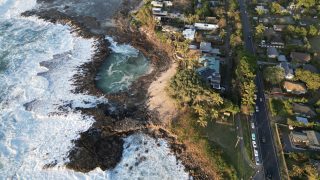
Baby Beach is small, residential, and familiar to people who spend time around Poipu. It is not a turtle-viewing site. People arrive to walk, sit on the beach, or bring children into the shallow water. They are likely not arriving with turtle rules in mind.
Rob has said more than once that a turtle often looks exactly like a rock from even a short distance. This is because a turtle often rests near a rock, making it easy for people to get too close. It is the kind of accidental encounter that can happen when a protected animal blends into the shoreline, and there is nothing around to tell people what they are seeing. Editor Jeff has had a turtle swim directly into him at Hanalei Bay. There was no time to even get out of its way.
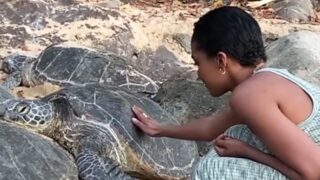
That chance encounter is just one version of what happens. We have also seen visitors who knew just what they were looking at and still moved closer. Maybe they wanted a better photo. We’ve seen one person actually sit on a resting turtle there, perhaps knowing what they were doing. Maybe they thought it was a rock. Maybe they did not know the rule, or maybe they knew and decided the Instagram moment was worth it.
That is when the beach changes. One minute you are walking along the shoreline or sitting on the beach, and the next you are watching someone cross a line around a protected animal with no volunteer, no lifeguard, no rope, and no one to help.
Yet five minutes away, everything changes.
Poipu Beach often feels like an entirely different turtle world. When many turtles come onto the beach there, ropes may go up, signs may be visible, and volunteers are frequently present both to keep people back and to answer questions. The beach is very busy, but the expectations are easier to manage before anyone makes a mistake.
The same federal protection applies at both beaches. NOAA Fisheries recommends staying at least 10 feet (3 meters) from sea turtles, and actions such as touching, feeding, chasing, surrounding, or harassing them are prohibited. Those rules do not change because some beaches have ropes and others do not.
Visitor behavior, however, changes anyway. At Poipu, people usually understand that the rope is there for a reason. They stop, take photos from behind the line, often with flash at night, and otherwise generally let the turtles rest. Some visitors may still push the boundary, but it’s visible enough that everyone nearby can see what’s happening.
That is not because Poipu gets better visitors than Baby Beach. It is because Poipu gives visitors a clear understanding. Baby Beach does not.
Hawaii turtle beaches don’t come with instructions.
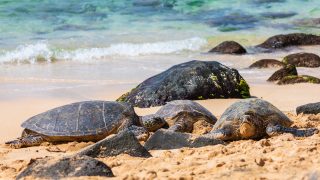
The managed turtle encounter is what many visitors recognize from famous beaches. Turtles are resting on the sand, a rope is in place, people gather at a respectful distance, and someone nearby may be able to explain more. That can still become crowded and tense, but at least visitors are not left guessing.
Most beaches in Hawaii are not like that. Turtles come up to small coves and beaches, stretches of shoreline near hotels, and places where nobody has prepared visitors for what they might see. Baby Beach is not the odd case. It may be closer to the normal case than the beaches that get most of the attention.
Telling visitors not to touch turtles is sometimes necessary, but it does not address the more difficult situation many people actually face. What do you do when someone else is too close, and there is nobody official around?
The famous beaches still draw the biggest crowds.
The Hawaii turtle viewing that reaches the news is usually the most organized one. At Laniakea Beach on Oahu’s North Shore, honu have basked on the sand for more decades, and volunteers known as Honu Guardians, with the nonprofit Malama na Honu, work the beach daily to keep visitors back and help explain the rules and answer questions.
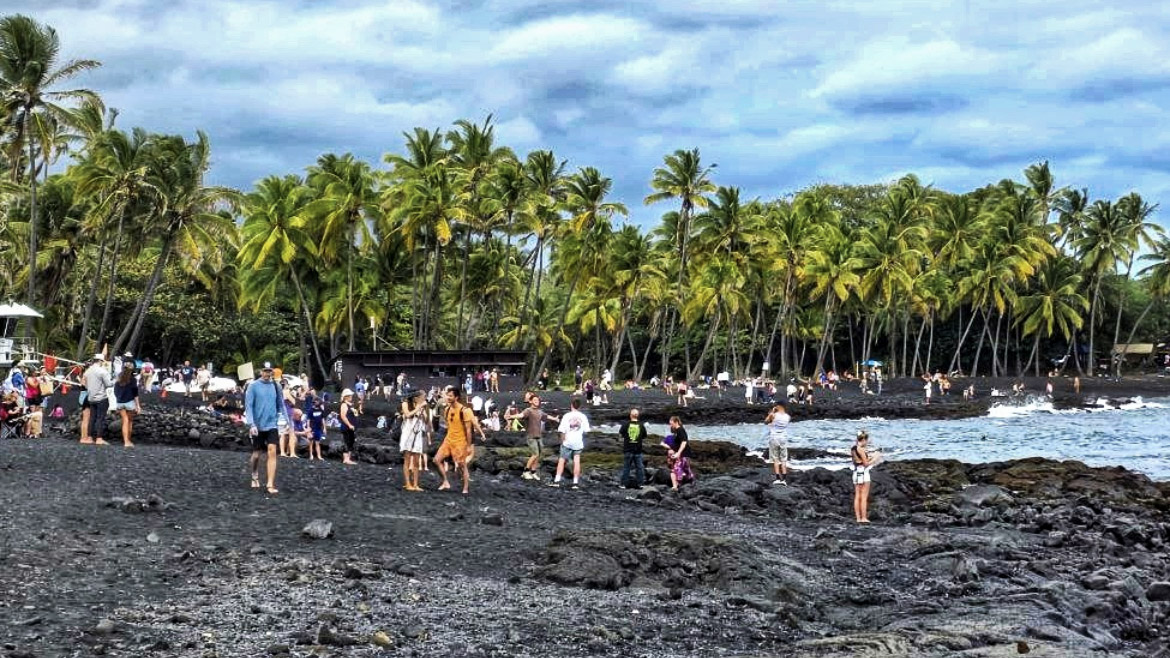
They are not there to act as turtle police, and they cannot write a ticket. What they offer is the one thing Baby Beach does not: a person standing between an unaware visitor and a resting turtle before anything goes awry. Punaluu on the Big Island (featured image) draws a steady flow of people to its black sand, where honu come ashore.
Those are the beaches with names visitors recognize, and they are the ones set up, however imperfectly, to handle the attention they get. They are also the beaches most likely to be photographed, discussed, and used as examples of what turtle viewing in Hawaii looks like.
The beaches we walk on the south shore of Kauai are not on that list, and neither are most of the places where turtles actually haul out. The famous beaches get the volunteers and the attention. The ordinary ones get the same animals and none of the help.
That ordinary version is the one many visitors are more likely to meet. A turtle is there, the beach is otherwise normal, and nobody has told anyone what to do before the encounter happens.
The question nobody really answers.
Most articles explain what visitors should not do around turtles. Do not touch, feed, or chase them. Do not crowd them for your photo. Those rules are important, and most visitors don’t need to be told twice once they understand the situation.
The harder situation is one we keep running into. You are on a beach with no volunteer, no lifeguard, and no sign, and someone nearby is too close to a resting honu. The person may be careless, confused, excited, fully aware, or entirely not of the line they are crossing.
There is no single right answer. The best move depends on the beach, the people involved, your own safety, and how comfortable you feel speaking up to a stranger.
That uncertainty is part of why the problem keeps going. The turtle needs space, the rules exist, and the person watching may still not know what to do next.
Six honest options, none of them simple.
You can approach the person directly and say something. It sometimes works, especially when the person simply does not know the rule and is open to hearing it. A calm reminder that turtles need space may be enough and may prevent a mistake from turning into something else.
It can also go badly. Beaches are public places, people do not always react well to being corrected, and nobody wants a wildlife encounter to turn into an argument with a stranger. That is especially true when the person already appears to know what they are doing and keeps moving closer nonetheless.
You can call NOAA. In Hawaii, the number often cited for protected marine wildlife concerns is the NOAA Marine Wildlife Hotline at 888-256-9840. A report helps build the record, though it can almost never stop what is happening in real time.
You can take photos or video for evidence. That only does something if you are willing to follow through and submit it, and many people don’t. It can also feel strange, because the moment becomes less about protecting the turtle and more about documenting another person in an awkward moment.
You can look for a lifeguard. On many of the beaches where turtles rest, there is not a single one nearby. Baby Beach is one of those places where the absence of any official presence is part of the problem.
You can educate gently if you feel safe doing it, sharing the 10-foot distance as information rather than accusation. Many visitors simply did not know. You can also walk away, which feels wrong to many people yet remains the realistic choice in many situations.
Most visitors are not trying to do harm.
The tone around turtle encounters can turn harsh quickly, and some of that frustration is understandable. Hawaii has seen enough wildlife harassment that nobody should pretend this is imaginary. Turtles, monk seals, and other protected animals have all been part of incidents that leave residents angry and visitors embarrassed.
We have written before about the monk seal struck with a rock off Lahaina and the public reaction that followed. Wildlife harassment in Hawaii is a well-documented, recurring problem. But that case was extreme and obvious. Most of what happens at beaches like Baby Beach is far more ordinary, including a few steps too close, a phone held too near for a better shot, or a child wandering toward an odd shape in the sand.
The dramatic cases get attention, and people sometimes get charged. The everyday ones happen constantly, at beaches nobody is watching, with nobody sure what they are supposed to do.
Still, most visitors are not arriving at the beach hoping to break any federal law. Many do not know the recommended distance, do not recognize a turtle at first, or assume that if something were prohibited, there would be a sign, rope, or person nearby saying so.
Baby Beach and Poipu tell the story together.
Poipu Beach shows what happens when a turtle encounter has a set structure. Baby Beach shows what happens when the animal and the people involved are left to sort it out for themselves in real time. Both beaches are beautiful, close together, and part of the same visitor landscape on Kauai’s south shore.
This is not simply another story about bad beach behavior. It is about how differently people act when the rules are visible, and how uncertain the moment can be when they are not. Hawaii asks visitors to help protect wildlife in settings that often look completely informal and may have no warning at all.
Those who deliberately crowd, touch, chase, or pose too close to turtles deserve to be called out. The bigger challenge is helping everyone else understand the rules before the mistake happens.
So now we’ll turn it over to you. Have you been to a beach in Hawaii where you saw a turtle and weren’t sure what to do? Have you watched someone cross the line when no one was around to step in? Tell us what you did, what you wish you had done, or what you would suggest to others.
Photo Credits: © Beat of Hawaii.
Get Breaking Hawaii Travel News


We return to Poipu regularly and love the turtles. A couple of times we have subbed for volunteer guardians and informally manned the barricade to keep mostly unknowing visitors at bay. 99% of the time gentle but clear contact with those who venture too close is responded to well, and we notice that the word please really helps, as in, “stay outside the perimeter markers please and use your zoom.” Acting a little officially goes a long way.
Any idiot can see that there are turtles and seals, especially after all the tourist marketing they have seen before even arriving in Hawaii. Swimming with dolphins didn’t stop until people got arrested, so arrest these tourists and incarcerate them if they are doing egregious things like sitting on top of turtles or throwing rocks at seals. Short of that, don’t let tourists go to the beach!
I think hotels and property owners could print basic rules for approaching all wildlife and provide it with the check-in package and post in the unit itself. I also think airlines, who make plenty of announcements regarding bringing produce in, credit card offers, etc., could make a short announcement regarding rules of engagement with wildlife. The more visitors hear it and see it, the more they’ll realize it is a serious matter. Waiting for locals to enforce seems too little, too late and as you stated, they can’t be everywhere.
We have no evidence that this is effective. Plenty of National Parks do exactly this at their entrances and visitors throw the information in the trash can (hopefully) and proceed to harass wildlife.
I am one of those volunteers at Laniakea Beach. When I see any issue w/ any animal, I very politely explain the rules, why we have those rules, & either ask if the person has any questions (I’m smart on turtles but limited on other animals) or ask where they are visiting from. Why? No one likes to embarrassed & moving the conversation beyond correcting and into something helpful or fun quickly removes the embarrassment & confrontation.
There is no 10-foot “rule” of law or regulation as a minimum distance to stay back from a sea turtle- whether on the beach or in the water. Nor 6 feet, nor 50 feet nor anything and everything in between, as can be found on the array of turtle signage on all the Hawaiian Islands. People, including well-intended government folks, have made-up manufactured these distances often presenting them as legally enforceable under penalty of law. They are not. The key word enforceable under the US Endangered Species Act is “take”. Please google the definition of take. Please also note that the abundance of signage- stay back, don’t disturb, don’t feed, don’t touch, etc. etc, serves to ‘tell tourists’ and others exactly where they can go to see turtles. The signs tell them, the signs lead the way.
I mean this with all due respect, but Hawai’i is Far from the only place in the US constantly dealing with tourists interacting with wildlife in negative ways. There’s an odd navel gazing quality to some of the reporting and comments on this subject. Hawai’i does not exist in a vacuum with totally unique issues.
Yearly in and around Yellowstone tourists harass bison, elk and a variety of protected wildlife. Injuries and death occur. Flyers and information regarding wildlife safety and required distances are handed to every visitor at the park entrance.
A video on a plane that someone will ignore is not going to fix it. You cannot run interference on every visitor unfortunately. There are no easy fixes here.
The turtles are fine and thriving been coming to the islands since 1973 never have I witnessed as much respect for turtles than now.
There’s always going to be bad players, but to expect 100 compliance is a pipe dream.
I regularly snorkel Wailea Beach turtles routinely swim into an area that I am just floating in and enjoying the marine life. Everything is chill I don’t cause them any stress they don’t seem stressed by my presence.
The locals are much harder on both turtles and monk seals than anything tourists are responsible for.
The small section of the beach across the street from us has 3-4 Honu that cruise back and forth all day. If I see them out for a lap I try and let the people around me in the water know to look for them and leave them alone. The turtles are used to people in the water and commonly swim up when you’re not looking and touch your leg or arm. Holding still and letting them swim away seems to be the best answer.
On Poipu Beach Honu Guardians are also with Malama ( i ) na Honu and work the beach each evening until late into the evening. The pillars of this non-profit organization are “To Protect the Hawaiian Sea Turtles through Education, Public Awareness, and Conservation”. Some Honu may haul out onto Poipu Beach during the day to bask in the sun but the majority of Honu
Haul out at night to rest. This is different from Laniakea Beach on Oahu where Honu haul out during the day and return to the ocean around sunset. Volunteers on Poipu do not use ropes to create perimeters for Honu, but use “A” frame placard signs and orange cones and are responsible to protect, educate visitors and take data for research purposes. The 10-foot rule is a minimum, and volunteers are trained to read beach conditions and set a perimeter that will accommodate the resting honu. Visitors should follow volunteer instructions and not use white flashlights or flash photography after dark.
Brah, you can blame Instagram or whatever platform people are using these days to document their vacations. You shouldn’t even need a rope. It should come down to common decency but sadly that’s hard to come by. It’s ridiculous to watch those idiots push their way to the front to get the “perfect shot” for their stupid vlog or whatever.
Older visitors mostly just look from afar, because they know better and we’re raised better in a different world than how we now live. The younger ones make a mess of it and treat their experience as the only important thing in the world and everyone and everything else be damned.
It’s sad to have to watch it as a resident. Locals just shake their heads. No talking to these people.
While in Kauai I like to snorkel at Lawai Beach, by the Beach House Restaurant. I go early in the morning. Several times I’ve had a turtle come out from a rock right underneath me. The first time it happened I panicked and thrashed around trying to move away. The better choice seems to to stay still and let them move away; and not follow.
My roughneck “local local” neighbors catch and eat turtles. (Other local families won’t go to parties at their place for that reason.)The problems are both ends of the spectrum and in the middle – people determined to do what they want in their homeland including eating turtles, residents determined to protect turtles including doing their own version of education to those they deem to be violating the turtles’ space, and tourists who want to be near the turtles.
Why oh why is there not a video on the arriving planes that everyone must watch who flies into the state? We’re the only state you cannot drive in so visitors are a captive audience. People arrive in our islands blissfully ignorant of wildlife rules and the reasons for them. There was talk of videos during COVID on the planes. Why can’t a video be shown educating out visitors to our unique ecology due to the fact we are the most isolated archipelago in the world?
on a resort beach on Hawaii (BI , is it ok to still refer to Hawaii that way??), often turtles swim just off the beach and i have witnessed groups of people surrounding the poor turtle. I calmly tell the crowd to leave an open path for the turtle and end with ” watch your toes and fingers as turtles think they are a snack” and that sometimes gives greater space for the turtle…. the resort has hono rules and warning signs at every spot where you can enter the beach area but i guess most ignore or dont pay attention… my family has to get me too cool off as bothering the turtles upsets me greatly. Maybe DLNR should make a video that every airline has to show prior to landing reminding them abouts the do’s and don’ts of Hawaii animals and how to spread Aloha!
I mention that they have claws that can give a nasty scratch and that they may not want to take home an infected scar as a souvenir. That usually gets the turtle a little space.
We often visit Ho’okipa beach to view from above the many turtles that rest there. It’s usually signed and roped off below. On a recent visit a couple was down amongst the turtles getting very close to take pictures. I brought this to the lifeguard’s attention. He sternly told me that wasn’t his job to protect the turtles. So I don’t think nearby lifeguards are a resource for this situation.
The lifeguards are there to protect the swimmers. They cannot take their eyes off the ocean. If there was a tragedy, they would be the first ones to get the blame. Also, making the city/county open for liability claims.
Again, isn’t this the kind of thing that should be addressed by a “Green Tax” by at least putting up more signs, ropes, etc.?
My thought exactly, although even so it wouldn’t do that much good, given all the idiotic instagram/posters in our society these days…. 🙂
Sometimes the turtle sneaks up on you. I was snorkeling at Tunnel Beach and one came up behind me. I turned around and it was only a few feet away. I don’t think I was bothering it, and gave it some distance.
On our last trip to Maui this past January, we were at our favorite spot at Kapalua Bay Beach. As is the case for every visit, a turtle came up to the beach rest. A few people immediately went over to take pictures, and those who got too close were politely told by the concession staff to move back over the P. A. After the initial excitement died down and people left the area, a lady came strolling down the beach. As she approached the turtle, people, including us, started trying to get her attention (she was totally “zoned out”). Even the guys on the P. A. couldn’t get her attention. Eventually, everyone in the immediate area started yelling loudly that she was about to step on the turtle. She finally came out of her “coma” and saw the turtle literally 2 feet from her.