Read our comments long enough, and the question answers itself. Hawaii residents tell us exactly what gets to them about living here, and the first answers come fast and practical. Restrooms locked or missing a door, sidewalks that stop where the danger starts, parking lots full by midmorning, lookouts so overrun people stand in the road for the photo.
Underneath the practical gripes, though, the answers turned and got heavier, and they were strikingly consistent. Most of them pointed straight back at the visitor reading this. Not as the villain, but as the person who moves through all of Hawaii’s issues on vacation and never sees the half of it residents live with on a daily basis.
We read the comments, and the real answer surprised us.
The answers carrying real heat here were not about parking or potholes. They were about cost climbing past what families can carry, neighborhoods filling with people who were not there before, beaches and trails too crowded to enjoy, turtles and seals crowded by visitors who mostly do not know better, and the tax money that pours in while the island shows nothing for it.
Visitors did not build any of that, and most never see it, because a week on vacation does not show you what a mortgage, a property tax bill, and a changing neighborhood do. The point was never that Hawaii wants fewer visitors. It is that most visitors never get shown what residents are actually reacting to.
The island people love is one that its own people can’t afford.
The most persistent answer was not tourism at all. It was cost. Families across Hawaii keep wrestling with housing, groceries, utilities, and insurance bills that would strain any household, and here they hit harder.
It shows up as children moving away, parents wondering whether their kids will ever be able to afford to stay, and friends leaving for the mainland, not because they wanted to, but because the math of living in Hawaii stopped working.
You see the same islands from the paying visitor’s side. A luxury resort costs more per night than some mortgages once did for a month; the rental condo may be worth several million dollars, and the restaurant charges what it charges because visitors will pay it, while residents mostly cannot.
None of that is wrong, but it helps create a strange reality in which the Hawaii you are enjoying feels increasingly out of reach to the very people who live there. The next time a dinner check or a room rate shocks you, it helps to remember that residents are standing in the same line, looking at the very same number, and not leaving in a week to return to something more affordable.
Here both sides end up looking at the same question. You pay more in lodging tax and park fees every year; residents pay more in taxes and everything else, and the island keeps showing everyone the same broken restrooms and unmaintained roads. Where the money goes is the one frustration visitors and residents tend to land hard on together, and it points at the government collecting the money more than at anyone reading this.

The building never stopped, and the islands are paying for it.
Part of what has always set Hawaii apart is the people in it, the families who have had the same places for generations, the small local businesses that hang on, and the sense that a place mostly belongs to the people who built it. Residents watch development chip away at all of it, resort by resort and subdivision by subdivision.
Decades of timeshares, condos, and vacation rentals went up while the roads, parks, and sidewalks around them never grew to match. Each project cleared its approval on the promise it would barely add to the load, but the loads kept adding anyway. The result is a Hawaii built well past what its own infrastructure was ever sized to carry.
What got built changes what you came for too. A coastline fills with units, a town that ran on local shops turns over to whatever serves visitors, and the Hawaii pulling you there keeps thinning into the same thing you could find anywhere.
The line between welcome and harm you can’t see.
Most visitors arrive in Hawaii wanting to do right by the place, and the trouble is that the line between respect and disruption often remains invisible until someone points it out. Wildlife can look at ease around people while taking on real stress from the attention, and a single photo shot can look harmless until thousands of people chase the same shot in the same spot. This is where a lot of resident frustration actually starts, not out of malice but out of plain unawareness.
The visitor crowding a monk seal is usually not trying to hurt anything; the person stepping past a barrier may assume the rule was written for someone else, and the family walking away from a packed overlook may never picture what that spot absorbs after millions of identical visits.
These are also the easiest of all the grievances to fix. The visitors who slow down, watch, ask, and leave wildlife and places more room almost never end up in the story residents are telling.
The old Hawaii is disappearing while you’re looking for it.
Visitors tell us all the time that they want authentic experiences, and we know exactly what they mean. They want the Hawaii that feels lived-in rather than staged like a luau, where conversations happen on their own, traditions remain visible, and places still belong to the people around them.
The hard part is that authenticity itself has turned into one of Hawaii’s most marketable products. As tourism grows, gathering places become attractions, neighborhoods become visitor destinations, and the corners where people actually met each other change.
A marketplace becomes a development, a longtime hangout becomes something shinier, and a familiar block becomes one more version of somewhere else. Residents register that loss much more than most visitors because they remember what stood there before.
The places we recall most clearly are not the ones that changed, but the ones that vanished outright, and the visitor hunting for old Hawaii has usually arrived after it was already paved over.
Your must-see list is everyone else’s.
Every generation of visitors shows up with a list, the same beaches, the same hikes, the same lookouts, the same drives. This is, after all, a small place. The list is not the problem. The problem is that millions of people are carrying virtually the same one, and it shows across Hawaii.
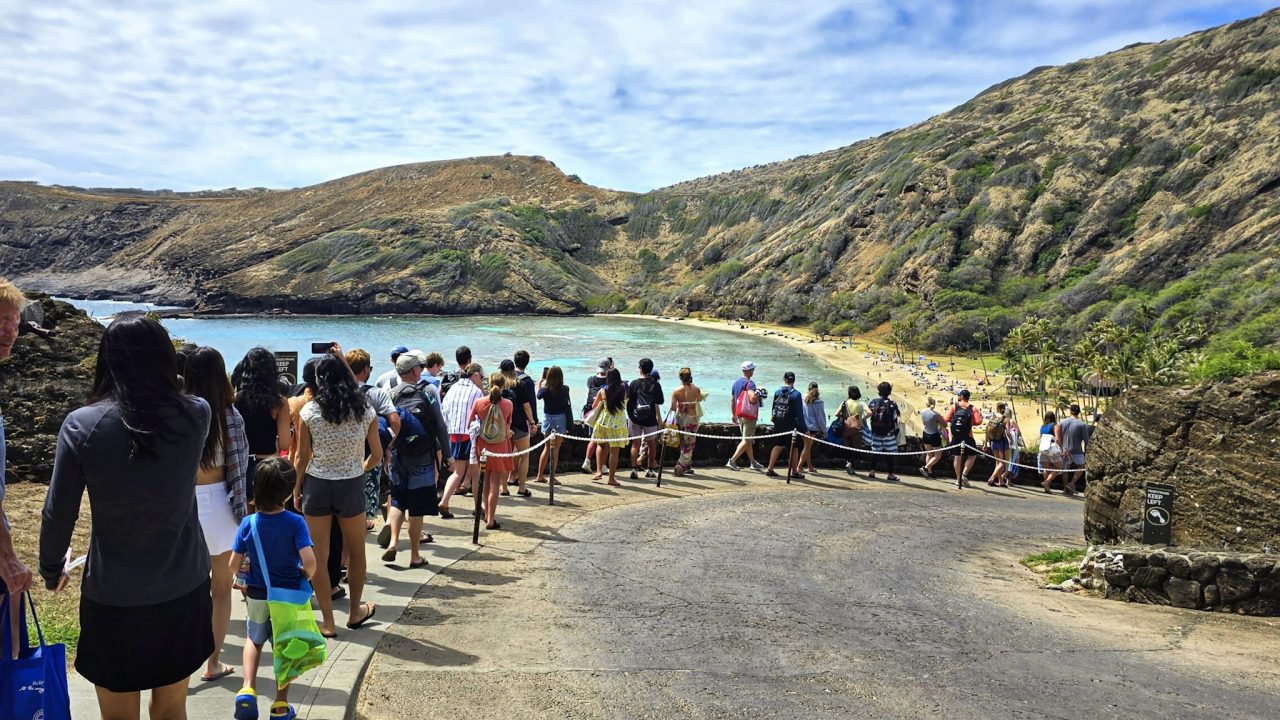
Spots built for a modest number of visitors now absorb extraordinary demand, roads turn into parking lots, trails into crowded corridors, and viewpoints into waiting lines. Residents feel it differently because those places are part of their everyday lives, and visitors feel it because the reality rarely matches the picture that sold them on the trip.
This is another one of the grievances where both sides want the very same things: less crowding, more access, and better experiences. Often the best of Hawaii is sitting one beach over, one town down the road, or one hour earlier than everyone else thought to ever show up, because the islands have always been much more than just the must-see list.
The visitor Hawaii wants back.
We have come to think that most of this conversation is not really about tourism at all, but about relationships. Hawaii depends on visitors, and visitors love Hawaii.
The tension seems to arise when people move through the islands as consumers rather than guests, or when residents start seeing every visitor as part of a group rather than as a person, and neither side gains anything from that.
The visitors who leave the strongest mark are rarely the ones spending the most or checking off the most stops. They are the ones paying attention, the ones who catch that there is a greater story behind the view, a community behind the beach, and a history behind the place. Hawaii residents tell us exactly what frustrates them, and most of it is not about visitors being bad. It is about what visitors move through without seeing, from crowded beaches and vanishing local places to the cost of living behind the vacation view.
Those visitors tend to leave with a deeper Hawaii experience than the one they came expecting to find, and they are usually the ones residents hope will see again.
So we will leave it with you. If you live in Hawaii, what do you most wish visitors understood? And if you visit, what is the thing about these islands that took you years to finally get?
Photo Credit: © Beat of Hawaii at Hanauma Bay, Oahu.
By Rob and Jeff, Beat of Hawaii.
Some of the most meaningful parts of Hawaii are the ones visitors walk right past without knowing they are there. We’ve spent nearly 20 years finding them firsthand for BOH as full-time Hawaii residents reporting on travel, culture, and island life, and telling you what they mean for your trip. Join us →
Get Breaking Hawaii Travel News