
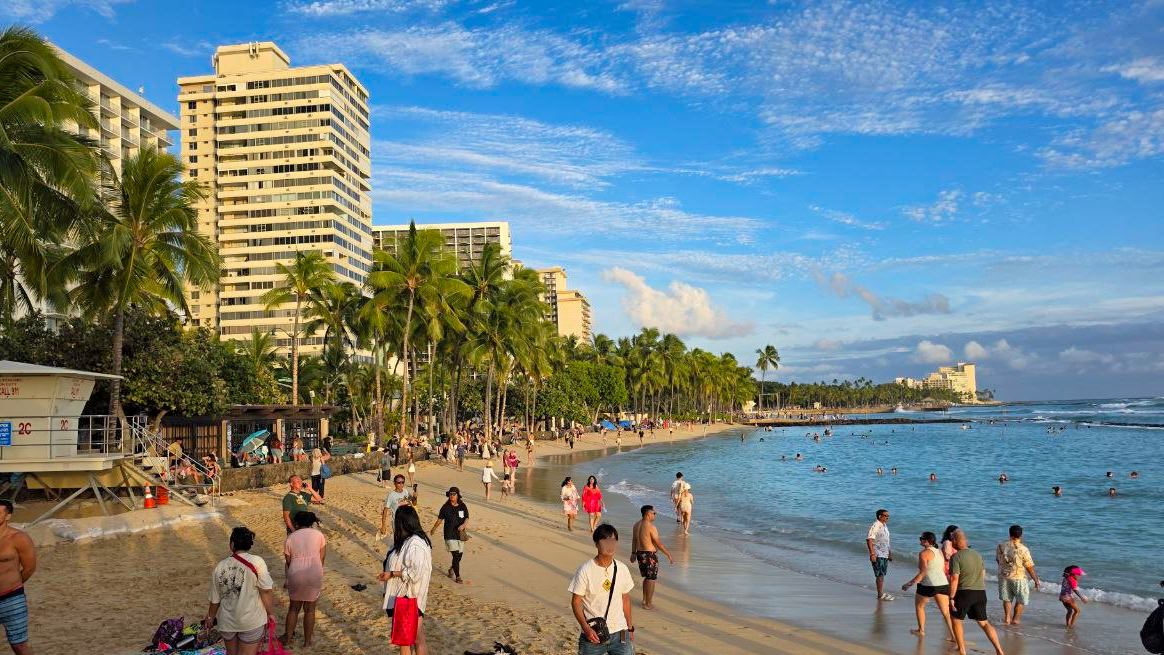
Fewer visitors have been coming to Hawaii this spring, yet the ones who do are spending at record levels, and the contradiction does not stop there. The same season is bringing shark closures and ocean rescues back into view, and the more we looked, the less these felt like separate stories.
We have been hearing different versions of the same thing this spring, and not always from those trying to make a point. A beach that usually feels packed can sometimes look a little more open. A parking lot that normally feels hopeless may suddenly have spaces. Nobody is saying Hawaii feels empty, because it absolutely does not, but something about the mix feels different enough that repeat visitors and residents too keep noticing it.
BOH editor Rob was the one who kept coming back to the contradiction. If fewer people seem to be here in some of the places where visitors normally bunch up, why do spending numbers keep climbing anyway? At first that sounded like two different conversations, one about crowding and the other about money, but April’s visitor report made the question harder to just brush aside.
The numbers this spring didn’t line up the way they should.
The latest April 2026 visitor data show Hawaii welcomed 828,959 visitors, down just one-half percent from April 2025, while total visitor spending rose 4.8% to $1.77 billion. Neither number looks shocking on its own, but together they describe a trip that is changing in ways many people already feel and write to us about.
The figure that may be most significant is the per-person daily spending, which jumped up another 14.1% to $278. At the same time, the average length of stay fell by nearly a full day, from 8.33 to 7.69 days, and the average daily census dropped by 8.2% to 212,409. Hawaii had fewer people here on any given day; they stayed for less time, and each spent significantly more.
This kind of change may help explain why some places feel less crowded while economic totals continue to rise. The crowd is both thinning out in places and, at times, growing more expensive overall, all in the same moment.
Fewer visitors are spending more than ever.
The market mix adds another interesting aspect. U.S. East arrivals were up significantly, 16.3%, with spending from that market up 18.1%, while the U.S. West market, long the bread and butter repeat-visitor base for Hawaii, dropped 4.8%. That does not mean the West Coast visitors are gone, but it does suggest the balance shifted in April.
That demographic shift may be another reason this spring felt a little off. A traveler from the East Coast may be taking a shorter, pricier trip. Those visitors are arguably less familiar with Hawaii, given the typical visitor behavior of returning to the same island, beaches, and spots year after year.
Hawaii has talked endlessly about wanting fewer visitors who spend more. April looks like it is getting closer to that goal, but what’s actually happening on the ground is not as tidy as that slogan. A higher-spending visitor is not automatically a better-prepared Hawaii visitor, and a more expensive trip with longer and overnight flights can create more pressure to do everything on a shorter clock.
Are the ones arriving now a different kind of visitor?
The numbers do not tell us whether someone knows Hawaii well or is a first-time or returning visitor. They do not tell us who has snorkeled here for twenty years, who is arriving for the first time, or who understands that a beach can look friendly from the sand and yet be very different once you are in the water.
Longtime Hawaii travelers carry knowledge that never appears in arrival reports. They know better when to stay out, when a north shore beach is not worth trying, and that lifeguarded beaches and signage can actually reduce risk without turning the ocean into any kind of controlled feeling.
A more affluent visitor from afar can be well-traveled and still not be Hawaii-experienced, especially when the state treats travel spending as a measure of quality. That visitor may still be learning one of the most basic rules here, that the ocean is not part of the package any visitor controls.
The change is not just on paper; it is in the water.
That is where Hanauma Bay keeps coming back into this story. On April 26, a 66-year-old woman snorkeling there was found unresponsive about 10 feet from shore in front of Tower 3C. Lifeguards began CPR, and she was later pronounced dead.
The location is what made that incident so hard to set aside. Hanauma Bay is not an obscure beach with no structure around it. It is reservation-controlled, carefully managed, lifeguarded, and built around visitor education. That is in part why our recent piece, Hawaii’s Most Managed Snorkel Spot Just Proved Drowning Risk Remains, felt like more than just another ocean safety article.
That incident undercuts the idea that someone must have ignored warnings or gone somewhere they should not have. Hanauma Bay is the place Hawaii sends visitors when it is attempting to manage their experience. If there’s still just as much risk, maybe the answer isn’t more signs and controls.
Sharks and rescues are telling their part of the story.
The same spring has brought other water incidents into view, including the June 1 response at Three Tables Beach near Pupukea on Oahu’s North Shore. A 64-year-old visitor snorkeling no more than 15 feet from shore was pulled from the water by beachgoers and given CPR, then taken to the hospital in extremely critical condition. His wife was rescued and did not need medical attention.
Three Tables has no lifeguard tower, only hazard signs, and Ocean Safety noted conditions were calm that morning, the kind of flat water that can read as safe to someone who does not know it.
That incident, along with others, still doesn’t prove a rescue trend, and we are not using it that way. It’s one current example, alongside Hanauma Bay and the drowning data we have covered before, of how quickly visitor stories shift back and forth between cost and crowding and whether people understand and respect the ocean they came so far to enjoy.
Shark closures have been part of the same spring picture. Hilo’s Carlsmith and James Kealoha beach parks closed on May 15 after a shark sighting, and Hanalei Bay on Kauai closed on May 24 after a reported 6-to-7-foot shark near the Pavilion Tower. On May 30, a 38-year-old local surfer was seriously injured in a shark bite at Cromwell’s Beach on Oahu’s south shore, with a separate warning issued at Ala Moana Bowls hours later. Those closures and incidents do not prove sharks are increasing, but they do reflect different ocean cautions forcing themselves into the Hawaii visitor convo again and again.
This is where Rob’s original question started to feel less like a travel hunch and more like the shape of this season. Fewer visitors are coming; the visitor mix arriving is different and spending more, and some of the hardest moments may be showing up in the water, where the Hawaii experience is hardest to fake.
What this says about the Hawaii vacation you think you know.
The old Hawaii trip ran largely on repetition. People came back to the same island, same condo, same beach, the very same routine, and that may actually have taught them some things the state didn’t understand: when to go to a different beach, when to stay on the shore, when the day they imagined was not the day the ocean had in mind.
The newer trip is becoming more compressed. It may cost more, last fewer days, and bring visitors from farther away who are well-traveled but do not yet know Hawaii as our repeat visitors do. That is not a criticism of first-time visitors, since every Hawaii regular started there, but it does start to change what the islands are dealing with at the beach.
The spending report and the water incidents do not prove each other. Yet they may point to the same uncomfortable possibility: that the Hawaii visitor has changed faster than state assumptions about visitor behavior have.
Have you noticed Hawaii feels different this year? Are there fewer people, but is it a different crowd, and does the change match what you are seeing on Hawaii’s beaches?
Get Breaking Hawaii Travel News


Again, if the state of Hawaii could produce a video with say some Hawaii celebrities, Jason Mamoa, Dwayne johnson or even Stitch to warm people of the dangers of our beaches and ocean and include education about our seals and turtles and hiking safety. All that on a video before landing or at some point in the flight might just help. As someone in the industry I can tell you people come here with no preparation or knowledge of our islands. Let’s educate them!
I’m not a math guy but the numbers to me indicated a fairly simple explanation. Overall, the cost of living and visiting Hawaii (Maui in my case) is up in 2026, therefore so is spending even though there are not as many visitors as 2025. The individual figure of plus 14% seems spot on. That’s what I’m seeing just about everywhere as a bottom line. Prices up 14%. This will be my 15th year of visiting Maui on the shoulder seasons (total of 30 trips or so). I’ve always come for the warm water and fun surfing. There have always been and always will be shark sightings and encounters. After a while the informed people know which places are “sharky” and which places aren’t. Hopefully we will inform each other about the dangers in Hawaii, both on land and in the sea, that we should all be aware of.
Spending is up but that extra money isn’t going directly into locals’ pockets, it’s covering the higher cost to provide services. So the exodus from The Islands to Las Vegas continues unimpeded for many who were born there. That part gets glossed over by the powers that be.
As a 50 plus year Hawaii traveler and 40 plus year STR owner here is my opinion. There has been so much inflation in not just travel but everything is raising the spending for everyone. The government, both federal and state, are calculating we are all spending more money because we feel confident in the economy but it’s just everything costs a lot more. Rental cars, food, restaurants all cost a lot more than they use too. So the increase spending is buying less and we all feel it.
It’s no mystery why visitor spending is up. The prices are up and keep rising. It’s not they’re making more purchases or choosing the higher priced restaurants. The tourists arrive and see something they like and buy it. They just figure Hawaii is expensive and so be it To get a better idea of what’s happening we’d have to compare actual transactions to compare the number of transactions to the past but that won’t happen. It would be a huge task. The state should not presume that spending being up means Hawaii is attracting a different, more affluent, type of visitor which is what they want.
My daughter works at a hotel on Kauai. She says guests ask questions now that would have been rare ten years ago. Many seem completely unfamiliar with Hawaii and many more than before appear to be from other countries.
My guess is spending is up due to a large increase in hotels and rental cars. Take that out and I wonder if spending is really up? If spending is then down, it is hurting mostly the mom and pop shops.
I completely disagree. We were on Oahu in April and it felt packed everywhere we went. Waikiki was shoulder to shoulder at times
Maybe Hawaii finally got exactly what it asked for. For years all we heard was “fewer visitors, higher spending.” Well, here we are. Be careful what you wish for
Exactly…. because what happens if the higher spending visitors, who don’t feel the same connection to the islands as the repeat visitors, decide that the price doesn’t justify the experience, or that once was enough, or that they prefer some other destination, and then never return?
We’ve been coming since the 1980s and there are definitely fewer familiar faces. Years ago you’d run into the same returning visitors over and over. That doesn’t happen as much anymore.
I think you’re onto something. We just got back from Maui and spent more than we ever have, yet the beaches didn’t feel nearly as crowded as before. It definitely felt like a different mix of visitors
There’s a very simple reason why visitor numbers are down and spending per visitor is up, and the numbers are directly related: it’s because the cost of everything is so inflated! Hotel and resort fees, food/dining, etc have all skyrocketed, as you have reported in the recent past.
We were on Maui in the Spring. I didn’t see a lot of difference from past years. There were fewer people, but it was a pretty rainy year, I think a lot of the ‘last minute’ crowd did not come. There seemed to be a lot of good deals on various condos, and the food trucks, many of which are pretty good, provide relatively inexpensive meals. The hotels were certainly not full. There are always a lot of water related accidents, this is not new.