
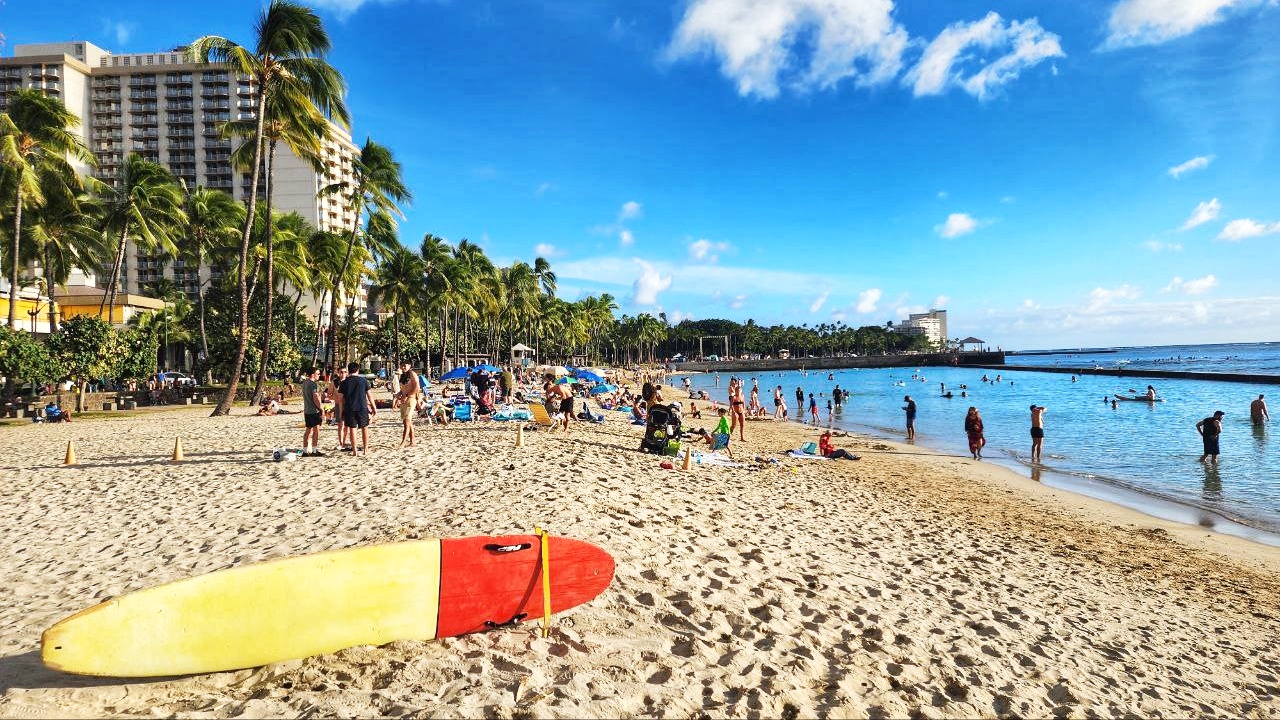
You’ve arrived at the Hawaii beach you’ve dreamed of; the water looks clear, it’s sunny, the sky is blue, and people are in the water. What none of that tells you is whether the water is actually safe to swim in today.
That doesn’t mean Hawaii’s beaches are dirty. Most of the time, they are clean and fine for swimming. The problem is that water quality can change fast after rain, near stream mouths, drainage outlets, canals, or anywhere runoff and pollutants reach the ocean.
We’ve had to change beach plans because of this more than once this year. The good news is that visitors can check the same public system we do before getting in the water, and once you know where to look, it takes just seconds.
The question every Hawaii swimmer should ask first.
Most Hawaii visitors check weather, surf reports, traffic, and parking before heading out. Some check online reviews. Few think to check water quality, even though it can change everything.
Conditions vary from one location to another, even when they are nearby, especially after rain. A beach under advisory on one spot of an island says nothing about beaches elsewhere, and even at the same beach (think Hanalei), water near a stream mouth can test very differently from water farther down the shoreline.
So you don’t necessarily have to cancel beach plans because one advisory appears. You need to know where it is, what caused it, and whether another nearby beach is a better choice today.
What Hawaii actually tests for, and why.
Hawaii’s Clean Water Branch monitors more than 250 beaches statewide under the federal BEACH Act program. The state doesn’t test for every possible pathogen. But it does monitor for Enterococci, bacteria used nationwide as indicators of fecal contamination, and elevated levels can signal sewage, animal waste, or stormwater runoff that carries disease-causing organisms.
Hawaii also checks Clostridium perfringens as a secondary tracer. That purports to help determine whether contamination is more likely linked to sewage or another environmental source.
The current Beach Action Value is 130 colony-forming units per 100 milliliters of water. When a sample exceeds the threshold, the state conducts follow-up testing, and depending on the results, this can escalate to a posted advisory.
Visitors don’t need to memorize many details. Just know that Hawaii has an established monitoring system and a public way to see what it finds. It’s not perfect, but it’s something.
Look for spikes after rain.
If there’s one thing those who live in Hawaii know, it’s that recent weather tells you more about today’s water quality than what’s happening today does. Heavy rain washes contaminants into streams, drainage channels, canals, and eventually the ocean, and most of Hawaii’s water quality advisories appear during or shortly after major rain events.
The state regularly issues brown water advisories after periods of significant rainfall, and this year it seems there have been more than normal. Those advisories are based on the simple reality that runoff carries contaminants into coastal waters even before testing can confirm elevated bacteria levels. Obviously, the highest-risk spots are near stream mouths, drainage outlets, canals, and places where water enters the ocean, and conditions can and frequently do improve a short distance away.
A recent Oahu weekend showed how specific this gets. Volunteer testing reported elevated bacteria near the Ala Moana canoe ramp while the surf break just offshore tested low, with currents, wind, and ocean flushing creating different conditions within the same reasonably small stretch.
The usual source isn’t what visitors expect.
When visitors hear about sewage contamination, they often picture something different than the reality. Hawaii still has about 88,000 cesspools, particularly in areas of Kauai, Maui, Hawaii Island, and the North Shore of Oahu that are not connected to sewer systems. The state and environmental groups have known these to be a recurring source of groundwater and coastal contamination for decades.
Reports estimate Hawaii’s cesspools release more than 50 million gallons of untreated sewage into the ground each day. And while not all of it runs into the ocean, it explains why Hawaii’s aging wastewater infrastructure keeps surfacing in our water-quality story.
On Oahu, the Ala Wai Canal is the best-known example, collecting runoff from a heavily developed watershed area before finally reaching the ocean between Waikiki and Ala Moana. Surfrider’s 2024 analysis found that nearly all of the chronically failing sites it identified on Kauai and Oahu were located in Priority 1 or Priority 2 cesspool areas.
Even then, most Hawaii beaches pass water-quality standards most of the time. The issue is not constant contamination. It is knowing when and where risk rises.
State monitoring isn’t the only source of information.
Volunteer programs also test ocean water regularly. Earlier this month, Surfrider Foundation’s Blue Water Task Force reported that 7 of 14 Oahu sites it sampled exceeded recommended bacteria levels, with two East Oahu sites measuring extremely high levels.
At the same time, the state’s advisory system showed only a single posted brown water advisory on Oahu’s North Shore. What that means is that different systems are testing different locations on different schedules and serving different purposes. Volunteer results are not the same as state advisories; no warning signs go up based on those alone, with beaches remaining open.
Surfrider says its volunteer testing is designed to add snapshots of conditions between official state testing cycles. For visitors, the point isn’t about choosing one source over another; it’s that ocean conditions can and do change quickly, and checking multiple sources gives you a fuller picture.
How to check in less than two minutes, usually.
The most useful tool is Hawaii’s Clean Water Branch. It has an advisory map, the state’s official source. Before heading out, you can check current advisories by island to see whether any high-bacterial notifications, sewage spill notices, or brown-water advisories are active. The map has occasionally been unavailable, which is concerning. If the map isn’t working, check again later and look at other ocean-safety supplemental resources, including Safe to Swim Hawaii.
There’s also a simple rule of thumb that still works well. After significant rain, especially near streams, storm drains, canals, and river mouths, wait before getting in. The state advises avoiding beaches during or immediately after heavy rain, staying out of brown or turbid water, and avoiding areas near stream mouths, drainage pipes, canals, or storm drains. Some guidance suggests 48 to 72 hours.
The same caution applies to freshwater exposure. Floodwater and standing freshwater pose different risks, including leptospirosis, that are distinct from ocean-swimming concerns.
So is it safe to swim or not?
Most of the time, yes, and that’s the part that gets lost whenever water quality warnings make headlines. Hawaii’s monitoring system exists because the state knows there are occasional contamination events. Most visitors swim without issues, most beaches aren’t under advisory, and most days don’t mean you need to change plans.
What catches many visitors off guard is just how localized the problem can be. One beach may be under advisory while another nearby stays perfectly swimmable. Water near a stream mouth may be the most questionable while the rest of the shoreline can be completely different.
The visitor who understands that has a real advantage. Instead of guessing from the color of the water or the number of people already in it, you’ll know how to check conditions yourself before heading out, and in Hawaii that’s usually enough to turn an unclear warning into a good decision.
By Rob and Jeff, Beat of Hawaii.
Some of the most meaningful parts of Hawaii are the ones visitors walk right past without knowing they are there. We’ve spent nearly 20 years finding them firsthand for BOH as full-time Hawaii residents reporting on travel, culture, and island life, and telling you what they mean for your trip. Join us →
Get Breaking Hawaii Travel News



My family and I have been “going to the beach” on Oahu for 72+ years and counting … both as visitors and home owning residents.
Swimming, surfing, diving; it didn’t matter. We never had a problem – real or imagined – with “pollution” or “water quality” in all those years … ‘cept for that pesky 3rd eye that grew in the middle of my forehead ??
I have, however, been stung by Man-o’-War on 5-10 occasions and received many boo-boo’s over the decades from surfboard bumps and even some coral scrapes – I don’t really keep count; it’s just the way it rolls when you’re in the waters of the Pacific Ocean …
But then, we’ve never been prone to a “grievance orientation” world-view in any case …
aloha, thank you for providing wonderful info on the Beat of Hawaii. The number one threat to ocean water quality human sewage. The untreated human waste problem has ignored or had little importance placed on it for decades. The failure of the state and county to deal with the problem will be the death of Hawaii, its coral reefs and costal waters. With the growth of Hawaii’s population is the problem. Dealing with human sewage with cesspools, septic systems or dumping raw sewage into a lava tube is the problem. Runoff after heavy rains isn’t just brown water, it’s human waste runoff! The only solution is to have human waste collected and treated by State, County or Federal sewage treatment facilities. On the outer islands the problem is far worse. If you are at the beach, look mauka and see a high concentration of homes or population don’t enter the water. The water may have been tested and has acceptable levels of pollution but is still not “safe”
As a former lifeguard on the mainland, rain was always the first thing we considered in terms of water safety. Not sure if that’s obvious to most visitors to Hawaii or not. And if you only have a few days to do the beach, and you paid so much and planned so hard, that’s another part of it.
Years ago we got caught in a downpour on Kauai and were back in the water the next morning. Looking back, maybe that wasn’t our smartest decision. We’re somewhat more careful than we used to be although we see people after a storm at Kalapaki Beach and clearly that isn’t safe.
I had never given thought to checking this before heading to the beach. We’ve been visiting Hawaii for 20 years and always assumed clear water meant safe water. Don’t get me started, but how can the state website for checking be down?