
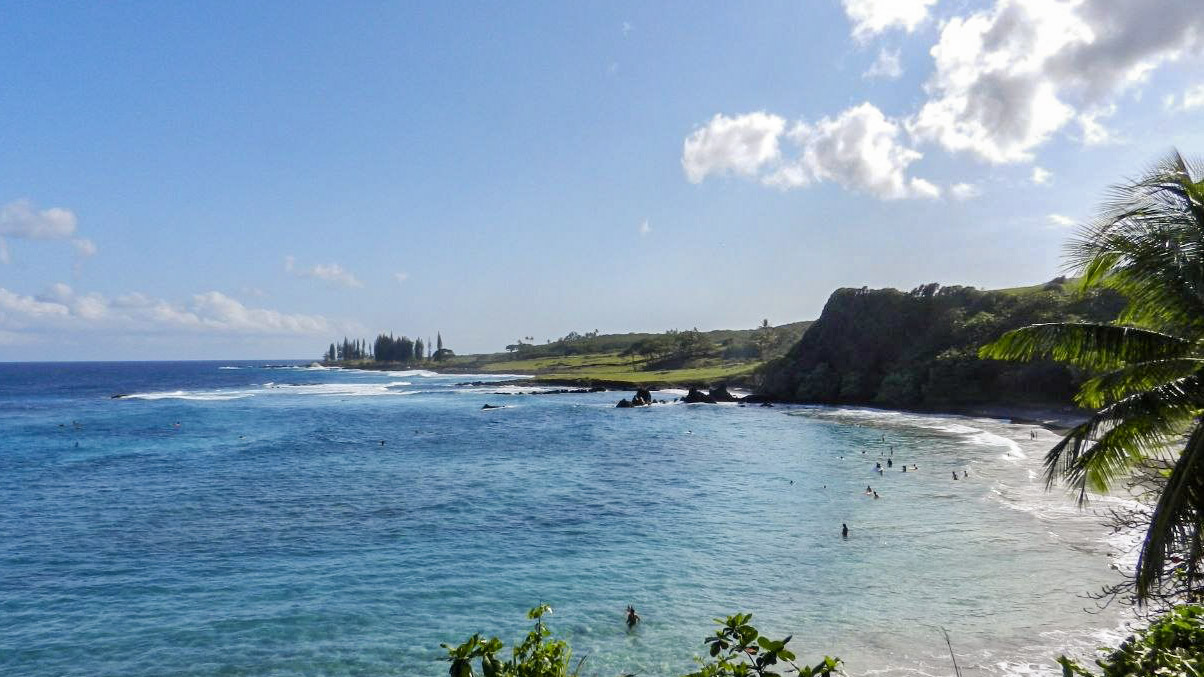
If you’re planning the Road to Hana, you may be more concerned about the drive and less about current beach conditions on the way or when you are there. When we go, our thoughts are usually on the narrow bridges, blind curves, and trying to fit everything into one day. But the greater danger may begin after your car is parked.
Some of the most beautiful and heavily photographed beaches, once you get there, are exposed to strong currents and heavy shore break, with no lifeguards.
This came back to our attention when a 56-year-old California woman died Wednesday morning after she and a 53-year-old Texas woman were pulled from the water at Koki Beach near Hana. The second woman was hospitalized in critical condition after bystanders and an off-duty firefighter helped bring both women ashore.
The incident serves as yet another reminder that the beaches near Hana aren’t like the guarded beaches many visitors know elsewhere on Maui. Beaches like Koki, Hamoa, and Waianapanapa may be located only minutes apart, but each offers different conditions.
The Road to Hana drive gets most of the attention.
We have driven the Road to Hana many times, most recently while reporting from East Maui earlier this year. The road demands patience, attention, and courtesy, yet many of us still arrive less prepared for the drive than we expected.
You may have studied the bridges, reviewed maps, packed food, checked the weather, and decided who would drive. By the time you reach Hana, though, you may have spent far more time thinking about the highway than about the ocean waiting at the stops along it.
That is easy to understand. The road has a reputation, while a beautiful beach can appear self-explanatory. You see sand, blue water, and other people near the shoreline, and the frightening part is how easily entering the water can feel less consequential than the drive that brought you there.
East Maui is different. A beach can look calm from the parking area and behave entirely differently closer to shore. Conditions can change before you fully understand what is happening.
The beaches near Hana are nothing alike.
Koki Beach and Hamoa Beach are less than a mile apart, yet they should never be treated as being interchangeable. Koki faces an exposed stretch of coastline where strong currents and heavy shore break can make entering the water dangerous even when the beach itself looks inviting.
Hamoa often appears more sheltered and is widely described, including by Beat of Hawaii, as one of Maui’s most beautiful beaches. It can sometimes offer better swimming in calm conditions, but it also lacks a lifeguard, and larger surf can instantly transform it into a very different place.
Waianapanapa attracts us for its black sand, lava formations, coastal trail, and dramatic setting. The beach can also experience strong currents and heavy shore break, which means the photographs we came for and the time in the water are two separate decisions.
That is part of an important lesson on the Road to Hana. One beach may be a place to swim when conditions allow, another may be better for walking or watching, and another may be a place where the ocean should be left alone entirely.
East Maui has almost no lifeguard protection.
The County of Maui places its full-time ocean safety towers at beaches in South Maui, West Maui, and along the North Shore. Koki, Hamoa, and Waianapanapa are not among them.
The only county lifeguard coverage in East Maui is at Hana Bay, where staffing is limited to part-time, seasonally. Hana Bay is also the more protected in-town beach, not one of the exposed coastal stops where visitors are most likely to misjudge the ocean.
That’s important because you may arrive in East Maui after spending time at Kamaole, D.T. Fleming, Baldwin, Hookipa, or other guarded beaches. The absence of a tower can be easy to overlook, especially when a beach is famous, busy, and included in nearly every Road to Hana itinerary.
A rescue tube stationed on shore is not the same as a trained lifeguard who watches people and conditions, warns swimmers over the loudspeaker, and responds immediately when someone is in trouble. Along most of this drive, nobody is performing that role.
Koki and Hamoa are different beaches.
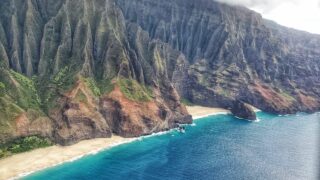
Koki is one of the beaches we would approach primarily as a place to look, walk, and photograph. Its red cliffs, offshore views, and exposed shoreline make it one of East Maui’s most striking stops, but none of that tells us whether the water is safe to enter.
Hamoa can be a different decision on a calm day. We have enjoyed stopping there ourselves, but we would still spend time first watching the water carefully, looking at what is happening beyond the first line of waves, and avoiding treating yesterday’s conditions or someone else’s photograph as evidence of what is happening now or what you should do.
The short distance between the two beaches is part of what makes this part of Maui easy to misunderstand. You can leave one beach, drive for several minutes, and arrive at another that looks calmer without knowing whether the ocean has become safer or has only changed appearance.
Waianapanapa presents the same issue in a different form. Its black sand beach is one of the Road to Hana’s signature stops, but the park’s scenery, trails, lava coast, and cultural landscape remain worthwhile even when the water is not.
Kipahulu is not a swimming alternative.
Visitors sometimes continue beyond Hana, expecting the famous Pools of Oheo at Kipahulu to offer another place to enter the water. Swimming there, however, remains prohibited, and the pools are viewed from the trail rather than entered.
That closure is tied to hazards that differ from the beach ones, but are just as difficult for visitors to judge. Rain falling upstream can change a stream or pool even when the immediate area appears dry, and flash flooding, falling rocks, and fast-moving water can arrive with little warning.
This part of Maui asks visitors to make several separate judgments on the same day. Road conditions, ocean conditions, stream conditions, and park restrictions are all important, and the right decision at one stop says nothing about the next.
How we approach these beaches now.
We never arrive at an East Maui beach assuming that stopping there means swimming. We watch the ocean, pay attention to whether anyone is having issues, look for currents moving along the beach, and then consider what the waves are doing before getting close enough to enter.
We also separate what a beach offers from what we expected. Koki may be memorable without a swim. Waianapanapa may be worth the reservation for the setting, black sand, and the coastal walk. Hamoa is spectacular and may be completely enjoyable from the sand even when the ocean says no.
The County of Maui’s guidance is direct: swim in lifeguarded areas, never swim alone, and if in doubt, don’t go out. That advice becomes harder to follow on the Road to Hana because almost every famous beach stop is unguarded, which places the decision entirely on the person arriving at the shoreline.
Visitors devote enormous attention to whether they can handle the Road to Hana. The harder judgment may be knowing what to do after reaching the beaches they came so far to see.
Has a local ever warned you away from a Hawaii beach that looked perfectly calm? Is there a Road to Hana beach you enjoy from shore but would never enter? We invite your comments.
Lead Photo Credit: © Beat of Hawaii at Hamoa Beach, Maui.
By Rob and Jeff, Beat of Hawaii.
Some of the most meaningful parts of Hawaii are the ones visitors walk right past without knowing they are there. We’ve spent nearly 20 years finding them firsthand for BOH as full-time Hawaii residents reporting on travel, culture, and island life, and telling you what they mean for your trip. Join us →
Get Breaking Hawaii Travel News


The mystery of the 41 year-old tourist and 16 year-old son missing on the Hanauma trail is still not solved. Speculation is that they were swept out to sea June 23. Their bodies have never been found. Weirdly, they told family beforehand they had no plans to swim or enter the ocean, and why was their backpack with phone and wallet found on the trail if they supposedly drowned?
On beaches with and without lifeguards how many us have witnessed individuals entering the water when conditions warrant not doing so.
Brown water, high surf, riptide warnings and still the clueless will enter the water putting others at risk when needing rescued.
Koki is a full sand bottom and pure beach break. That means it’s always shifting, day by day. Also, I have seen warning signs, one by locals, declaring “strong currents,” attached to trees at Koki. Are they still up?
Two important things. First, if you don’t know true ocean safety and how to ocean self-rescue, stay out. This means you better know multiple swim strokes, especially sidestroke and the king of safety strokes, the elementary backstroke (super efficient, if you know what you’re doing you could do this one stroke all day and all night). You also better know how to float on your back effortlessly and know how to effortlessly breathe in the water, either while swimming or while resting on your back. If the only thing you know how to do is tread water while upright, you’re already in very serious danger merely being in the ocean. You’re a mark.
Second, Koki has rips. Strong ones, hidden ones. Koki is very deceptive, just like Makena and Hamoa.
We’ve driven the road to Hana numerous times and it honestly never entered our heads to go swimming at any of the beaches. They were strictly for admiring, not swimming.
East Maui is also geologically younger, like the Big Island. No fringing reef, so big waves and big sharks can easily get in to shore.
There is one more risk on that stretch that’s not in your article: No cell service. That means it is a long time to reach out to help to get them started.
When I drove the road, we had a PLB. It does do text so we could send a text to the emergency center describing what happened. It can be 5-15 minutes to send though. We now have Starlink Mini and plan to take it on our next trip. It allows for cell calls right away after 1-3 minutes of startup.
As someone who grew up around the ocean in Hawaii, I was taught to watch the water for at least ten minutes before deciding anything at an unfamiliar beach. It’s amazing what you can learn just by standing still. The time pressures of the Hana Highway drive clearly compete with that good sense.
Just wondering how many visitors even really notice whether the beach has a lifeguard or not before heading into the water. Probably fewer than we’d like to think.
We’ve visited Waianapanapa several times and never entered the water at the black sand beach. The beach itself was enough for us. It’s one of the most beautiful places on Maui without needing to swim there.
Couple of thoughts. First, the Road to Hana is incredible. But I think too many visitors try to cram every stop into the one day that is already long and exhausting and demands attention. That all probably doesn’t help people make good decisions when it comes to getting into the water.
One thing locals told us years ago has always stayed with me: just because someone else is there swimming doesn’t mean it’s safe. Some of the best advice we ever got in Hawaii.
Two of us went in one day at Fleming. After we cleared the shore break we realized we’d made a mistake and got out. It was doable, but more work than we were looking for that day. On our way out a couple asked us if it was swimmable and we asked them a couple of pointed questions about their abilities before telling them no. The only better people to ask than someone who just got out is the lifeguards.
We stopped at Koki and never got in because the ocean just looked too dangerous. I feel better about trusting our instincts on that one.
Understanding this should be required for first-time Maui visitors. The scenery is so beautiful and the circumstances so magical that it’s easy to forget the ocean conditions somehow.
We’ve driven the Road to Hana four times and I honestly never noticed there weren’t lifeguards at those beaches. I guess I just assumed someone was there because there were always plenty of people around who needed watching.