

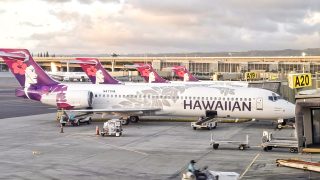
When Alaska announced in July that Hawaiian’s Boeing 717 fleet would be replaced by Boeing 737-800s, at first we pictured exactly what most readers probably did. Now we know those airplanes will start showing up October 3, the same day Hawaiian changes a check-in routine Hawaii travelers have known for years.
Hawaii checked-bag cutoff changes from 30 to 50 minutes.
Beginning October 3, all Neighbor Island passengers must check in online or through the Alaska Hawaiian app at least 50 minutes before departure, and checked bags must also be dropped by then. That’s up from the current 30-minute cutoff we’ve long lived by.
Hawaiian says nearly all of its Neighbor Island passengers already check in at least 50 minutes before departure and says the earlier cutoff will improve baggage handling and support on-time departures. The new rule applies whether passengers are flying on a 717 or 737.
At Honolulu, passengers on both aircraft types continue to check in and drop bags at Terminal 1, Lobby 3. At Kahului, passengers flying the 737 to Honolulu are directed to Alaska’s counters next to Hawaiian for check-in and bag drop, while passengers on the 717 continue using Hawaiian.
But we’ve spent many years flying these exact Alaska Boeing 737-800s between Hawaii and the mainland. These aren’t aircraft Alaska is buying for Hawaii. They’re airplanes already in the airline’s fleet that will be refurbished, later repainted in Hawaiian colors, based in Honolulu, and assigned their new job.
That sent us looking for things both the announcement and other articles never mentioned, including how old they are. The answer wasn’t in the press release. These weren’t some unusual replacement jets waiting somewhere for their Hawaii debut. They were the familiar Alaska airplanes we had boarded, flown, photographed, reviewed, and then watched gradually give way to newer MAX aircraft on Alaska Hawaii routes.
We realized then that we’d been sitting in Hawaiian’s future airplane all along. We simply did not know what was to come, and they didn’t say Hawaiian on the side at the time. A traveler who has flown Alaska to Hawaii over the years has a good chance of having flown the same aircraft type too, although Alaska hasn’t said which individual airplanes from its 59-plane Boeing 737-800 fleet will ultimately move to Hawaiian. The announcement describing Hawaiian’s future fleet made the airplanes sound modern, premium, reliable, connected, and ready for a career over Hawaii.
Honolulu to Maui 737 flights begin October 3.
Nobody has to wait until 2028 to see this start taking shape first hand. Alaska has now confirmed that beginning October 3 it will operate three daily Honolulu to Kahului round trips using an Alaska-branded Boeing 737-800, with the new flights described as supplemental capacity while Hawaiian’s 717 fleet continues roughly 140 daily flights around the islands.
Those flights use Alaska crews because the two workforces are not combined yet. AFA-CWA says the flight attendant groups cannot merge until a joint contract is ratified and the seniority list is accepted, and management does not receive that list before ratification. The pilots follow the same sequence, and the pace of it has already produced some pushback from Hawaiian workers.
Alaska says the Hawaiian-branded Boeing 737-800 fleet will eventually be based in Honolulu and flown by Hawaii-based crews, with the permanent transition still set to begin in 2028. Passengers will be able to see whether they’re booked on a 717 or 737 when shopping on either airline’s website or in the Alaska Hawaiian app. Spot a 737 at a Hawaii island gate this fall and you’re seeing Alaska equipment doing the same job the Boeing 717 has handled for a quarter century.
Alaska’s own annual report lists the Boeing 737-800 fleet age.
Page 31 of Alaska Air Group’s 2025 annual report lists 59 Boeing 737-800s at an average age of 17.7 years at the close of 2025. That’s the pool of aircraft Hawaiian will draw from.
The fleet averages roughly 18 years old today. By 2028, when the Hawaiian transition is planned to begin, the average reaches about 20 and keeps growing. Overall, Alaska’s public fleet page tells the story differently, reporting an average age of about 10 years for its entire Boeing 737 fleet. But that blended figure combines every 737 variant, including nearly 100 MAX 9s and MAX 8s that are far newer than the Boeing 737-800s.
Alaska’s second quarter loss explains the 737-800 decision for Hawaii.
Alaska Air Group reported a second-quarter 2026 GAAP net loss of $76 million, or $0.68 per share, on a GAAP pretax margin of negative 5.3%. Its adjusted net loss reached $102 million, or $0.92 per share.
Alaska already owns these airplanes, already maintains them, already has trained crews and available parts, and has years of operating experience with the type. Refurbished airframes with updated interiors and Starlink are the current answer for flights lasting around 30 minutes. Alaska knows the Boeing 737-800 better than any airplane it could have bought, and using aircraft already on the balance sheet is a defensible call for the company. The refreshed cabins and the free Starlink are tangible gains for Hawaii visitors and residents.
Hawaiian Boeing 717 pilots are losing an airplane they loved dearly.
Ask a Hawaiian pilot about the Boeing 717, and you get an answer you don’t get about most airplanes. It climbs quickly, handles short island sectors well, has been the reliable and time-proven backbone of Hawaiian’s operation for decades, and many of the airline’s pilots built their careers around it.
Nobody is going to talk about a Boeing 737-800 that way. The 717 is how BOH editor Jeff talks about the 1993 Porsche Carrera he kept in his garage. Newer cars are faster and arguably better in every measurable way, and none of that is why he kept it.
Alaska’s fleet page lists 19 Boeing 717s at an average age of 23.7 years as of January 2026, and Boeing stopped building the type in 2006. By the time the transition is fully underway, those airplanes will be approaching 26 years in service, an endpoint we saw coming when we examined Hawaiian’s dwindling replacement options.
Boeing 717 flight cycles explain the Hawaii retirement.
Calendar age understates what Hawaiian’s Boeing 717s have endured. Each takeoff and landing adds structural stress. Alaska addressed cycles in its announcement. The release calls Neighbor Island flying uniquely demanding, with short segments, frequent daily cycles and salt air, and says the 737-800 has airframes and engines that can withstand it.
Hawaiian is known to work these airplanes through as many as 16 cycles a day on short flights, perhaps the most cycle-intensive flying anywhere. In our earlier examination of the aging Boeing 717 fleet and FAA concern, we reported that the fleet had likely already moved beyond its original design life as measured in cycles, with additional maintenance keeping it in service.
A federal airworthiness directive effective January 2, 2026 requires repetitive inspections of the nose landing gear upper lock link on every Boeing 717 in the country. It followed a 2023 Delta Boeing 717 landing at Charlotte with its nose gear retracted.
The Boeing 737-800 looks very different by comparison. Alaska’s aircraft have generally spent their lives flying longer mainland and transpacific sectors, often completing four or five cycles a day rather than a dozen or more.
They may average about 18 calendar years of age at present, but they’ve accumulated only a fraction of the punishing short-flight cycles associated with Hawaiian’s Boeing 717s. By measures related to structural fatigue, the replacement is the far younger airplane. But by calendar-age measures missing from Alaska’s announcement, it isn’t that new.
What Hawaii passengers gain and give up on the 737-800.
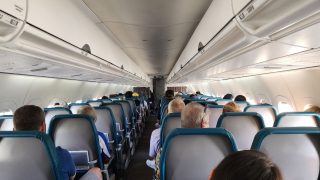
Depending on configuration, the Boeing 737-800 seats 159 or 161 passengers, compared with the Boeing 717’s 128. Hawaiian’s current aircraft carries 8 First Class, 17 Extra Comfort, and 103 Main Cabin seats, a layout we examined when the middle-seats doubling first surfaced.
The current 737-800 layout has 16 First Class, 36 Premium Class, and 109 Main Cabin. First Class doubles, and 17 Extra Comfort seats become 36 Premium Class.
Starlink comes free on equipped aircraft. The airplane offers more cargo room for everything from surfboards and golf clubs to other baggage. Power and device holders come at every seat, which the 717 never had. But on an under 25-minute flight to Kahului, some travelers will notice the middle seats being added while others will focus more on the newly added free Wi-Fi.
A Boeing 737-800 carries about 33 more passengers than the Boeing 717, almost 26% more seats per departure. If demand stays roughly where it is, maintaining approximately the same total seat capacity would require about 20% fewer flights.
Alaska has said the larger aircraft will support frequent departures from morning through evening, but it hasn’t said today’s flight frequency will remain unchanged once the permanent transition takes place. We raised that question when we looked at why Hawaii’s beloved two-seat side disappears in 2028. A larger airplane solves one problem while creating another question Hawaiian hasn’t answered yet: how many departures will travelers actually have when the 737-800 becomes the only Hawaii workhorse?
What counts more to you on a Neighbor Island flight, modern amenities and more premium seats, or keeping the Boeing 717’s two-across seating? And if the bigger aircraft eventually means fewer departures, would that change how you feel about the switch?
By Rob and Jeff, Beat of Hawaii.
There will be plenty more announcements between now and 2028, and the numbers behind them will keep sitting in documents almost nobody opens. We open them. Subscribe to our email list for free. It’s where we post our findings before the travel press catches up.
Get Breaking Hawaii Travel News



Hawaii News Now is warning of another El Nino tropical storm this week that will likely bring wind, rain and flooding for five days or more.
Very risky to plan a Hawaii trip during El Nino. (No Refunds for many)
California has great weather, 75 degree ocean, and less flying.
Food and activities and lodging all very affordable now that school is back in session.
This seems like a very rational choice by Alaska. We have been going to Hawaii from the Bay Area once or twice a year since 2009 (almost always Kauai) and have not flown in anything other than a B-737 (amost always Alaska, but SWA a few times) and are fine with it. I would rather be in a single aisle than the middle of a two aisle, unless it was a B-787 or B-767.
Re chg in check-in procedures for inter-island flights. Does your labeling of Inter-Island include leg 2 of a LGB-OGG-LIH flight. 50 minutes ahead of leg 2 takeoff I may still be in the air or in the waiting area at OGG..
Aloha, Can you please talk about 737 vs 321 vs 330 west coast to the islands? I don’t like the smaller plane for that long of a distance. I feel the most comfortable (and safe) on the 330 which I flew for the first time this month. Am I in the minority or majority? We go to Kauai quite often and have been for over 30 years. The 321 is ok but the 737 seems just too small in all ways to go that distance. The 330 is my fave! Mahalo
The A-321 is about 16 feet longer that a 737, and it’s also about a foot wider.
I agree that the A-330s are very comfortable with 2-4-2 seating in coach. They are slowly being replaced by Boeing 787s with 3-3-3 seating. It’s unfortunate that the airline chose this seating pattern, but it allows them to seat one more passenger in each row, with narrower seats.
I love thec2 seated side on the 717, especially when I’m flying with my elderly parents. It’s easier for them to get in and out of the 2 seat row rather than the 3 seat row. Our alternative now would be to book them both in aisle seats.
I wondered why Alaska choose the Boeing 737 instead of the Embraer 175 for flying the interisland flights. Horizon Air, their regional airline, flies the Embraer on many of their routes on the West Coast. I have flown them and find them a really comfortable plane. It is designed for short hops unlike the 737-800 which is better suited for longer flights. You would think the cost of fuel would be one driver of the choice of planes especially in Hawaii where every drop of fuel is imported from the Mainland. Not only that but the main cabin is four seats per row! l guess they got concerned about Southwest using 737’s in the Islands. Tough keeping up with the Joneses.
Why?
Freight. Staff. Airpanes
#1 – Freight is a big driver of interisland
#2 -Pilots and staff. 2 pilots needed whether its a 737 vs a 175 or something else. Also, pilot’s day is longer than the flight from west coast to Hawaii. They can get 2 or 3 runs interisland runs in before the staff runs out of hours, another plus.
#3 – Aircraft. Alaska does not have the aircraft. There is a long wait for new aircraft. The 737-800s that are fulfilling this are older Alaska aircraft. Yes the planes are larger, but this can also work to their advantage. A larger aircraft can replace 2 or 3 interisland flights, this saves planes. Planes that they do not have, and will not have any time soon
I can’t help but think Alaska will cut the number of daily flights if they have 26% more seats on newer planes. I guess we will adjust like we always do, lol.
Aloha~ Change is always difficult but we are getting much lower cycle airframes, which is the real determinant on an aircraft state of being. The pilots will miss the racecar they have been flying and will switch to managing the aircraft vs flying it. Overall, it is a logical step but as one reader commented, this is an intermin assignment until the long term decision is made. Which could be to send us low cycle aircraft with 10+ years on the airframe, or bring over the regional jets (ERJ175 or future stretch). For me, I am looking forward to increased overhead bin space to make boarding go faster and a quiet cabin to enjoy the hops! Cheers all
Takeways so far on this fleet renewal.
1. I love the Boeing 717, especially the 2 -3 seating. Really nice when you fly alone. No middle seat. Quieter plane up front away from the rear mounted engines.
2. The one thing I hated about the 717 after 2015 is when Hawaiian took out the soft seats that came with the aircraft when they got them new. The hard seats used since 2015 stink not to mention the lost legroom too as they wanted. to sardine more passengers in.
3. 737-800 NG. Positives: Hopefully soft seats throughout updated cabin. Free wifi is nice. They have that on Southwest 737s. More cargo space.
4. 737-800 NG Negatives: Old in calendar year age even though far less cycles than 717. Quite possible lesser flights more price fragmentation for different seats (cheap seats will be middle seats that no one likes). More cargo space: What the hell are they loading on passenger flights? Hopefully no firecrackers or lithium battery / devices.
For a 23 minute in air flight, who really cares what aircraft you fly,
Whatever the type, the priority should be maintenance, of course. The corrosive humidity of Hawaii plus the high number of cycles or utilization rate are a double whammy threat to any aircraft. We certainly don’t need an encore of Aloha 243 from 1988, or worse !
My one wish is that they would add seatback video monitors on their mainland to Hawaii planes. I hate watching media on a phone, but don’t want to buy or carry a tablet. Meanwhile, I am sorry to see the 717s retire. They are amazing workhorses.
I’m betting that Alaska is looking at these aircraft as a stopgap – they’re too old to look at as a long term solution.
If they can solve the money problem then they can look at new aircraft for these routes – and they’ll also have seen if a slightly larger sardine can makes sense from a number of passengers standpoint.
That might help them decide if a Max7, Max8, or some completely different airframe makes sense starting in the mid-2030s.
Yep, they are an interim strategy. We’ll see how they work out and what Alaska does with them – less flights (but more seats on the remaining flights), empty seats? Seats at a bargain price? Try to entice more Honolulu connections?
Presumably with a larger aircraft they have to have more flight attendants whether they sell seats or not.
Yes, they’ll have to go from 3 (101-150) to 4 (151-200) it appears. I wonder if they’ll think about knocking the number of seats back to 150 to avoid that?
I don’t think that matters. Aircraft staff (pilots, flight attendants) all have a certain amount of hours they can fly in the day. You will see the mainland pilots and attendants pick up 1-3 interisland flights and that will now be a more complete day.
The bigger planes are going to primarily run Honolulu to Maui and back and forth, where loads are greater. And yeah, maybe more seats = lower fares? Doubt it, but maybe
I may have missed the coverage on this site. So, forgive me if this is repetitious.
The Alaska/Hawaiian move to 737-800s is not without precedent. Aloha Airlines flew 737s for years. From the old noisy 737-100s up to the 737-700s in their fleet at the time that they went out of business in 2008. They are great planes. The airline will need to alter their operations to make the best and hopefully profitable use of these airframes.
Yes, they need to be profitable. Safety, reliability, and a good customer experience cannot be achieved if there is not a positive cash flow.