
“I came here so you wouldn’t have to.” Those words came from Paul Harada, who was sent to Kalaupapa with Hansen’s disease and later became one of the community’s longtime leaders.
More than 40 years ago, Harada proposed a memorial that to this day hasn’t been built, one that would preserve the names of everyone forcibly separated from their families and sent to the remote Molokai peninsula. But on August 28, Hawaii’s Board of Land and Natural Resources approved a right-of-entry and a pathway toward a long-term lease for Ka ‘Ohana O Kalaupapa, the organization of residents, descendants, family members and friends that has worked for decades to make this happen.
There are now four remaining residents on the patient registry, down from five when we wrote about it just this past January. At the same time, an attempt to start public National Park Service tours in July lasted just one day before protests led NPS to pause the program.
The memorial Kalaupapa residents have long wanted.
Harada believed residents had expressed gratitude for the housing, food, and health care the government provided them, while he said the government had never thanked those sent to Kalaupapa for surrendering their freedom so others could feel safe at the time.
Nearly 8,000 people were sent there beginning in 1866, 90% or more of whom were Native Hawaiian, with ages ranging from 4 to 105. Hawaii’s isolation law wasn’t abolished until 1969, long after effective treatment had made such forced isolation medically unnecessary.
Only about 1,000 of their graves can be identified, according to Ka ‘Ohana O Kalaupapa. The memorial would give descendants another way to find and remember family members whose burial places may no longer be known, with the names of those admitted to Kalaupapa engraved on granite slabs and arranged chronologically by arrival date.
Where the Kalaupapa memorial is planned.
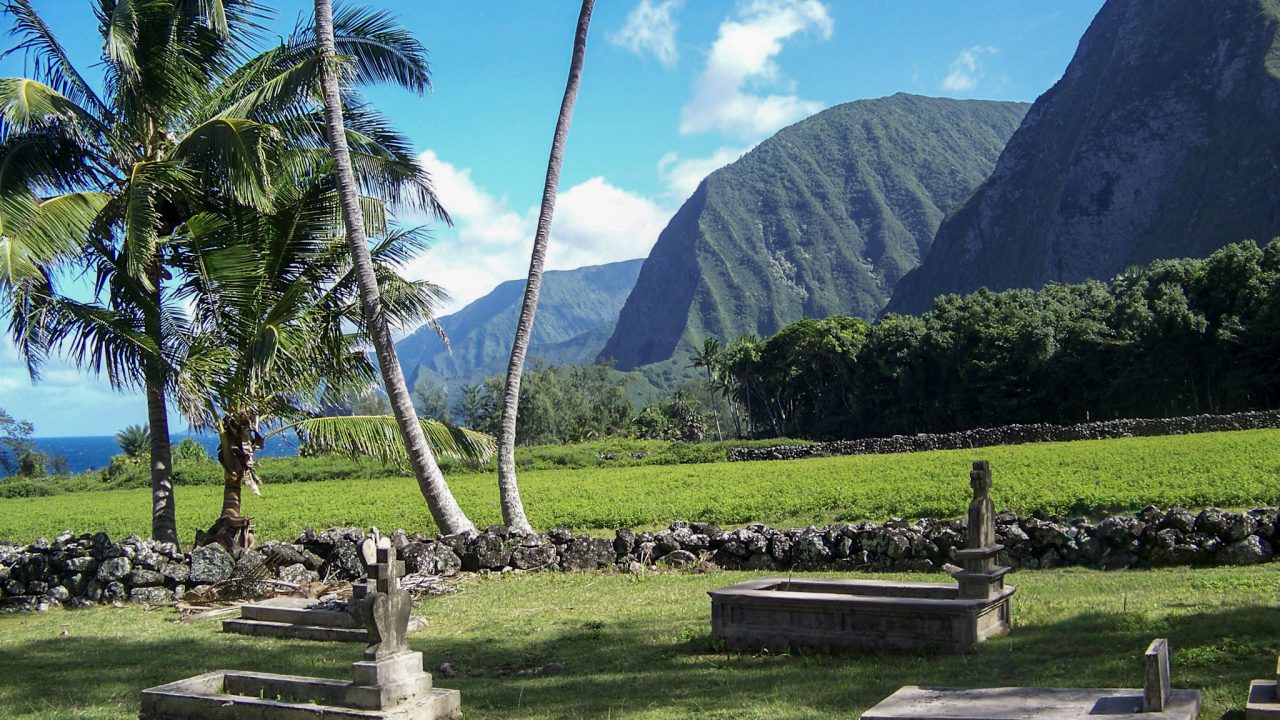
The proposed location is in Kalawao, across from St. Philomena Church, on the former grounds of the Baldwin Home for Men and Boys. We know this part of Kalaupapa from our own visits there, which makes it easy for us to picture exactly where the memorial would be.
Its design consists of two interlocking circles, one representing the people taken from their families and sent to Kalaupapa, the other the families left behind and their descendants. The place where the circles meet represents their reunion.
A stone altar, or ahu, already marks that meeting point, where descendants and visitors have gathered to pray and leave lei and flowers. The design was developed with descendants, Native Hawaiian cultural specialists, architects, planners and a Kalaupapa historian.
More than 40 years, and still more work to do.
The August 28 Land Board decision is important, but it doesn’t mean construction will begin. BLNR approved a right-of-entry so Ka ‘Ohana can complete due diligence and approved the pathway for a direct lease covering construction, operation, and maintenance, while several state and federal requirements still have to be completed before the formal lease can be executed.
Ka ‘Ohana was established in 2003 with the memorial among its central goals; Congress authorized it in 2009, and Hawaii lawmakers appropriated $5 million toward construction in 2022. The state money has remained tied up in a lengthy administrative process while costs have risen greatly, so Ka ‘Ohana is seeking additional funding.
Ka ‘Ohana hopes to dedicate the memorial in October 2028, although enough remains unresolved that we would not treat that as a set date. Many of the Kalaupapa residents who worked toward the memorial over the years have already died without seeing it completed.
Visitor access remains unsettled too.
After longtime resident Aunty Meli Watanuki died in May, we wrote about what her death could mean for the future of Kalaupapa tours. NPS later announced new $21 Kalaupapa hiking tours, but the attempt to restart public visitation quickly ran into opposition.
The objections went beyond the question of how many people should be allowed into Kalaupapa. Some Molokai residents and descendants questioned the level of community consultation and who should interpret the place for visitors once patient residents were no longer leading them through it.
The planned memorial grew out of Kalaupapa residents themselves deciding how they wanted their lives and those who came before them remembered.
We’ve been fortunate enough to experience Kalaupapa ourselves, including spending time in the settlement when access worked very differently and hiking the pali trail. What stayed with us wasn’t simply the isolation or the scenery, but the people who were still living there.
Paul Harada explained the obligation to remember that community better than we could: “I came here so you wouldn’t have to.”
Photo Credit: © Beat of Hawaii outside of St. Philomena Church at Kalawao/Kalaupapa on Molokai.
By Rob and Jeff, Beat of Hawaii.
Some of the most meaningful parts of Hawaii are the ones visitors walk right past without knowing they are there. We’ve spent nearly 20 years finding them firsthand for BOH as full-time Hawaii residents reporting on travel, culture, and island life, and telling you what they mean for your trip. Join us →
Get Breaking Hawaii Travel News




Earlier patients had a rough deal. But after treatment for Hansens was developed in the 1940’s, things vastly improved. So, for about 60 years patients could come and go as they pleased. Kalaupapa was like a private resort with free food, shelter and medical care. Or they could live elsewhere.
And now taxpayers are paying $5 million for a memorial nobody can see? Viva la Molokai!
As is typical in Hawaii, they want our money but they don’t want us.
I’m a bit surprised such a memorial has not already, years ago, been constructed. It makes perfect sense. I also try to imagine this happening today – people sacrificing willingly (or even not) by going into forced isolation and doing it for others too. It wouldn’t happen today. They’d be rising up and protesting in the name of their “freedoms”.