Americans aren’t giving up their vacations. In fact, a new survey found that they expect to take 3.9 leisure trips over the next year and spend $5,655, while nearly one-third say they’re cutting other household spending just to keep traveling.
That entire annual travel budget can vaporize, however, in a single Hawaii trip. We’ve previously found that a week here for two can easily run $5,000 to $6,000, before getting into the considerably higher cost of some higher-end resort vacations. Set against that, a generational divide is also becoming unmistakable: Boomers expect to spend $8,796 on travel during the coming year, while Gen Z expects to spend just $2,195.
Hawaii has long appealed to a much wealthier pool.
Spring research on Hawaii specifically shows how different its prospective visitors already are from U.S. leisure travelers overall. Among people likely to visit Hawaii, 49% report household incomes of at least $150,000, compared with just 32% of U.S. leisure travelers. At the other end, just 20% of Hawaii prospects have household incomes below $75,000, compared with 39% nationally.
Those numbers are not based on actual visitor counts, so they don’t mean half the people around Waikiki or Maui earn $150,000. They show that the Americans most likely to consider Hawaii are concentrated at the higher end of the income scale, while lower-income travelers are far less represented.
The same research found that 30% of likely Hawaii visitors describe themselves as luxury travelers, compared with 19% of U.S. leisure travelers overall. Hawaii prospects are also overrepresented as world travelers, cruise travelers, and family travelers.
Plenty of people still want Hawaii but don’t actually book.
The same research asked U.S. leisure travelers whether they had considered an island trip and then changed their minds. Thirty-eight percent said yes; among that group, airfare was the biggest deterrent at 44%, followed by vacation-package prices at 29% and hotel prices at 28%. Airfare creates an immediate shopping hurdle for Hawaii trips, even though accommodations ultimately become by far the biggest vacation expense once visitors arrive.
We saw the same tension last year when we looked at why Hawaii visitors still loved the islands while increasingly disliking what travel here had become. Interest was not the problem then, and the new research still points to cost as the barrier between considering Hawaii and actually booking it.
For a couple with plenty of room in an annual travel budget, an expensive week in Hawaii may still fit without changing much. A family buying four airline tickets, needing a larger room, renting a car and feeding everyone for seven days can hit the limit much faster.
The new findings make the contrast especially stark because Americans overall are still protecting travel. Thirty-five percent are shifting trips to off-peak periods, and 32% are trimming other household expenses rather than eliminating vacations, while 64% cite lower cost as one reason for choosing domestic destinations.
Hawaii is domestic, but it doesn’t offer many of the ways Americans can make another U.S. vacation is dramatically cheaper. You can’t drive here, and after you buy airfare, the rest is lodging, ground transportation, and food.
The Hawaii trip changes before it disappears.
We’ve been seeing what happens next in BOH reader comments for years: visitors don’t necessarily cancel Hawaii first, but shorten the stay, eat some meals in, rent a car for fewer days, choose fewer activities, or stop adding another island. Those changes were visible again in our recent look at what longtime Hawaii visitors now skip on trips they once took very differently.
July’s state data showed the average Hawaii stay falling from 8.83 days to 7.59 days even as visitors spent 17.1% more per day. Hawaii’s numbers can’t tell us which parts of those trips were cut, but the pattern matches what readers have repeatedly told us.
What have you had to cut, shorten, or change to keep a Hawaii trip within your budget, and what are you still unwilling to give up?
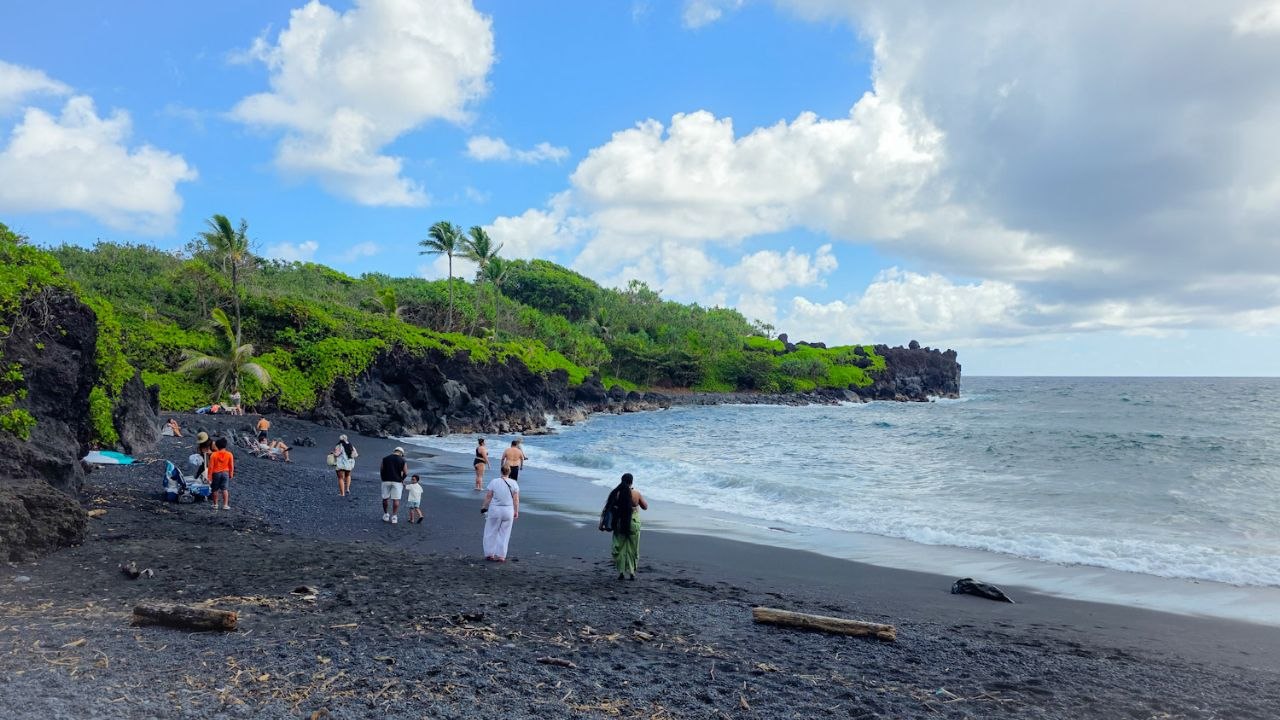
Lead Photo Credit: © Beat of Hawaii at Waianapanapa State Park, Hana, Maui.
By Rob and Jeff, Beat of Hawaii.
Some of the most meaningful parts of Hawaii are the ones visitors walk right past without knowing they are there. We’ve spent nearly 20 years finding them firsthand for BOH as full-time Hawaii residents reporting on travel, culture, and island life, and telling you what they mean for your trip. Join us →
Get Breaking Hawaii Travel News